


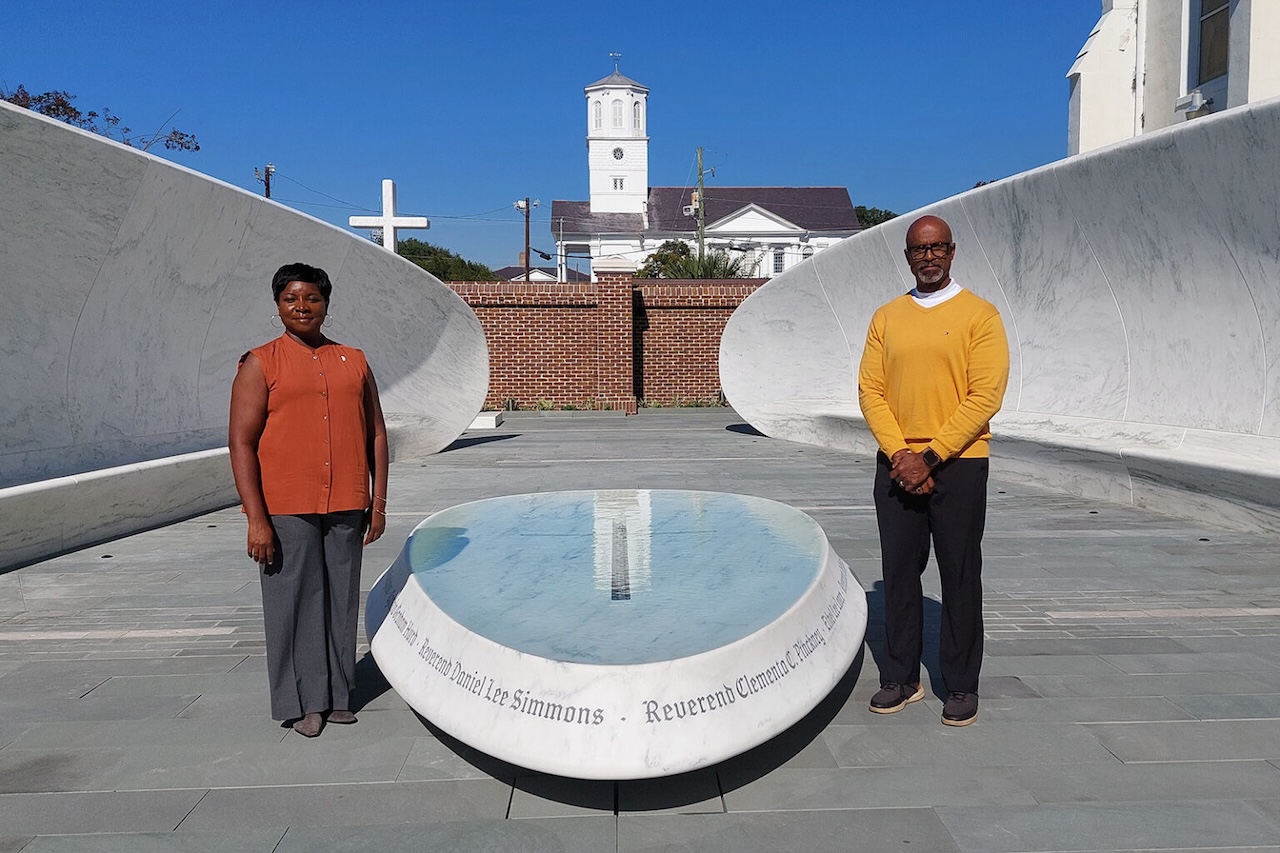
Just to the west of Mother Emanuel African Methodist Episcopal Church, two high-backed marble benches face a fountain. Water from a cross at its center flows over nine names inscribed around its perimeter.
The new Emanuel Nine Memorial remembers those who were fatally shot by a young white man whom they welcomed when he joined them for Wednesday evening Bible study on June 17, 2015. Clementa Pinckney, then senior pastor and a state senator, had joined eight others in the fellowship hall to study the passage from the Gospel of Mark known as the Parable of the Sower, a story about how people respond differently to the teachings of the Bible.
On Nov. 14, the memorial site officially opened to the public with a dedication ceremony after a decade-long building campaign and construction work that spanned three years. A steering committee that considered building the memorial was formed in 2016, the same year as the conviction of the assailant, who had planned a race war and was later sentenced to death.
Eric S.C. Manning said he finds that the memorial site, steps away from his office, provides for him an opportunity “to experience a peace in a place where hatred reared its head.”
The flowing water of the fountains on the memorial site is compared to baptism and the large benches to sheltering wings. But Deona Smith, executive director of the Mother Emanuel Memorial Foundation, said visitors are likely to have different interpretations.
“We don’t know what people’s reactions are going to be, but I think the memorial offers space for everyone to interpret it and feel it in their own way,” Smith told a small group of journalists at a preview event early in the week.

While one of the most striking parts of the Mother Emanuel story is the forgiveness quickly stated by some — but not all — family members of the murder victims, always remembering them is an ongoing determination.
“We will never forget the Emanuel Nine, and we will never forget the sin of racism that led to it,” said Bishop Francine Brookins, chair of the African Methodist Episcopal Church’s Commission on Social Action.
Manning, who just received his doctorate in ministry, spent years writing a dissertation on themes he had been grappling with since becoming the church’s pastor in 2016: the pain and racism his church has suffered since its founding two centuries ago and the resilience that it has harnessed to continue to carry on.
Architect Michael Arad, an Israeli-born man who considers himself an agnostic, said, “It’s very hard to remain agnostic when you’re part of a project like this.”
Smith recalled the cloudy day the Fountain of Grace was put in place. She joined others in praying that it wouldn’t rain because a crane necessary for the work could not be in operation if lightning was near.
“As soon as the fountain came in and they sat it down, the church bells started ringing all over the city — 11 o’clock, on the dot,” she recalled of the moment that she said brought her to tears. “It was so touching to me, and also it was such a significant moment because we have worked on this for so long.”
A total of $25 million was raised for the first phase of the memorial project, with donations from South Carolina and Charleston among the largest. Mother Emanuel and other businesses also contributed. Arad donated his time as an in-kind contribution. The Mother Emanuel Memorial foundation lists him among donors of more than $100,000.
More funds are being raised for the Survivors’ Garden, which is to be located on the east side of the church. Six stone benches are planned for that space to pay tribute to the five survivors and the sixth, the church itself.
The foundation leaders say their ultimate goal is to work toward eliminating racism and other kinds of hatred.
Manning said in an interview that he expects members of an already established interracial group of clergy will be among the first participants in a memorial-related Crossroads Education & Outreach program. It will focus on acknowledging racism, fostering reconciliation, inspiring forgiveness and empowering inclusivity.
“It’s still an opportunity for all of us to come together and to still share, and then we trickle down into our congregations,” he said.
Smith, who was raised in the African Methodist Episcopal denomination, said the memorial courtyard is designed as a place where visitors can sit down, greet someone they didn’t know before, ask questions about their background and start to move ahead.
“Ironically, this tragedy happened when they welcomed a stranger into their midst,” Smith said. “But we cannot allow what happened that day 11 years ago to prevent us from still welcoming strangers. If we are going to move forward as a community, as a country, we have to position ourselves where we are open to meeting new people, to understanding who they are as people, to recognizing their humanity.”


Have a comment on this story? Write to the editors. Include your full name, city and state. Selected comments will be edited for publication in print or online.