


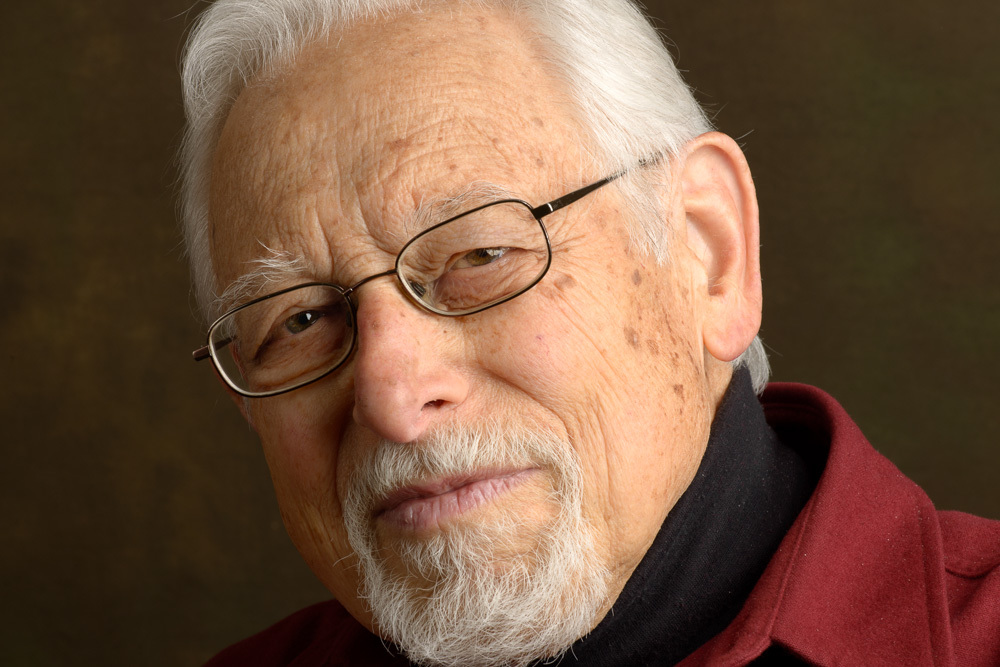
Photo: Ray Gingerich, former professor of theology and ethics at Eastern Mennonite University, Harrisonburg, Virginia. Photo by friend and emeritus professor Howard Zehr.
Ray Gingerich, a professor of theology and ethics who inspired generations of students to think in new ways about their callings and helped shape Eastern Mennonite University’s strong ethos of peace and justice, died June 17 of cancer. He was 84.

From the creation of the first course in peace and justice during his first year on campus in 1977 to his retirement in 2004 and the years after, friends and colleagues remember Gingerich as passionately dedicated to Christian discipleship.
“How does one present Jesus as our example for life today – this Jesus who was killed for the kind of life he lived? How does one speak of Jesus’ call to take up our cross as good news to a people already vulnerable and suffering?” he wrote in a 1999 Mennonite World Review article, soon after leading a peace and justice short course in war-ravaged Colombia.
A co-founder of the Center for Justice and Peacebuilding
After graduation from Eastern Mennonite College (now University) and an additional year at Eastern Mennonite Seminary, Gingerich and his wife, Wilma Beachy, headed to Luxembourg as missionaries under Eastern Mennonite Board of Missions (now Eastern Mennonite Missions). After returning from Europe, Gingerich graduated from Associated (now Anabaptist) Mennonite Biblical Seminary in Elkhart, Indiana. He completed doctoral studies at Vanderbilt University in Nashville, Tennessee. His dissertation explored the mission impulse of the sixteenth-century Anabaptist movement.
Gingerich made a deep and transformative impact over 27 years on EMU’s undergraduate and graduate programs: He established a minor in peace and justice studies in 1979, the precursor to today’s three peacebuilding-related majors, and was for many years the faculty sponsor to EMU’s Peace Fellowship, an organization still active on campus today.
In the late 1980s, he and colleague Vernon Jantzi helped recruit John Paul Lederach to a teaching position in the sociology department. The addition of Ron Kraybill to the faculty eventually led to the quartet’s collaborative founding of the Conflict Transformation Program, now the Center for Justice and Peacebuilding. Their joint commitment to ensuring that global voices would help shape the program’s mission and curriculum led to the inclusion, in planning stages and for three years following, of Hizkias Assefa, then from the Nairobi Peace Initiative in Kenya, and Ricardo Esquivia and Paul Stucky, then both from JustaPaz in Colombia.
Connected with restorative justice pioneer
Gingerich made the first connection with Howard Zehr, then a founding practitioner in the new field of restorative justice with Mennonite Central Committee.
“He kept pestering me to promise that I wouldn’t take another job without checking with him,” Zehr says. With eventual further guidance by Jantzi, Zehr would find his way to EMU.
Zehr’s arrival, thanks to Gingerich’s persistence, opened the university to new alternative visions of justice. The university now offers two master’s degrees in the field, as well as professional trainings, and houses the Zehr Institute for Restorative Justice.
Those who remember Gingerich as persistent also call him passionate. “When I think of Ray as a professor at Eastern Mennonite,” says former dean Lee Snyder, “perhaps the word that best describes him is passionate. Deeply committed to his faith and to living out the way of peace and justice, Gingerich enlivened the classroom with energy and intellectual challenge. His appreciation for his Anabaptist heritage and for the ways we are called to make a difference in the world have indelibly shaped his students. He will not be forgotten.”
Beyond service and individual salvation
Tony Krabill, a 1989 graduate who took two courses from Gingerich, remembers him well.
“Many of my EMU contemporaries and I have been reflecting on the influence Gingerich had in shaping the theology, worldview and passion for peace and justice of a whole generation of students who are now leaders and laborers in the church and beyond,” says Krabill, who now works at WVPE public radio station in Elkhart, Indiana. “Gingerich, along with Titus Bender and Vernon Jantzi, were part of a trio who really galvanized a sense of call in their students that the gospel was more than just individual salvation and evangelism, or even service in the traditional 20th-century Mennonite context, but about speaking truth to power and advocacy on behalf of the poor oppressed.”
While a student, Krabill observed Gingerich, Bender and Jantzi, with WEMC station manager Ed Nyce, develop a 15-minute weekly radio program, “Global Village Forum.” Highlighting peace and justice issues, the program was “an alternative to some of the syndicated Christian programs the station aired at the time that didn’t always seem to line up with Anabaptist theology or the mission of EMU,” says Krabill. “Those conversations inspired me to work in radio and shine a light on topics that receive little coverage.”
After concluding his teaching career, Gingerich helped found the Anabaptist Center of Religion and Society, a community of retired academic colleagues from Mennonite and other neighboring higher education institutions. The organization hosts monthly meetings and has an active agenda, which has resulted in a book series and other contributions. He has also provided support for the Center for Interfaith Engagement.
For more than 25 years, Gingerich was an active member in small group and congregational life at Community Mennonite Church in Harrisonburg, Virginia.
Gingerich’s body was donated to the Virginia State Anatomical Program for scientific research.
Visitation will be held 6-8 p.m. June 28 at Community Mennonite Church, 70 S. High St., Harrisonburg, Virginia. A memorial service will be held at 11 a.m. June 29 at Community Mennonite Church, follwed by a fellowship meal and sharing.


Have a comment on this story? Write to the editors. Include your full name, city and state. Selected comments will be edited for publication in print or online.