



Students learn about themselves in cross-cultural settings
Cross-cultural experiences are integrated into the curriculum of Mennonite higher education institutions. While the location and itinerary vary, over and over again the experience is life-changing, transforming how students see themselves and the world around them.
The following are seven stories that illustrate the significant impact the experience can have on a student’s life.
SunJu Moon, student, Associated Mennonite Biblical Seminary
“I want to experience ministry as a missionary, learning to work with another culture and another language,” SunJu Moon says.
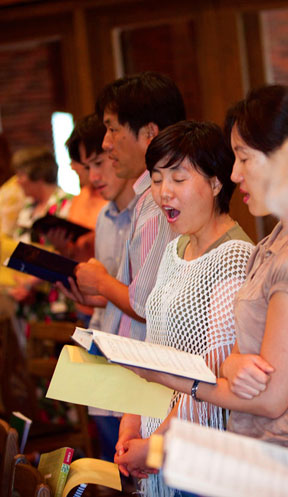
SunJu and DongJu Park, her husband, and their daughters came to Associated Mennonite Biblical Seminary in Elkhart, Ind., from Korea two years ago for her master of divinity degree.
This year she is completing a required internship with Hively Avenue Mennonite Church in Elkhart, where she and her family have been worshiping.
“I want not only to have the congregation learn from me, but I want to learn from them, too,” SunJu says. She hopes she can bring her understandings of spirituality to the congregation, using her experiences from Korea. At the same time, she wants to apply what she learns from the congregation’s members to her own spiritual journey.
Another goal SunJu has is to learn more about peacemaking. “I want to learn how to practice peace in my personal life and in the community,” she says, then consider how the ways the Hively congregation is involved in peace and justice might be applicable in Korea.
Most of all, though, SunJu says, “I want to be friends.” She is meeting with members of the congregation individually to get to know them better and to break down stereotypes she says she may have of North Americans.
SunJu expects to complete her AMBS studies in 2011 and then will see where God is calling her. “Maybe I will go to another country as a missionary. I will be bringing my experience to them and humbly learn from their experience, too.”—Mary Klassen, director of communications, Associated Mennonite Biblical Seminary
Bradley McKellip, Bethel College student
Bradley McKellip, a Bethel College (North Newton, Kan.) senior from Newton, Kan., readily admits he “hadn’t even heard of pacifism until high school.” Nonetheless, he chose to go to the local college, knowing full well it identified with a tradition of Christian peacemaking. As a Bethel student, Brad took advantage of an opportunity to study for a semester in Northern Ireland in the fall of 2008.
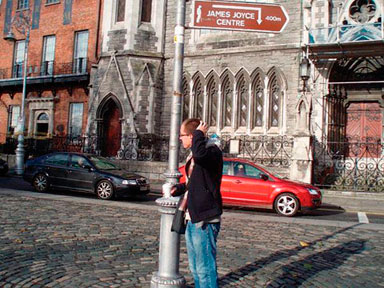
“I didn’t have the upbringing to instill nonviolence as an integral part of my identity,” he wrote in a speech he submitted for Bethel’s C. Henry Smith Peace Oratorical Contest last spring. “It took three months of walking through the tired stone streets of war-battered Derry, Northern Ireland, to do that.”
A pivotal event happened when his fellow university students chose a club to celebrate his birthday.
“The specific club they chose, unbeknownst to me, was key … because some other Irish friends of mine informed me that they would not be joining us for the festivities because, much as they loved all that nightclubs had to offer, the particular club we were going to be attending was a ‘Protestant’ club. In other words, [good Irish Catholic] kids named O’Donnell do about as well in ‘the Protestant game’ as kids named McKellip do in ‘the Mennonite game.’ Only instead of ending in hymn-sings, these conflicts end with fists. Or bats. Or hunger strikes. Or guns. Or bombs.
“In that moment, I realized just how much I did not want this seed of violence to be cultivated in me: in the words I speak, in the papers I write, in the way I love those closest to me.
“Of course, [campus] divisions are not even remotely close in terms of magnitude to the horrors that have happened in Ireland. They are, however, of the same nature. And the solution, not unlike my own epiphany, is not grandiose. [It] must come from me and my fellow students, recognizing and searching for the things we share, as well as the strengths we have to offer each other.”—Melanie Zuercher, writer and editor, Bethel College
Anna Yoder, 2009 Bluffton University graduate
Here are a few moments that made lasting impressions on me during my trip to Israel/Palestine: sitting on the roof of the Ecce Homo in Old Jerusalem while the Dome of the Rock glistened in the moonlight, floating in the Dead Sea, immersed into the culture, grace and hospitality of my Palestinian host family, lolling on the shore of Sea of Galilee, singing hymns in ancient churches and talking to different peace organizations that daily refuse to give up hope amid the realities of the conflict. I was also blessed to travel with such a remarkable group of students and faculty. Together we struggled with tough issues, served, laughed, played and praised God together.
 To sum up my entire cross-cultural experience during May 2008 is a challenge. So much of it was life altering, not only in terms of my faith but also my worldview. Mere words cannot do it justice. One must go and see the pain, suffering and joy of the people living in a world ridden with violence and conflict in order to truly understand how spending a mere two and a half weeks in Israel/Palestine invited me out of my limited American perspective and comfort zone and enlarged the realities of Christ in my life.
Bluffton (Ohio) University has given me a taste of the world larger than myself. As I left Israeli-Palestinian soil, I came away changed, with a heart for social justice, a greater appreciation for the church and a conviction that peace is only found through the gospel of Jesus. I carry these learnings with me daily. I have no doubt this experience will continue to shape my vocation and faith for the rest of my life.—Anna Yoder, serving with Radical Journey in Pietermaritzburg, South Africa
Tim Moyer, 2008 graduate, Eastern Mennonite Seminary
“I grew up believing the American dream—that if you worked hard and saved, you could get ahead,” says Tim Moyer. And for Moyer that dream has come true; he owns an auto body and mechanical repair shop in Harleysville, Pa.
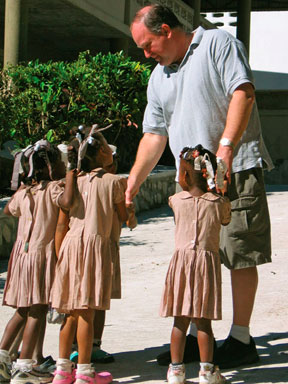
“But after I visited Haiti for my cross-cultural experience at Eastern Mennonite Seminary (Harrisonburg, Va.), I have come to question that dream,” he says.
Moyer’s self-designed cross-cultural trip was a requirement for his master of divinity degree. “I balked at the idea of a cross-cultural trip,” he says. “I didn’t like the imposition, but once I got back I realized the vast value of it.”
“One of the most profound experiences for me came after I returned,” he says. “I woke up in my warm bed, took a warm shower, traveled on well-maintained roads and arrived at my climate-controlled church and sang some of the same songs we sang in Haiti.
“When we sing ‘Showers of Blessings,’ it means something totally different than it does in Haiti,” he says. “The poverty there is profound, yet they sing that song with great joy. Christianity is such a huge part of their lives.”
Moyer’s main goal was to engage with Haitians and learn about their lives. He spent time at the mission school in Labaleine, Haiti, eating with the children and spending time in the classroom. He also visited with as many people as possible. He ate in their homes, talked to them about their own small businesses and went to four church services.
“Cross-cultural experience, if it’s done well, can deepen a person’s capacity to minister. It gives them a broader base to view and interpret life.”—Laura Lehman Amstutz,
communications coordinator, Eastern Mennonite Seminary
Curtis Reesor, Eastern Mennonite UniversityCurtis Reesor, a senior business administration and accounting major from Stouffville, Ontario, was one of 24 Eastern Mennonite University (Harrisonburg, Va.) students who spent the fall 2009 semester on a cross-cultural trip in South Africa and Lesotho.
Our first church experience in Lesotho was probably the most memorable. We sat through 90 minutes of a four-hour service. We walked through town to the outskirts of the village to a small rectangular hut on the side of the mountain.
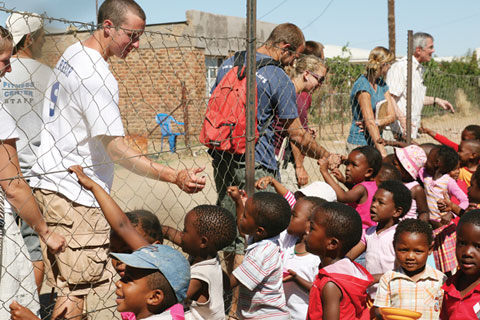
All 24 students and our leaders piled into a room with 10-15 congregational members. A small candle burned in the middle of the floor while we all lined up against the walls. We clapped along with the lively music of the congregation while someone beat a drum as four people ran around the candle in the middle of the room singing and clapping, raising their arms in the air praising and worshiping the Lord. Several of us were coaxed into the middle of the floor to run about and clap with the members.
The pastor delivered a kind and passionate message in Sesotho while [our leader] translated the key points for us. He then asked us if two or three people would step forward and share their testimonies. Everyone was interested in knowing about us and why we had come to their small, primitive village for two and a half weeks and what we thought of them and their country. When each testimony had finished, everyone smiled and clapped. We sang some of our songs for them, then entered prayer time.
Churches like this believe that through worship, prayer, singing and dancing we can open up our souls to be cleansed by God. There is so much passion in the services in Lesotho, and everyone feels free to do whatever it takes to rid themselves of stresses and burdens. I left that day feeling refreshed by the passion and love of the people of Lesotho and felt closer to God.—Curtis Reesor
Lydie Assefa, 2009 Goshen College graduate While participating in Goshen (Ind.) College’s Study-Service Term in Tanzania and during the first week of our service assignment, fellow student Laura and I decided to go for a run through the tiny village of Buturi. A student at the local high school and our cultural guide, John, also came along with us for the exercise.
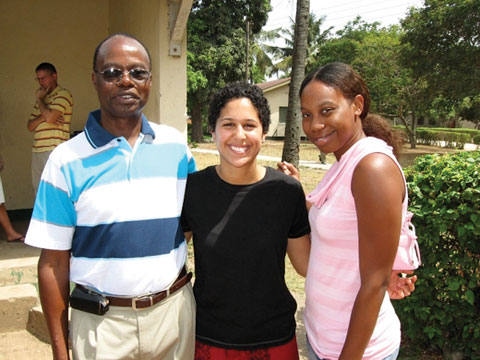
About 20 minutes later and miles away from home, a thunderstorm quickly materialized. John suggested that we simply walk into a neighboring house and wait out the storm. Once inside, we met a group of older women sitting around, drinking tea and talking. Upon seeing us, they immediately ushered us inside and provided us with chai tea and chapati (fried bread) and engaged us in delightful conversation. The women were warm and friendly and invited us for dinner the next day. Even in the middle of a thunderstorm, there was much cheerfulness and warmth between strangers.
Later, Laura and I experienced the tragic death of her 15-year-old host brother. In the days and weeks following his death, Laura’s house was constantly visited by neighbors, school friends and relatives to mourn with the family. Neighbor women, distant relatives and friends volunteered to manage meals for the large number of visitors, and a collection plate circulated for the family to buy a cow to feed everyone.
However, in the flurry of mourning and making necessary preparations, Laura’s host grandmother stepped out of her own grief to ensure that we, as visitors from abroad, were properly fed, not overly exhausted by the activity and able to sleep well. Her mindfulness and concern in the midst of the crisis was a humbling statement of hospitality and compassion that moved me to tears.
My experience in Tanzania acquainted me with what is important in the everyday lives of people thousands of miles away and helped me better embrace my responsibilities as a global citizen.—Lydie Assefa, spending the year in Ethiopia with Mennonite Central Committee’s SALT program
Kendra Alison, Hesston College student Growing up in the house I did, I have been able to meet many people from different places, and it has fascinated me to see everyone coming and going and hear their life stories. My parents opened up our house for anyone and everyone, so I got to meet a variety of people. I always wanted to be like them and travel the world and see exciting new places.

I decided to come to Hesston (Kan.) College because I knew they had a large international student population, and I wanted to experience all that the world had to offer me. I decided to room with an international student, and that experience alone taught me more about the world than I even realized it would. I got to see the world from someone else’s perspective, and that made me understand my own a little better.
This past summer, I traveled to Guatemala and I got to experience what it was like being the one who was different in a foreign land. I now understand why it is so hard for people to come here and try to fit in. Experiencing a new culture is difficult not only because there is a language barrier but because daily customs are different.
I think the cross-cultural experience is one everybody should have because we get out of our trap of being with people who are like-minded, living lives similar to ours. The intentional community of being with people who are different teaches us how to relate to one another in a new way, and that is such a reward. Being open to change allows us to live out our Christian faith, and that is what life is all about.—Kendra Alison


Have a comment on this story? Write to the editors. Include your full name, city and state. Selected comments will be edited for publication in print or online.