


In Indonesia, where Christians are a minority, the Christmas tree often serves as a marker of identity. My own family doesn’t keep that tradition, though my children often ask to have one. I always tell them, “That is not a tree. It is plastic that will end up stored in a warehouse like trash.” For us, a Christmas tree has always been a living one, growing quietly in front of our home.
To imagine the Christmas tree as a living tree is to be invited into an incarnational, contextual celebration. Celebrating Christ’s birth means caring for the world he entered. Amid environmental crises, a planted Christmas tree is no longer just decoration; it is a declaration of our active part in God’s work of embracing creation.
Recently, I invited our congregation, a Javanese Mennonite Church (GITJ) in Jepara, Indonesia, to reimagine this symbol in our context. What if we turned it from a seasonal decoration into an active commitment to care for life? What if our Christmas tree was one we actually planted and nurtured? For a Mennonite community living out discipleship in simplicity and peace, this could be a tangible expression of God’s holistic shalom. Here are five things I see in a “living Christmas tree,” a symbol of Christ’s incarnation and our part in restoring creation.
1. The center of the universe: Christ as the tree of life (Kayon)
Javanese culture holds a symbolic image of the cosmos called the gunungan, or mountain. With its tree-like shape, it is also known as the kayon, the tree of life and the center of the universe, depicting all elements of existence. This resonates deeply with the cosmic Christ of Colossians 1:17, in whom all things are created and find their purpose. Choosing a living tree as our Christmas tree reminds us that Christ is the heart of all reality. Planting it becomes a symbol of the incarnate Christ, present with humanity and all creation. In him, divine and human meet; heaven and earth are joined in communion.
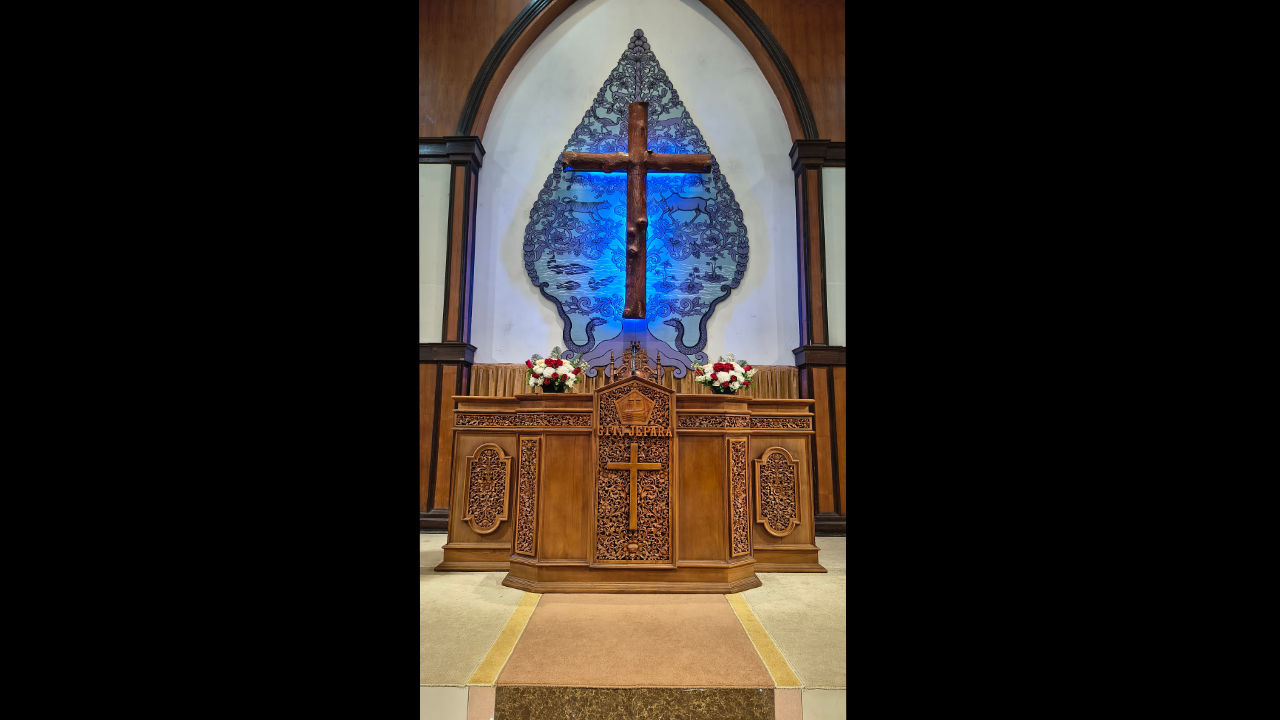
This very image graces the pulpit backdrop in our church. It illustrates our confession and mission: that all things are reconciled in Christ, and the church is called to join in this work of reconciliation. Therefore, planting a living Christmas tree becomes a quiet symbol of hope, a family’s confession that Christ is the source of life for all beings, the one in whom the entire universe is held.
2. From origin to purpose: The full story of salvation
Javanese spirituality understands that all life has an origin, sangkan, and a purpose, paran. Everything comes from God and returns to God. A living tree embodies this. It begins as a seed in the soil, and its purpose is to grow, bear fruit and finally return to the earth, giving way to new life. Theologically, this reflects the complete biblical arc from Creation in Genesis 1–2 to the restoration pictured in Revelation 22:2.

This view helps us see Christ’s incarnation as part of God’s entire saving story. At Christmas, we remember Christ who entered our fragile world. In his life, he proclaimed God’s Kingdom—peace, welcome for the wounded, and life’s transformation. Through his redemption on the wood of the cross, he restores all things.
Planting a living Christmas tree helps us see God’s salvation as a complete process, not a temporary December decoration. We don’t just remember God’s work within church liturgy; we enact it in daily life liturgy through the simple act of planting and tending. Of course, one tree won’t solve all ecological crises, but it is a concrete act of faith, a way to participate practically in God’s work of restoration.
3. Sacramental communion: God revealed through creation
Traditionally, Javanese society has known God through nature. A tree that grows and blossoms with color and fragrance inspires awe and points to the Creator. Christian tradition calls this a sacramental understanding of creation. The natural world can be a sign of God’s presence — not that God is identical with nature, but that God is present within it and also beyond it. Scripture also reveals creation as a medium of God’s revelation (Romans 1:20; Psalm 19:2–5; Job 12:7–9; Colossians 1:15–17).
A tree also presents a beautiful symbol: its roots are in the earth while its branches reach for the sky. It is a vertical connection, uniting humanity and creation with God. Javanese spirituality speaks of this as manunggaling kawula Gusti, the union of the human and the Divine. Christmas is the pinnacle of that union: “The Word became flesh and made his dwelling among us” (John 1:14). Planting a living Christmas tree reminds us of this communion. It reawakens our awareness of God’s presence around us, a celebration of Immanuel, God who is with us.
4. Caring for and restoring creation’s harmony
A key Javanese wisdom is memayu hayuning bawana: to nurture the beauty and harmony of the world. Life is meant to care for life, not to dominate it. Here, nature is not an object for limitless exploitation but a partner whose balance we must guard. When this relationship breaks, when trees are clear-cut and land poisoned, the world loses its peace and suffering follows as a collective consequence.
In the light of Christmas, this ethic finds a powerful theological foundation. The incarnation shows God choosing to be present and involved within the world, not outside it. Christ came not to dominate, but to embrace and save. Therefore, celebrating Christmas without concern for the earth is to celebrate the incarnation without living it out, reducing it to something merely private and human-centered. Our Mennonite faith, emphasizing communal discipleship, offers another path: to follow Christ is to join him in embracing and caring for creation, to mend what is broken.
In this way, planting a living Christmas tree becomes a practice of memayu hayuning bawana. By making tree-planting part of our Christmas ritual, the church turns celebration into a movement of participation. That planted tree becomes a living confession: caring for the earth is not an extra program, but central to our calling as people who believe God became flesh and dwells within creation.
5. Roots of life and hope: an incarnation that gives life
A tree is not merely a symbol for the incarnation; it is its living embodiment. The birth of Jesus is the life-giving Word made flesh, the Divine taking root in our earth. Just as a tree draws from the soil to sustain all that depends on it, Christ, in his incarnation, rooted himself in our fragile world to become the source of life and hope for all creation.
This mystery finds a profound echo in the Javanese understanding of trees as tunggul kawit, the roots of life that sustaining both present and future. Communities once honored great trees, often found near springs that gave life to the people. Planting a tree is an act for life, not just for now, but for generations to come. It is an act of hope, trusting in its role for life’s sustainability.
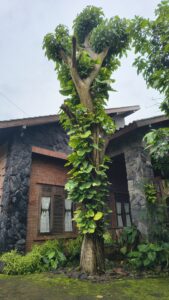
I planted a Kalpataru tree in front of my house around 2019. My family calls it our Christmas tree. It has grown quickly, and one tangible gift it has given us is water: since it grew large, our well has not run dry in the dry season, a problem we faced every year before. Symbolically, planting a living Christmas tree means living out the presence of Christ, who brings life. It is a way to concretely participate in sustaining life and nurturing hope.
This can start in a family, but it grows richer as a communal practice. Imagine if every Christmas celebration ended with the ritual of planting a tree. It would stand as a lasting sign of our shared commitment to care for the earth, a simple, tangible and hopeful practice of our faith.


Have a comment on this story? Write to the editors. Include your full name, city and state. Selected comments will be edited for publication in print or online.