



Mission legacy comes full circle through new African-born Eastern Mennonite Missions president Nelson Okanya.
When Nelson Okanya grew up in Kenya, he played with the children of the first mission workers from Eastern Mennonite Missions (EMM) to plant a Mennonite church among his people.
Today, Okanya, the first-born son of John and Mary Okanya who received from EMM’s ministry, and his wife, Jessica, are raising their two small sons, Barak and Izak, in North America. It’s where since October 2011 he has served in his new role as EMM president in Salunga, Pa., to help a new generation of Anabaptists join in sharing God’s good news in Christ.
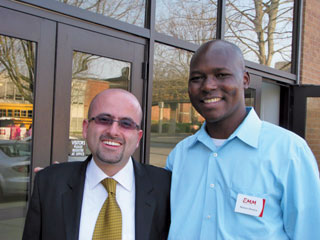
One day Barak and Izak will tell their own story of being part of a biracial and bicultural family who served God. The narrative will likely include how the family legacy of loving and serving Jesus is bearing fruit across generations and cultures because of EMM’s faithfulness to Christ.
The sons may also share the joy of how EMM’s ministry has come full circle through their father’s ministry as EMM president. That ministry —which began after longtime EMM president Richard Showalter retired—has roots in the soil of his boyhood home in a rural western Kenyan village and in the city of Nairobi.
It’s also ministry that 40-year-old Okanya—former pastor of the multiracial Capital Christian Fellowship in Lanham, M.D.—hopes will take root among believers who faithfully live as citizens of God’s kingdom, which has no national boundaries. It’s a kingdom Okanya believes today begins in one’s backyard before spreading into other fields.
“It’s a new day in missions, because the world is coming here to the doorstep of North America,” Okanya says. “It’s a day when North American-based mission agencies need to share the gospel with the influx of people from other cultures and religions who are being drawn to this country.


Photo by Jonathan Charles
“North American mission agencies have spent the last 100 years learning how to do cross-cultural ministry. It’s now time for these same mission agencies to share those tools with local congregations who are seeking to do the same kind of ministry at home.”
Tending home fires first
Okanya, an Anabaptist from the global South who is leading a mission agency in the global North, symbolizes how 21st-century missions are simultaneously local and global in emphasis. Marrying his international perspective with a local focus requires he make tough decisions about how he will spend his time and mark his calendar.
Helping form his decision to focus on the home front to help build long-term sustainability for EMM was guidance he received from Lesslie Newbigin’s book The Open Secret. Newbigin writes: “The traditional sending agencies have, in general, totally failed to recognize that the most urgent contemporary mission field is to be found in their own traditional heartlands and that the most aggressive paganism with which they have to engage is the ideology that now controls the ‘developed world.’ ”
Part of tending the home fires included meeting one on one with all 47 staff members. The meetings helped rebuild morale after a restructuring downsizing process cut about 25 percent of the staff.
“A new structure had been put into place, and because staff was dealing with the pain of seeing their colleagues leave, morale was low,” he says. “By meeting one-on-one with people, I could be present to their sadness, their adjustment, their losses as well as their hopes and prayers for the future.
“I wanted to know them as people, not just as roles, and I wanted to hear their life stories and their journeys of understanding call. … I naively thought it would take 30 minutes each, but the shortest meeting lasted at least an hour.”
Kaylene Derksen, EMM’s development director, says Okanya’s caring presence, engaging personality and intent to connect with local constituents has brought healing and encouragement.
She says he has also generated more work for the staff members who welcome the opportunity to partner with Okanya during his Sunday morning visits to local congregations. Okanya’s calendar is filled up through April 2013 with local engagements.
“It feels really right that Nelson is here, because he symbolizes the completing of a circle for EMM’s initial work in Kenya,” Derksen says. “And he brings youthful energy and a young family. … Occasionally when they are here, it feels so good to hear and see the children running down our halls in the office.
“He also has a renewed vision for serving our local constituency. … Because he is social and connects easily with people as he visits local congregations throughout Lancaster Mennonite Conference (LMC), people are becoming generally more interested in EMM overall. … When people feel cared about, they want to be connected.”
It is the constituents’ own passion for missions that Okanya is tapping, he says. The area conference gave birth to EMM and has always had a strong heartbeat for missions. He hopes to help them rekindle that intensity by encouraging each congregation to become a missional center.
His hopes are being realized, says Keith Weaver, moderator of LMC, who feels welcomed by Okanya in helping the conference renew its missional passion and vision.
Much needed are missional forays into the multicultural world of refugees and immigrants who are making Lancaster County and the surrounding region their home. Also in the region are many unchurched North Americans who are searching for a place to belong and to find meaning.
“I am excited about how Nelson is building bridges to congregations and helping build a sense we are EMM and LMC together in this,” Weaver says. “Nelson is passionately committed to spiritual renewal and well-being of LMC congregations. His passion and focus means so much to conference leaders and bishops.”
As an example of this growing partnership, Okanya and the LMC bishop board recently met to discuss the increasing need to better develop the faith of children and young people who are being shaped by moralistic therapeutic deism, or MTD.
MTD is causing children and young people to develop a thin, feel-good faith that has lost its radical sense of sacrifice, discipline and biblical base that are part of being disciples of Jesus, Okanya says. He knows that sending agencies need disciples prepared to go.
“If our young people are not transformed according to the Judeo-Christian, biblical understanding of the gospel of Jesus Christ [but] are shaped by MTD, then they won’t be prepared to share the transforming message of Jesus with others,” Okanya says.
Partnering, mentoring build strong foundation for local-global perspective
The connection between solidifying discipleship at home and fostering global missional vitality is not lost on Okanya. He is networking with other Anabaptist mission agencies—including Mennonite Mission Network, Virginia Mennonite Missions and Mennonite Central Committee (MCC). One of the connections he has made in this first year is a new and supportive relationship with J. Ron Byler, executive director of MCC U.S.
“EMM’s role has traditionally been different from MCC’s, but Nelson and I, both relatively new in our roles, quickly learned that we shared a commitment to a holistic gospel, one in which witness and service are inseparable,” Byler says.
“We made a commitment to support each other and to encourage our staff groups to do the same. I pray for Nelson regularly, and I know he does the same for me. I’m looking forward to our relationship growing and for ways EMM and MCC can deepen our collaboration.”
Okanya believes his ability to form solid relationships and partnerships is the fruit of having had affirming mentors throughout his life’s journey, including his parents, educators and mission leaders.
Okanya received a diploma in Christian ministries (counseling) from Daystar University in Nairobi. He later earned a master of divinity degree from Eastern Mennonite Seminary in Harrisonburg, Va. He is currently taking doctoral classes in moral theology from Catholic University in Washington, D.C.
He also has had much practical experience, including being a participant and a leader in EMM’s mission programs in his younger years, including YES and STAT in Kenya and other locations. Later on, he served as assistant director and director of the Baltimore YES training center.
In 2004, he also served on a one-year GO! assignment with Jessica at the Mennonite Theological Training College of Eastern Africa, where he was academic dean. In 2006, he served as associate pastor at Capital Christian Fellowship in Lanham, Md., and then as lead pastor until 2011, when he was called into his current EMM role.
One of his mentors was Richard Showalter, Okanya’s predecessor, who was EMM president during Okanya’s earlier years of EMM service. Showalter served during a season when the Anabaptist church was forging new partnerships with the global South. The planting of those seeds has most likely helped produce the fruit of receptivity toward Okanya’s leadership.
“It is particularly appropriate that Nelson is from East Africa, because Tanzania was EMM’s first international destination in 1934,” Showalter says. “It is a wonderful gift from God that Nelson, being the kind of person he is, was available and was tapped to serve in this way.
“His appointment has sent a very important message: mission has become a joint effort of churches everywhere and not just a function of Western culture or Western churches. It is equally a function of southern churches as well. And Nelson coming to EMM is an honor to EMM and an appropriate expression of the confidence and partnership shared by the entire global church.”
Saying yes to new ways of sharing the gospel story
Okanya knows how quickly the old paradigm of North and South, East and West, is changing into a global neighborhood. Because of a shrinking world, fed by new forms of media and social networking, the church faces unprecedented opportunities for communicating the gospel.
At the same time, a growing pluralism of messages are threatening to drown out the biblical narrative. As his sons, Barak and Izak, and sons and daughters of Anabaptists worldwide are called to grasp the baton of faith and to run the race of making disciples everywhere, what must be forged is a fierce commitment to sharing the gospel in ways that can be heard by a noisy world.
“If we want new generations to be compelled to listen, then we must risk telling our story in new ways,” he says. “There are all kinds of other groups and religions that are telling their story more effectively to younger generations.
“The gospel is competing with powerful narratives that have power to shape our culture through powerful media outlets, and the church is slow to leverage this technology to tell its story. … Will we commit to live our story in ways that not only tell the story but also shape our world?”
That is the question Okanya has come to EMM to help answer with a resounding yes.
Laurie Oswald Robinson is a free-lance writer in Newton, Kan., and the author of Forever Family.


Have a comment on this story? Write to the editors. Include your full name, city and state. Selected comments will be edited for publication in print or online.