


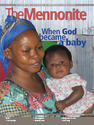
A meditation on the implications of incarnation
Our small congregation celebrated the births of two babies this past summer. On a Sunday morning and at other gatherings, you’ll see people taking turns holding these infants, giving the parents a break and themselves the pleasure of holding a baby. But after a while, the baby gets fussy, then cries, perhaps needing to be fed, and back or she goes to the mother.
 Babies are wonderful, innocent, cuddly, so cute. But they also cry and poop and need attention, sometimes in the middle of the night, when parents are trying to get some needed sleep.
Which brings us to Christmas.
When you dig through the consumerist clutter that Christmas has become, you get to a startling belief: at a point in real history, God became a baby.
The Almighty Creator took shape as a mewling, hungry baby born to a Jewish girl in an animal trough in an obscure backwater village in the outskirts of the Roman Empire millennia ago.
We tend to mouth this belief—or merely think about it briefly once a year—without considering quite how outlandish, how radical such a belief is. Or what implications it may have for our own lives.

It’s so radical, in fact, that we tend not to believe it—not in our bones (pun intended).
The belief I’m talking about has a theological name: “incarnation,” which means “in the flesh.” It is one of the central doctrines of Christianity—and one that distinguishes it from other religions.
In the first several centuries of the Christian era, the church was sorting out the implications of their experience of Jesus having been born, having walked among witnesses, died, then been raised from the dead. In several councils—gatherings of leaders from across the church—participants decided on language that carefully named Jesus as human and divine.
The Nicene Creed, for example, says that Jesus is “God of God, Light of Light, very God of very God; begotten, not made” and later adds that he “was incarnate by the Holy Spirit of the virgin Mary.”
Although we may not often use such language, we tend to take this belief for granted and wonder why those Christians back then fought over the wording. The reason, in a very small nutshell, is that many followers of Jesus either denied Jesus’ divinity (Arians) or his humanity (Gnostics).
Arianism taught that Jesus was made by God the Father and is not “of one substance with the Father,” as the Nicene Creed states.
Gnosticism, meanwhile, taught that the material world should be shunned and the spiritual world embraced. “Spiritual” here means nonmaterial.
Many followers of Jesus held to one of these beliefs, and that was a problem. But that was then, you say.
Today, however, these same beliefs exist and are temptations for all of us.
Are some of us not inclined at times to see Jesus as a great teacher and prophet, one who showed compassion to the marginalized, yet not as divine? That’s just going too far.
Are others of us not inclined to question the importance of the things of this world and focus solely on going to heaven when we die? Do not some of us downplay what we may call “social issues” and want to focus on spiritual realities and preaching the Word?
In my book Present Tense: A Mennonite Spirituality (Cascadia, 2011), I write that ” ‘spiritual’ does not mean noncorporeal or disembodied. In our spirituality we are to follow the Spirit’s leading and manifest the divine life in the arena of worldly existence.”
God is present in our world. As Richard Valantasis in his book Centuries of Holiness: Ancient Spirituality Refracted for a Postmodern Age (Continuum, 2005) has written: “everything in the world—every religious tradition, every scientific exploration, every medical breakthrough, every political situation, the environment, outer space—everything in the world has been altered by the presence of God in the physical universe.”
Furthermore, every part of our life—how we eat, bathe, work, play, celebrate or worship—is to be spiritual activity, following the leading of the Holy Spirit.
Stephanie Paulsell in her excellent book Honoring the Body: Meditations on a Christian Practice (Jossey-Bass, 2002) calls us to “honor our bodies and the bodies of others in the midst of everyday life” and to attend to “the sacredness of the body when we bathe and dress, eat and drink, run and rest and love.”
Some of the implications of Christmas, of this belief in God becoming flesh, are not very comfortable. Just as those cuddly babies soon need feeding or having their diapers changed—and often in the middle of the night—so we are bodies that often break down, that experience hunger or thirst, illness, the hundred little things that bug us.
Just as we tend to romanticize Christmas—the tinsel, the gifts, the family together, the old movies on TV—we tend to romanticize our spiritual lives.
Following Jesus is more about serving others, sharing the gospel or going to church than about our everyday activities around bathing, dressing, eating, resting or loving.
We’d rather not talk about how we spend our money, our sexuality or dying. Such things are private and hidden away. Money, sex and death are taboo subjects.
In this way we tend to follow the ways of our society. Esteemed critic Harold Bloom has called Gnosticism the American religion. More and more of our existence is disembodied. Increasingly we relate to each other via the Internet, where the flesh does not exist. Fewer of us gather together. Instead we stay in our offices or our living rooms.
Mennonites lift up community as a central concern, yet we often fail to practice it. It’s difficult to maintain such a practice in a society where the individual is preeminent.
Paulsell writes that “the integrity of our bodies is a gift from God, but the meaning of our bodies does not stop at the boundaries of our skin. For we belong to one another, and so we are called to attend to the effects of our choices.”
This need for relating is a part of how we are made and even goes to our genes. In his article “The Social Life of Genes” in Pacific Standard (September/October), David Dobbs reports on research showing how our experience affects us even on a cellular level. He interviews a scientist named Steve Cole, who studies social psychology and the genetics of immunology.
Cole discusses stress and notes that “social isolation is the best-established, most robust social or psychological risk factor for disease out there.” He adds, “Nothing can compete.”
Cole also makes a distinction between our environment and our experience.
“Your subjective experience carries more power than your objective situation,” he says. Two of us may share the same environment but experience it differently. “You can shape both your environment and yourself by how you act,” he says.
We live in the flesh. In Jesus, God became flesh and “lived among us”(John 1:14). In that environment we experience all kinds of limitations—hunger, thirst, sickness, suffering, death—as well as joys beyond our hopes—a sumptuous feast, good company, loving friends.
That environment is where and how we live our spiritual lives, following the leading of the Holy Spirit.
According to Cole, “your experiences today will influence the molecular composition of your body for the next two to three months, or, perhaps, for the rest of your life.” He adds, “Plan your day accordingly.”
As we celebrate Christmas, God becoming flesh in a vulnerable baby in that faraway time and town, let us live in the flesh in ways that build communities of grace, joy and peace.
Gordon Houser is associate editor of The Mennonite and a member of New Creation Fellowship Church in Newton, Kan.


Have a comment on this story? Write to the editors. Include your full name, city and state. Selected comments will be edited for publication in print or online.