


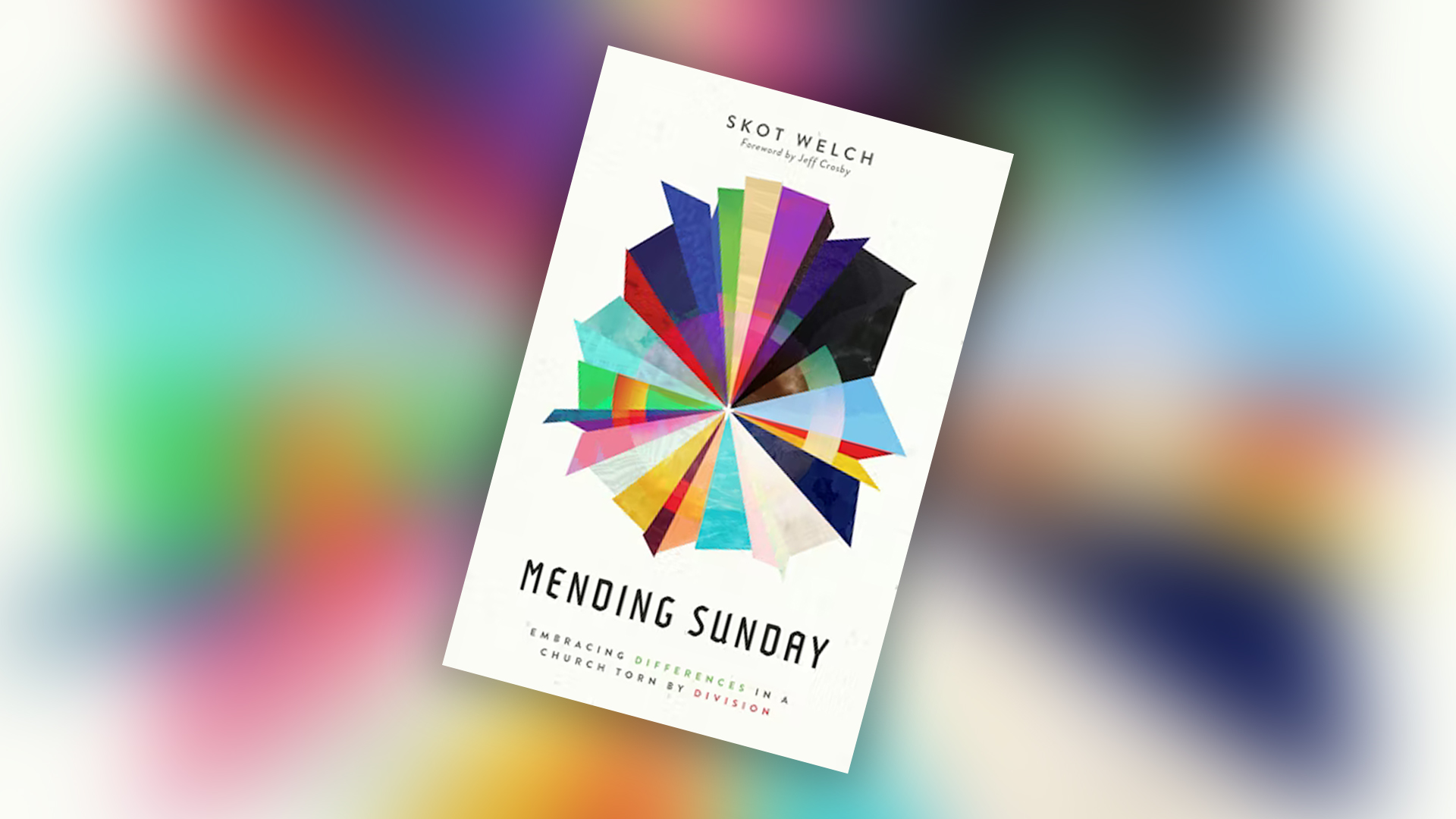
SKOT WELCH’S timely book, Mending Sunday, addresses divisions in the church and calls for transformation. His advice: Pick up “the ministry of the Christocentric ethnoconscious Christian and lay down, even forsake, the lifestyle of the ethnocentric, Christoconscious religious person.”
In other words: To maintain the unity God desires, we must make our
identity as followers of Christ primary. But too many in the church find their identity in their ethnicity or their politics.
He begins by stating that diversity is God’s idea. Just look at God’s creation or note the message in Revelation 7:9 that worshipers “from every nation, from all tribes and peoples and languages” will stand “before the throne and before the Lamb.” While we may acknowledge and even celebrate our various ethnicities, we are called to make Christ central to our identity.
Unfortunately, Welch writes, “in the Christian culture we’ve created, we’ve built walls and constructed a narrative that supersedes what God says.” Making our ethnic identity central, he says, is idolatry. Does our ethnicity determine who we spend time with, make friends with, be in community with and worship with? It’s a good question for Mennonites to ask.
Welch is the founder of Global Bridgebuilders, a firm that focuses on organizational development, cultural transformation and inclusion. He devotes several chapters to two myths and idols that must be destroyed: White superiority and Black inferiority. Different is not better or worse but simply different. And colorblindness is a liability, not an asset. “Once our eyes are open,” he writes, “we cannot stop seeing how entrenched racism is in our culture.”
Welch, who is Black, explores key elements of the Black church — preaching, music, forms of worship — because they are judged by the “standard” of what’s acceptable by the default White church culture. It’s assumed that White preaching and music don’t have to be explained because they are understood as the standard.
He goes on to look at “race,” a term used correctly only when it refers to the human race. “Although racism is real,” he writes, “the concept of race is an invented one.” It’s a socioeconomic construct with no basis in biology. He goes on: “The concept of race was created to stratify people and ultimately became the method by which people were and are discriminated against based on the concentration of brownness or melanin in the skin.”

How does one move from being an ethnocentric Christoconscious Christian to a Christocentric ethnoconscious Christian? Welch describes a “change sequence” that involves recognizing “the injustices and early intentional structuring of systems that greatly influence our lives today.” Further, we must repent of our disunity and take on the mind of Christ.
Welch looks at “cultural ditches.” He considers ethnicity or race in a historical context. Slavery was not an “oops” but “an iniquity.” He quotes the 19th-century abolitionist William Lloyd Garrison, who referred to the U.S. Constitution’s protection of slavery as “a covenant with death and an agreement with hell.”
Many African Americans, he says, suffer from “the deception of inferiority,” while Whites suffer from the deception of superiority. This “is not as much an individual feeling as it is something that is continually reinforced in our culture.”
Such cultural ditches, he says, are forms of idolatry. The responsibility of doing something about the inequities in our culture lies with those who have the means to make things right. Love must speak up.
Welch argues that “kingdom privilege” must replace White privilege. He prefers the term “white deception” and discusses its characteristics: cultural blindness, arrogance and pride, ignorance and self-reliance.
While many talk about reconciliation, Welch argues you can’t have reconciliation unless you first have conciliation. To live out the unity God has created, we must build Christ- centered friendships. He argues for appreciation of God’s mosaic rather than assimilation or tolerance. He advocates for belonging rather than welcoming.
He calls for reparations for African Americans: “America has to come to terms with the reality that our economy was built on almost 250 years of unpaid coerced labor, and you can’t call that biblical.”
Welch calls us not just to talk but to act out a ministry of Christocentric ethnoconsciousness. This book would make a good resource for a Sunday school class.



Have a comment on this story? Write to the editors. Include your full name, city and state. Selected comments will be edited for publication in print or online.