


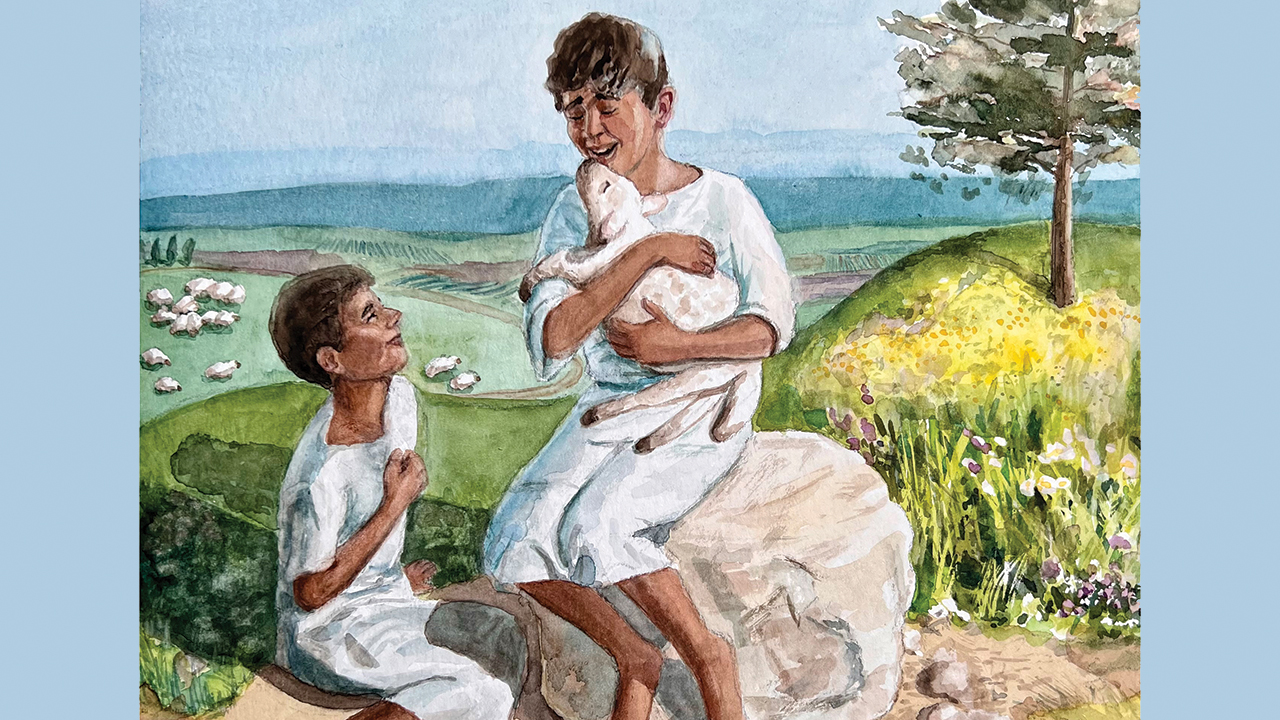
I am Jude, a brother of Jesus, one of the Twelve. Matthew, Mark, Luke and John mention me. They call me Judas or Thaddeus, as some people do.
But there’s a lot that my friends don’t tell about my life.
I was born about two and a half years after Jesus, in the normal way, no angels or fancy gifts involved.
Jesus and I had a pretty normal childhood. He was different, though. He often went off to talk with the wild animals outside the village. He said they talked about the sounds of the earth and the movement of the winds.
I believed him.
I was different, too. One thing the storytellers fail to mention is that I was born lame. My right leg and my right hand never worked quite right. They were too tight, muscles pulling me at odd angles. I walked with a limp and carried my hand close to my chest, all curled up like I was holding onto something precious.
People were always keen to blame these kinds of afflictions on the sins of the parents. But my family was well-liked in the village. My father was an honest and skilled carpenter. And my brother, even at a young age, had a knack for fixing things.
Which wouldn’t have been unusual, except that he could heal animals.
If a hen wouldn’t lay eggs anymore, or a goat wouldn’t produce milk, my brother might be called on to talk to the animal. And before you knew it, they’d be productive again.
I think he mostly did this to keep them from the chopping block. I could tell he found the idea of eating another moving being distasteful. But my parents pretended not to notice, and so I never asked.
One day, after talking with a cow whose milk had dried up too early, we were walking along the road back to the house, picking daisies and kicking rocks, and I asked him a question that had been burning inside me for a while. He was about 14 years old and already a skilled carpenter working with our father.
I was almost 12, old enough to start apprenticing in a trade. I had tried to be a carpenter, but I couldn’t hold the tools correctly, and I was a bit accident-prone, so mostly my mother kept me at home, saying she needed my help running the household.
This meant slopping out the goat pens, sweeping the floors and other unimportant tasks. I wanted to do more, to be helpful like the rest of my family. But my body made everything a little bit harder and a little bit slower, and I couldn’t quite keep up.
I walked beside him, the question bursting at the tip of my tongue, afraid of what he would say, until I couldn’t hold it inside any longer.
“You heal all these animals, Jesus. Can’t you fix me too, so I can be useful?”
It came out too fast, almost like a shout.
He stopped and stooped down so his face was right next to mine.
“Jude, I do that so they won’t be killed. No one is going to hurt you because you’re lame.”
“I know, but I want to be useful. I want to be good at something, to have a trade like you and Father. I don’t want to spend the rest of my life trailing after Mother, helping her cook dinner and cleaning up after the animals.”
Jesus sat down with his back to a rock and patted the dirt next to him. I sat down, too. The rock was warm and felt good on my sore back.
“God created you to be exactly who you are,” my brother said. “You are perfect, just different.”
I made a sound to protest, but his stern look stopped me.
“I know what you’re saying. You want to find your place here, to fit in.”
He paused and smiled.
“I’ll teach you to heal animals. That can be your trade.”
“How are you going to do that? I thought animal healing was a special gift you were born with.”

“No, it’s a matter of listening to the animals and speaking the right words.”
Jesus began to take me to his animal-healing cases, as he called them. I learned to listen to the soft speech of goats and cows, to understand the songs of field sparrows and crows.
By listening, I was able to help them heal. To others it looked like a miracle, but to me it felt more like repairing a rift we had caused long ago between ourselves and our animal kin.
When Jesus left Nazareth, I went with him. I was there when he called the three fishermen from the banks of the lake. I was there when we fed the crowds of hungry people. I was there when he healed the hemorrhaging woman and cast out demons and made a paste with mud and spit and put it into the eyes of a blind man.
I was a healer, too, listening to animals in the towns where we went.
Once, Matthew and I were sitting by a fire after a long day, and he asked me, “Doesn’t it bother you that Jesus is healing all these people and you still walk with a limp?”
I looked up at the stars and thought about it.
“No, I don’t need healing. I have my place in the world, and God created me to be like this. I am content.”
I think Matthew didn’t like my answer. I think he secretly held it against Jesus that he wouldn’t heal his own brother. He didn’t understand all that had passed between Jesus and me.
So, while I made it into his account, my limp and my twisted hand did not. I think Matthew and the other disciples were embarrassed by Jesus’ apparent oversight.
The truth has a way of bubbling up anyway.
After I died, people visited my tomb to pray for healing. Somehow, they knew about me, though no one wrote it down. I became the saint of lost causes, listening to those no one else heard and bringing them peace.
Sarah Werner is the communications director for Anabaptist Disabilities Network and for Central District Conference of Mennonite Church USA. She is the author of Rooted Faith: Practices for Living Well on a Fragile Planet (Herald Press, 2023) and lives in Columbus, Ohio.

Have a comment on this story? Write to the editors. Include your full name, city and state. Selected comments will be edited for publication in print or online.