


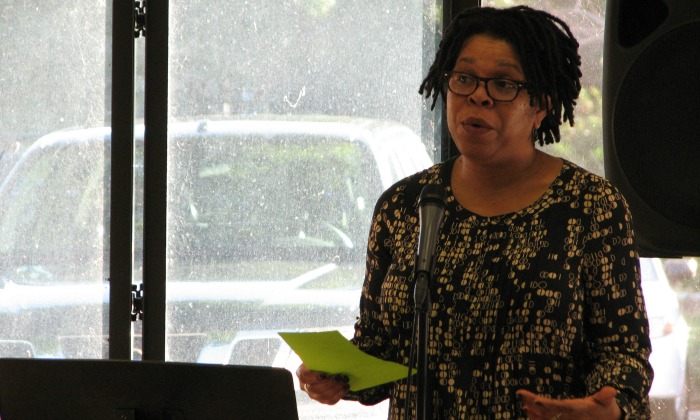
Regina Shands Stoltzfus at Hope for the Future IV. Photo by Nekeisha Alayna Alexis/Anabaptist Mennonite Biblical Seminary.
When Regina Shands Stoltzfus traveled with a friend who is in a wheelchair, she kept thinking, This isn’t fair.
Checking into the hotel, the clerk addressed Regina, even though her friend initiated the conversation. Eating at restaurants and running errands proved difficult.
“When the system is working for you, you probably don’t notice the depth of how it isn’t working for others,” said Shands Stoltzfus, professor at Goshen (Ind.) College, during Hope for the Future IV, a gathering for leaders of color and Mennonite Church USA leaders to work at finding adaptive solutions for culturally appropriate leadership development, held Jan. 23-26 at Iglesia Menonita Arca de Salvación in Fort Myers, Fla.

This year’s focus was power and racism in institutional settings.
Over 100 individuals registered for the meeting—the largest number for a Hope for the Future event.
Seventy-eight of the participants were people of color, and 26 participants were white.
New for this year’s event, students from Hesston (Kan.) College, Goshen College and Eastern Mennonite University, Harrisonburg, Va., also joined.
Radical unity
Drew Hart, a Ph.D. candidate at Lutheran Theological Seminary in Philadelphia who also blogs for The Mennonite, provided the opening sermon on Jan. 23.

Using Philippians chapters 2 and 5, he spoke about a “radical unity” that is not assimilation or homogeneity.
“The temptation in the Church in the West has always been to displace Jesus,” he said. “Thinking maybe that God needs help or assistance in being God, we have arrogantly tried to assist in the process. White men have forced others to conform to their image … Too often white men have stood at the center of Christian community in the West.”
He challenged the participants to move away from the concept of using “white privilege for good,” which further perpetuates the white savior mentality and fails to address the real problem.
“The Mennonite church has the opportunity to seek unity by seeking the mind of Christ,” he said.
‘Gap people’
Gilberto Perez Jr. senior director of intercultural development for Goshen College, led the morning worship and table group time on Jan. 24.

He shared brief stories of “gap people,” or individuals who fill the space of suffering that lies between God’s love and our lives.
One story was about Jonah Yang, who left California with his family of seven for North Carolina, to pastor Hickory Hmong Mennonite Church with only two people attending at that time.
Yang listened to the call and took the risk and ‘filled the gap,’ said Perez.
Power Cube
Iris de León-Hartshorn, Mennonite Church USA director of transformative peacemaking and planner of the event along with Carlos Romero, led an exercise with the “power cube,” a matrix for different types of power.
Table groups then evaluated case studies based on stories from their own experiences in Mennonite institutions using the cube.
The exercise provided participants the language to talk about power in the church and church organizations.

“Power is not easy to talk about,” she said. “But it is a Jesus thing. It’s kingdom work.”
On Jan. 25, the people of color and white people met in separate caucuses to share with one another. Then the attendees joined for a church service with Iglesia Menonita Arca de Salvación, and Sue Park-Hur gave the sermon. Information from her message will be in a later report.


Have a comment on this story? Write to the editors. Include your full name, city and state. Selected comments will be edited for publication in print or online.