


Communist efforts to wipe out the memory of religious groups in the 1930s resulted occasionally in the Soviet Union being built on a Mennonite foundation.
An example of just that was discovered in July when a Ukrainian researcher uncovered Mennonite gravestones used for the footings of a barn in Ukraine.
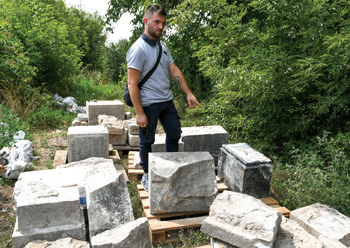
Bearing names like Thiessen, Epp, Dyck and Pauls, the broken stones mostly date from the 19th century and stood originally in the cemetery of Chortitza Mennonite Church.
For Werner Toews of Winnipeg, Man., the discovery began with mild interest in a post on a Facebook Mennonite history group about some people digging at a barn in Ukraine.
“The next day they post this stone, and it looked really familiar,” he said. “I quickly do my GRANDMA [Mennonite genealogical database] research and — ‘Oh, that’s my great-great-grandmother!’ ” he said. “The minute I saw it I got pretty emotional. I wondered what else he will uncover and, sure enough, he uncovers another great-great-grandmother.”
The gravestone excavator was Max Shtatsky, a research fellow at Khortitsa National Nature Reserve who grew up in the suburb of Chortitza, now part of the city of Zaporizhzhia.

Chortitza was a bustling center of Mennonite activity before the Bolshevik revolution. While many Mennonites in the neighboring colony of Molotschna emigrated to North America in the 1870s, Chortitza’s colonists stayed longer, before many departed for Canada in the early 20th century.
Something was wrong
Shtatsky grew up hearing stories about “Germans” who built beautiful buildings. This developed into an interest in Mennonites.
“For years, people had guessed that something was wrong with this shed,” he said by email. “On the side by the street, part of the foundation could be seen, and it consisted of plates that were obviously too good.”
As part of the Soviet effort to wipe out many traces of religion, Chortitza Mennonite Church closed after authorities deemed the building unsafe and the congregation couldn’t afford repairs. Yet the structure was somehow converted into a theater in 1935.
The cemetery’s life as a place to honor the dead came to an end around the same time. It was leveled for a soccer field.
“They built a school on top of the bones, to put it bluntly,” said Toews. Records are vague, but there would have been at least 200 graves.
Any metal and stone that had been there could be used for industry. In Chortitza, that meant building a barn, at night, in 1936, so neighbors wouldn’t see that the ornately etched stones came from less than half a mile away.
In recent years the barn had fallen so deeply into disrepair that its roof collapsed and the property was used as an informal landfill for construction debris. That was the opportunity Shtatsky needed to act on his hunch and take on the demolition for research purposes.
“After three hours of working with a hand tool, the plate with the inscriptions was finally removed,” he said. “It was a female burial, indeed unnamed, only with dates of birth and death. But it was an opening! And, yes, I jumped like crazy!”
Shtatsky fed Toews names and dates as they were uncovered, and the two pieced together a list of more than 85 individuals using genealogical records.
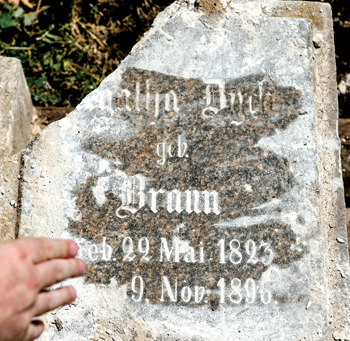
“One historian in Winnipeg made the observations that there’s thousands of people who are descendants of these people,” said Toews, who said the GRANDMA database revealed names of about 700 descendants using just a couple of gravestones.
Memorial of memorials
Some fundraising has taken place in the Winnipeg area to support the work in Ukraine. Khortitsa Reserve was able to budget $10,000 to $12,000 for the project. However, the archaeological dig’s costs expanded beyond that.
Toews and Louie Sawatzky are putting together a working group based in Winnipeg to continue supporting the project. They are coordinating with Mennonite groups to raise $10,000 to help the museum store the stones and develop a memorial that tells the church’s story.
“We have stones, now what?” Toews asked. “Do we get them restored? And it’s a touchy subject, trying to make decisions for ancestors. One stone’s in five pieces. What do we do? Take it to a dump?”
Khortitsa Reserve has already identified a location near its ethnic and cultural heritage museum to serve as the stones’ final, final resting place.
“We plan to create a memorial dedicated to Mennonite heritage and the significant contribution to the region’s culture and economy,” Shtatsky said. “Concerning other artifacts, there is an opinion on the existence of similar buildings that have Mennonite tombstones in their foundations.
“It is almost certain. And soon I’ll look further.”



Have a comment on this story? Write to the editors. Include your full name, city and state. Selected comments will be edited for publication in print or online.