


I appreciate a mystery, and Proverbs 31:1-9 provides an intriguing one. The chapter opens with “The sayings of King Lemuel of Massa, which his mother taught him.” What follows is a poem in which a mother warns her son against promiscuity and too much strong drink because those will get in the way of his acting justly as king. She tells him to speak on behalf of the voiceless and defend the rights of the poor and needy.
Who was this King Lemuel? He’s never mentioned elsewhere. Scholars have theories, but no one knows for sure. And who is his mother? How did she get to be so wise?
Rabbis were curious about her, too. Through ancient commentary called Midrash, they gave her a name and a backstory. In a sense, they did what the poem advises: gave voice to the voiceless.
According to Midrash, King Lemuel was another name for King Solomon — whose mother was Bathsheba, the beautiful woman King David spied from his palace roof as she took a bath. David arranges for Bathsheba’s husband to be killed in battle so that he can marry her.
Regarding Bathsheba and her husband, David does not act justly, does not respect the voiceless.
Several Midrash explain how Bathsheba comes to give her son Solomon the advice he quotes. One asserts that on the night of Solomon’s marriage to the Pharaoh’s daughter, he drinks too much wine and oversleeps the next day, which happens to be the same day as the inauguration of the Temple. He’s supposed to open the gates, but he’s asleep, with the keys under his head. Bathsheba wakes him up with the words of Proverbs 31:2-9. In one account, she slaps Solomon with her shoes!

Midrash with a capital “M” refers to such biblical commentary written between A.D. 400 and 1200. The same word with a lowercase “m” refers to similar biblical interpretation, a creative reading between the lines.
Midrash, whether ancient or contemporary, provides missing information and reveals new perspectives. It makes sense of contradictions and connects scripture to current times. It views the biblical text as multilayered, with no single interpretation. It sees the text as the beginning of a conversation instead of the final word. It considers God’s revelation ongoing, not restricted to the distant past.
If you’d like to learn more about the midrash tradition, Rabbi Sandy Eisenberg Sasso’s Midrash: Reading the Bible with Question Marks is an excellent place to begin.
For nine years, I was the literature faculty member for Religion, Spirituality and the Arts, an Indianapolis-based program initiated in 2012 by Rabbi Sasso. In this seminar, artists study a biblical text, read its related Midrash, look at the tradition of art, literature and music inspired by it and then create their own artistic midrash in the form of paintings, sculpture, poetry, drama, music or dance.
We studied the narratives of Creation, Adam and Eve, Cain and Abel, Lot’s wife, Jonah, Noah’s ark, Moses and Jacob. Artists created deeply moving works as they looked at biblical stories from new perspectives, often relating them to such concerns as climate change, environmental injustice, family violence and the plight of immigrants.
The artists gave voice to the voiceless — to people such as Lot’s wife or Noah’s wife, or even to a rock aquifer, a raven, a whale.
You don’t need to be a painter, a poet or a rabbi to create midrash. Anyone can engage with it as a meditative practice by reading a biblical passage and asking, “What’s been left out? What unexpressed perspective draws me in?”
Maybe it’s the perspective of Pharaoh’s daughter. What is she thinking when she finds a Jewish baby afloat on the Nile? How does she persuade her father to let her bring a Jewish child to live in the palace?
Looking at the Gospel of Luke, what is the prophet Anna’s backstory? How does she recognize the infant Jesus?
Maybe you are drawn to Simon of Cyrene, compelled to carry the cross. How will the walk to Golgotha redirect his life?
You don’t need to write your midrash, but writing can draw forth ideas that might not come otherwise. Writing quickly is especially helpful. This derails our analytical thinking and makes us more spontaneous and creative, more receptive of surprises.
In “White Fire: The Art of Writing Midrash,” the poet Alicia Ostriker refers to the Torah (and, by extension, all of scripture) as a Tree of Life: “A tree can stay alive only if it grows. So it is with all tradition — it stays alive by growing and changing. To reinterpret Torah is to add new twigs and leaves to the Tree of Life.”
When I imaginatively enter a biblical narrative, exploring the characters’ perspectives, I become part of an expansive, ongoing story.
Shari Wagner, Indiana Poet Laureate for 2016 and 2017, is the author of three books of poems: The Farm Wife’s Almanac (Cascadia, 2019), The Harmonist at Nightfall (Bottom Dog, 2013) and Evening Chore (Cascadia, 2005). Visit shariwagnerpoet.com for information about her books and workshops.
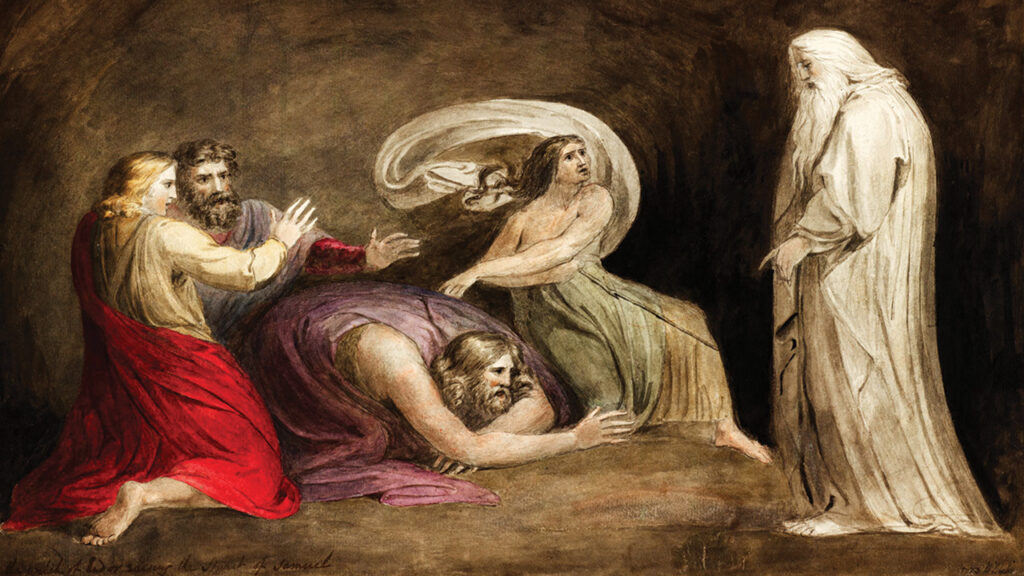
The Witch of Endor
It’s time for me to speak from the dead,
to answer the question so many men
have answered for me: At the séance with Saul
did the Witch of Endor really summon
Samuel’s spirit? The righteous say,
“God wouldn’t touch a woman like that
with a 10-foot rod.” Either I was a ventriloquist
or I conjured up a demon. Truth is, as a medium
I might have dabbled in some slight deception,
but I offered only solace: “Your wife prepares
your favorite meal for the far-off day you join her.”
Or, “Beyond the shining veil, your son plays
dice and knucklebones with an angel.”
Of course, I screamed when I saw Samuel’s spirit
real as mist and nothing like the priest
I pictured. He was in a foul mood, muttering
Saul’s name under his breath. Believe me,
his dire prediction that the king would die next day,
along with his three sons, was not in my repertoire!
So many astute men have failed to note
what happened after the séance. I could’ve slunk
into the shadows, but that was against my nature.
I ordered Saul up from the cold, hard floor
and served him the feast meant for my son.
—Shari Wagner

Have a comment on this story? Write to the editors. Include your full name, city and state. Selected comments will be edited for publication in print or online.