


A five-year partnership between African and North American women concludes.
The Mennonite World Conference assembly in July marked the completion of a unique five-year partnership between North American and African women church leaders. Through the partnership, nine women from Congo, Kenya and Tanzania have received theological training.
We of Mennonite Women USA recognize that power dynamics are inevitably at play in telling a story like this; the story would be different if told by our sisters from the African Anabaptist Women Theologians (AAWT) group. Still, we want to share our experience as an encouragement to the church and a testimony to the movement of the Spirit within our institutions. We share it with appreciation for all who participated and with thankfulness to God.
For us, for me, the story began in January 2005 with a set of committee meeting minutes.
Four years earlier some African Anabaptist women church leaders formed a group with the help of Mennonite World Conference (MWC) staff. At the 2003 MWC assembly in Bulawayo, Zimbabwe, seven women from five countries were chosen to serve as a leadership committee, and this group met again in Nairobi, Kenya, in November 2004.
Mennonite World Conference distributed 14 pages of minutes from this meeting to Mennonite agencies. I was then editor for Mennonite Women USA (MW USA), and I remember reading those minutes with a sense of awe. I had never before heard my sisters from this part of the world so fully articulate their sense of God’s calling. Something about those minutes made these women, on a distant continent I’ve never visited, real to me.
In their words, this was their vision for their group: “to identify talents and help nurture women’s gifts in the ministry for the glory of God and for sustainability by coordinating women’s training and creating awareness in the church so that women are effectively utilized in the church on an equal basis with their male counterparts.”

Their first stated objective: “The women anticipate that by the year 2009, at least 20 women will have trained fully and/or partially in theology across Africa Mennonite and Brethren in Christ Church.”
Twenty African women trained in theology. An inventory in the minutes tallied 227 women (nearly all of whom were in Zimbabwe) with any amount of theological training in the five nations, so a gain of 20 would be significant.
In conversations with MW USA executive director Rhoda Keener and members of our board of directors, we kept returning to this specific goal. We realized how ambitious it was, yet it was something we could get our heads around. We could see that a partnership between MW USA and AAWT could help make our sisters’ dream a reality. And this dream struck a chord in us.
Such a partnership was not like anything MW USA had attempted before, and it felt like a big leap of faith. We knew it would require a significant commitment of staff time and financial resources. Yet we came to see it as an opportunity to take our own ministry to a deeper level. We hoped, too, that forming a connection to African theologians might help our organization strengthen its ties with U.S. women church leaders.
As we debated getting involved, we told the biblical story of Esther—the woman who found herself in a place of privilege, of resources, “for such a time as this.” What was our organization for if not for this kind of partnership with our sisters? We noted that another phrase from the story seemed applicable—that if we refused to answer the call we were hearing, the African women would find assistance elsewhere someday. But we said, Why not us? Why not try?
The fact was, it appeared no other agency at the time was better suited or more likely to make a commitment to these women. MWC staff member Tim Lind said, “While there has always been a lot of interest in AAWT throughout the global church, we had difficulty finding a group that was willing to serve as a formal link. As a result we were grateful and relieved when Mennonite Women USA accepted the challenge. We think the experience can contribute much to our common search for authentic ways of being a global faith community.”
Through an MW USA program called Sister-Link, assisted by Mennonite World Conference, a three-pronged partnership developed.
First, Mennonite Women USA committed to providing scholarship funds for women selected by the AAWT committee. I was no longer working for MW USA but teamed up with another former staff member, Susan Jantzen, to lead this fund-raising effort as volunteers. The project raised approximately $35,000 over the five years. While part came from MW USA’s budget and special offerings, a large portion was provided by a group called Les Amies (friends): about 40 North American women pastors and theologians who agreed to support the scholarships financially throughout the duration of the partnership.
In the second part of the partnership, the AAWT leaders were paired up with women theologians in North America as pen pals, with the intention of developing friendships and providing mutual support as women leaders in the church.
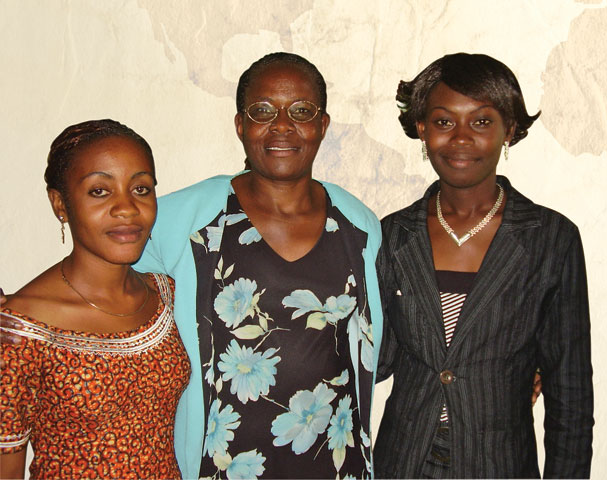
“To pray for Christians around the world is a good thing, but I found myself praying in a much more meaningful way for my Sister-Link partner Mama Swana in Kinshasa, Congo, whose photo was in my living room,” says pen pal coordinator Sylvia E. Shirk, pastor of Manhattan (N.Y.) Mennonite Fellowship.
“We had the blessing of having met at Mennonite World Conference in 2003, and as her pen pal and prayer partner, it was rewarding to read her letters and overwhelming to receive her gifts,” says Shirk. “She used email and was a faithful correspondent. Mama Swana’s prolific writing has been an inspiration and a challenge to me. Our exercise of partnership between women theologians of two continents in this Sister-Link was life-giving. Catching a glimpse of the world through each other’s eyes created a space for liberating interdependence that offers ongoing benefits for all those who participated.”
Third, the partnership included a commitment from Mennonite Women USA to walk beside AAWT organizationally as they develop and implement their vision for ministry.
Rhoda Keener reflects: “This part of the Sister-Link became my unique responsibility. Although AAWT secretary Rebecca Osiro and I talked about ways MW USA has organized, I believe being present as a sister organization was far more important than any governance structures or forms we shared. I’m delighted to know that the AAWT now has a constitution, a brochure and has successfully transferred leadership for the next six-year period.”
In the past five years we have rejoiced in seeing women complete their theological training and mourned when one scholarship recipient, Lucy Apiyo of Kenya, suddenly passed away after a brief illness. We exchanged emails, letters, gifts and visits; AAWT leaders came to North America, and Rhoda Keener participated in a 2007 AAWT meeting in the Democratic Republic of Congo.
We prayed for our sisters facing violence in Kenya and Congo. We were thrilled to see an article by AAWT leader Sidonie Swana published in Associated Mennonite Biblical Seminary’s journal Vision. And we praised God when our sister Rebecca Osiro, the AAWT secretary who received AAWT scholarship funds, became the first woman to be ordained for pastoral ministry in the Kenya Mennonite Church.
All our shared dreams were not realized. Cross-continental communication was challenging, and some of the pen-pal relationships were more meaningful than others. Fewer scholarships were awarded than hoped. At times AAWT leaders were unable to choose among possible recipients because of the great difficulties they face in communicating among themselves across five countries and two languages.
Work still lies ahead for the AAWT group as they continue to work through the hard questions of how visions can be shared and decisions made in the future. Yet while the pace was not always rapid, progress was made.
Now that the initial partnership has concluded, scholarships will continue to be available to AAWT-selected women through MW USA’s International Women’s Fund. This fund has provided scholarships for 56 women in the last 10 years.
“This is a story of women being moved by the Spirit and others being moved to respond also—of being stirred by something far away, something we haven’t seen yet but know in our bones could happen,” Susan Jantzen says. “Coming together across these distances and cultural gaps is complex. But a shared vision of what can be was greater than the obstacles.”
Cathleen Hockman-Wert is a member of Corvallis (Ore.) Mennonite Fellowship.


Have a comment on this story? Write to the editors. Include your full name, city and state. Selected comments will be edited for publication in print or online.