


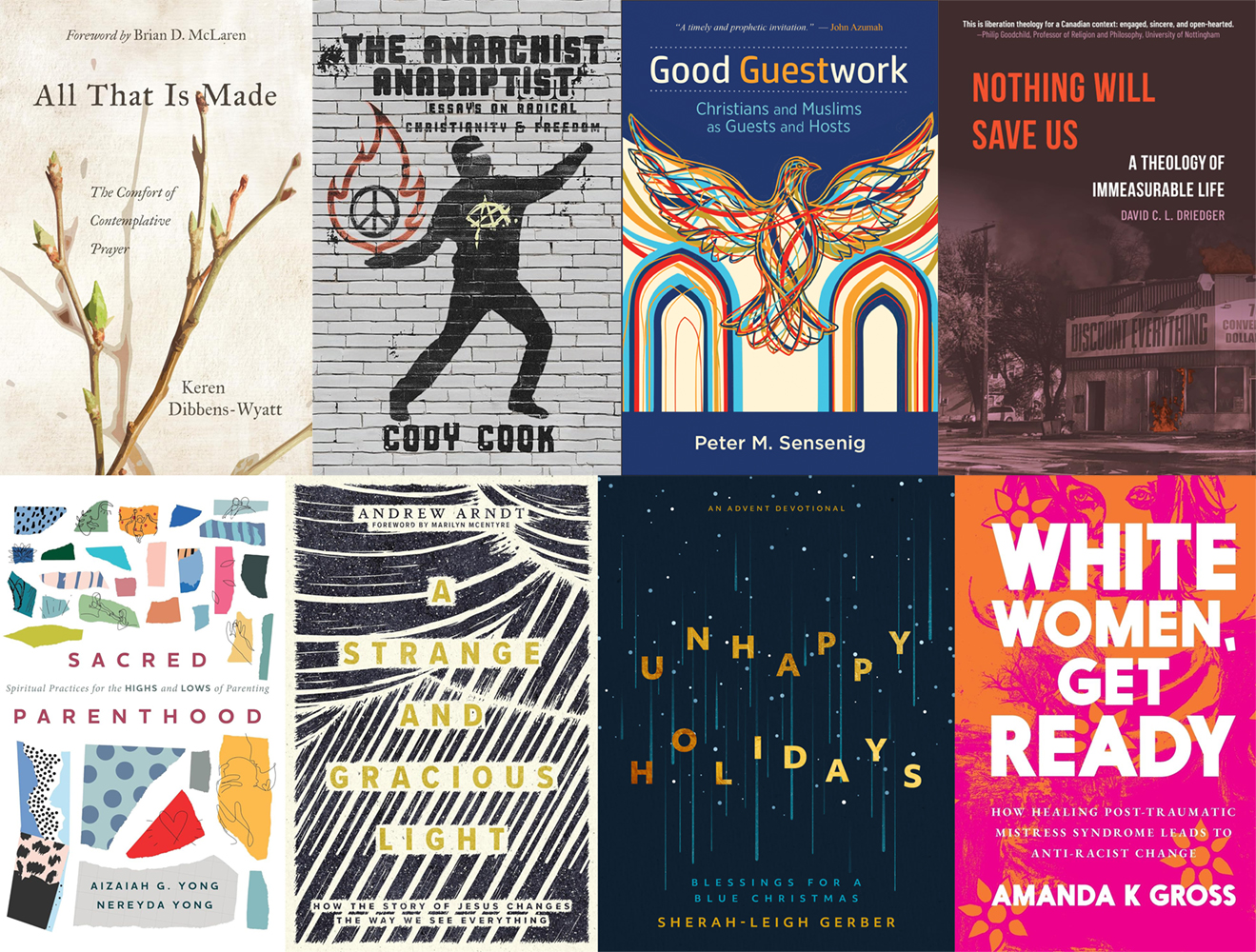
The October 2025 issue of Anabaptist World includes several mini reviews of recent books on faith and introspection.
Most of All That Is Made: The Comfort of Contemplative Prayer (Herald Press) is an extended meditation on Revelations of Divine Love by Julian of Norwich. One asset of this book is that it encourages readers to explore that classic of Christian mysticism, which is considered the first book written in English by a female. While this is not a how-to book, author Keren Dibbens-Wyatt does offer suggestions in describing her journey into contemplative prayer. She distinguishes contemplation as “the foundation and living relationship with God” from mysticism, which is “the way of seeing, being and receiving that comes from that.” What is perhaps most remarkable and most moving is the author’s experience of being “permanently in pain, exhausted and housebound” for 25 years. In spite of this, she has devoted herself to prayer and to sharing her insights through her writing. She writes, “In many ways I had hit rock bottom, and deeper into prayer was truly the only direction my life could take.” Most of the book consists of looking at one of Julian’s 16 “shewings,” or revelations from God, that of the hazelnut. It’s amazing what Julian derived from this, and remarkable how extensively Dibbens-Wyatt examines it further, though there is some repetition. This book will encourage readers to give themselves to God in prayer and, hopefully, delve into Julian’s writings. — Gordon Houser
In The Anarchist Anabaptist: Essays on Radical Christianity and Freedom (Libertarian Christian Institute Press) Cody Cook, a self-proclaimed Libertarian Christian, posits that “anarchists and Anabaptists have run on parallel tracks — seemingly going in the same direction but rarely mingling.” He wants to bring the two ideologies together. And there are similarities, though also clear differences, which he acknowledges. In covering Anabaptists, Cook sticks mostly with the 16th-century kind, with occasional mentions of Amish and Hutterites, but he largely ignores the variety of Anabaptists worldwide. He is more nuanced when describing Libertarians. “Anarchists,” he explains, “do not necessarily reject governance. . . . The problem is not governance per se, but coercive force used against peaceful people.” He notes that he is not promoting “anarcho-communism or the promotion of anti-state violence.” He explores the similarities and differences between the groups. For example, “Anabaptists tend to be very focused on community and simplicity in their daily lives, while libertarianism has tended to promote individualism and advocate for commerce as a solution for many of humanity’s greatest problems.” I don’t quite buy his rosy view of capitalism; though he does criticize big business, he ignores capitalism’s contribution to environmental destruction. Nevertheless, this is a good book to learn about a viewpoint many of us may be unfamiliar with. — Gordon Houser
The meek shall inherit the Earth, and the humble mission worker shall inherit positive interfaith relationships — if they come as a guest. Good Guestwork: Christians and Muslims as Guests and Hosts by Peter M. Sensenig (Santos Books) draws on the author’s experience seeking interfaith peace in Muslim-majority communities. He encourages prioritizing the role of the vulnerable guest. This posture builds friendships (“The Power of Friendship,” AW August 2024), follows the example of Christ and embodies the antithesis of Christian nationalism. Guests might find they encounter their own faith more deeply. Sensenig works with Mennonite Mission Network and Eastern Mennonite Missions’ Christian-Muslim Relations Team. He offers counsel not only for Christians sharing the Good News abroad but members of any majority group, even Anabaptists who aren’t as marginal as they might think. While Good Guestwork focuses on Christian-Muslim relations, Sensenig’s concepts apply to interactions with various ideological “others,” perhaps even political rivals. — Tim Huber
In communities across North America, homeless encampments have sprung up — and so have calls from politicians and annoyed residents to remove them. For David Driedger, lead minister at First Mennonite Church in Winnipeg, Man., that’s not a solution. Instead, those tents, tarps and shopping carts should be seen by everyone — and especially Christians, since they can show a way to salvation. That’s the argument he makes in Nothing Will Save Us: A Theology of Immeasurable Life (Pandora Press). According to Driedger, people who are seen as nothing by society are not only people loved by God but also people with whom Christians can encounter God, discover truth and see how some structures of society are set up in such a way that some people, despite their best efforts, simply can’t move forward or get ahead. In Philippians, the Apostle Paul wrote that Jesus “made himself nothing by taking the very nature of a servant.” Similarly, Driedger says, Christians should empty themselves of their stereotypes about people who are poor and marginalized in order to truly see and hear what God is saying through those who are seen as nothing, including at their encampments. — John Longhurst
Sacred Parenthood: Spiritual Practices for the Highs and Lows of Parenting (Herald Press) is a book all Jesus followers who care for children should read. Aizaiah and Nereyda Yong share from their experiences as parents in a multiracial family, drawing from contemplative Christianity, scientific research and wisdom from communities of color. As a full-time working woman and a full-time parent, I loved how they make the belief in humanity’s belovedness by God a foundation of parenting. This defines the posture they encourage us to have with ourselves and the children in our care. They offer examples of how to counter the ways that colonialism has diminished the truth of belovedness, especially for people of color, but also for everyone. Sacred Parenthood is an encouraging read for anyone trying to nurture children a way faithful to the teachings of Jesus. You’ll find helpful examples of ways to care for yourself and children. Beyond a theological foundation of parenting, the book is a tool to come back to for ideas to meet the moment before us. — Danielle Klotz

The gospel is more than Jesus’ life, death and resurrection. It is also how Jesus makes himself known in our lives today. The gospel, or “the story of Jesus told as a promise,” can transform our lives if we let it, writes Andrew Arndt in A Strange and Gracious Light: How the Story of Jesus Changes the Way We See Everything (Herald Press). The “strange and gracious light” of the gospel will transfigure how we see things. The book follows the life, death and resurrection of Jesus, organized by seasons of the church calendar. In a chapter called “Christmas: Everything Holy,” Arndt, a pastor, shares stories of encountering Jesus in unexpected places, such as being prayed for by a homeless man covered in vomit. Arndt thought he was helping the man by the garbage can but instead found himself being ministered to. “Whenever we deal with people,” he writes, “we deal with God.” Believing “the story of God-with-us never ceases to be strange,” he describes encounters that open our eyes to the presence of Christ in our own lives. Each chapter concludes with questions, making this book ideal for personal devotions or group discussion. — Eileen Kinch
There is an Advent devotional for those who might not feel like singing “all is calm” and “all is bright.” Advent was originally meant to be a time of darkness, which can be difficult when Mannheim Steamroller’s Christmas tour already gets rolling Nov. 18. Unhappy Holidays: Blessings for a Blue Christmas (Herald Press) acknowledges these might not be happy holidays for everyone and makes space for lament in the busy season. Sherah-Leigh Gerber brings experience in spiritual formation, balancing the need for comfort with the need for acknowledgment that some people are in pain. This might be especially true for pastors and family managers tasked with planning and implementing all the celebrations everyone expects. Daily devotional readings are joined by a blessing, some of which might sneak into worship services — hopefully with author attribution. That’s probably why the bonus materials at the back of the book include litanies for Advent candle lighting and suggestions for adapting material for small groups. Coming Oct. 7, it might be just the early Christmas present for someone not looking forward to Christmas. Neither Grinch nor Scrooge, Gerber is also coauthor of Comfort and Joy: Readings and Practices for Advent. — Tim Huber
Amanda K. Gross invites the readers of White Women, Get Ready: How Healing Post-Traumatic Mistress Syndrome Leads to Anti-Racist Change (Otterpine) to “follow [her] trajectory of learning and unlearning the way of white womanhood.” Mennonite readers will find much that resonates from Gross’ Swiss German Mennonite heritage and upbringing, including being “Mennonite Humble” and childhood vignettes. Readers may also resonate with the “white-woman overwhelm that is our commitment to overdoing it (often in service to others) that leaves us so exhausted we don’t have time or energy to challenge the systems around us.” A significant part of Gross’ journey focuses on healing from Post-Traumatic Mistress Syndrome. This syndrome draws on ideas in Joy DeGruy’s book Post Traumatic Slave Syndrome and the study of interlocking traumas of victims and perpetrators, the oppressed and the oppressors. Gross writes that “white people have also been impacted by this traumatic legacy of multigenerational violence, racial superiority and the justification of 500 years of trauma and dehumanization [that Europeans and their descendants] and their institutions produced.” White female readers, particularly those with a Mennonite, middle-class background, will appreciate Gross’ combination of research, vulnerable sharing and inspiration for post-traumatic healing. She takes care to encourage as well as challenge, acknowledging that readers are “more than just a mind pursuing information. You have a body with a heart that feels things and also stores trauma.” — Jennie Wintermote


Have a comment on this story? Write to the editors. Include your full name, city and state. Selected comments will be edited for publication in print or online.