


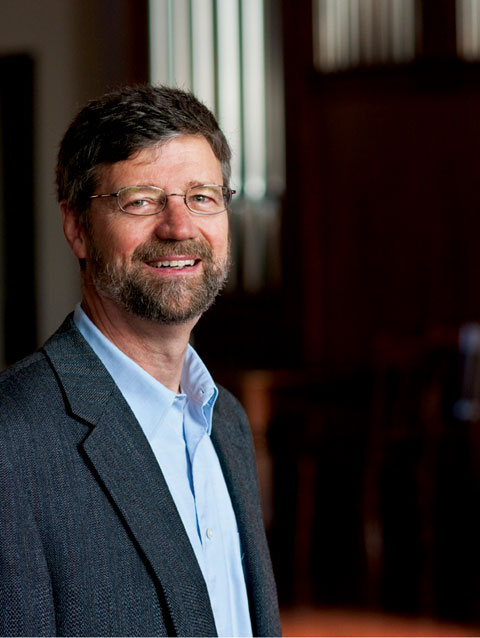
Introducing Ervin Stutzman, the new executive director of Mennonite Church USA
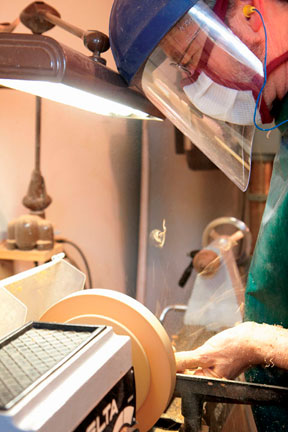
Ervin Stutzman, the new executive director of Mennonite Church USA, has been a hobby woodworker for most of his adult life. He learned early on that a tool is only as useful as the person who wields it …
Ervin Stutzman, the new executive director of Mennonite Church USA, has been a hobby woodworker for most of his adult life. He learned early on that a tool is only as useful as the person who wields it. Stutzman brings many tools with him to his new position as executive director, a position he begins this month. As a child growing up in a Beachy Amish
community in rural Kansas, he developed some of his most useful tools early on.
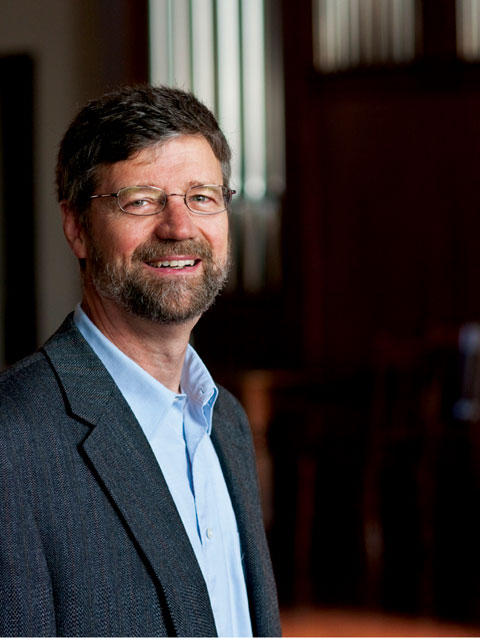 Stutzman chronicles much of his childhood in two recent books, Tobias of the Amish and Emma, Widow of the Amish. He and his twin, Erma, are the youngest of six children. Their father died when the twins were 3. Afterward, his mother moved the family from Kalona, Iowa, to Hutchinson, Kan., where her family lived.
“I don’t think I realized at the time that most of our congregation was made up of people who were at least distantly related to me,” says Stutzman. “Our relatives surrounded my mother and cared for her after my father died.
“At that time, the Amish Mennonite Church had many people who had returned from I-W service after World War II. The leaders of the congregation had seen the world in ways their parents had not.
“That congregation had a sense of mission in the world and it encouraged young leaders. Lots of church leaders have come from the congregation,” says Stutzman. “It gave me a place to grow.”

Stutzman had many opportunities to exercise leadership early in his life. At 22, he and his wife, Bonita (Haldeman) Stutzman, were leading a voluntary service house in Cincinnati. He was also co-pastor of Mennonite Christian Assembly in Cincinnati.
“I have always been given a lot of responsibility for my age,” says Stutzman. “I have been preaching regularly since the age of 22.”
At 29, he and Bonnie and their young family moved to Lancaster, Pa., where he was associate pastor at Mount Joy Mennonite Church. After only 18 months he was asked to be the bishop of the Landisville District of Lancaster Mennonite Conference.
“I was the next to youngest pastor in the district and was asked to give oversight to people twice my age. I got practice really fast with how to work with people,” says Stutzman. “This seems to be a pattern in my life. When I come into new situations, I get handed responsibility.”
The responsibility he was given early on spurred him to find a way to help other congregations mentor and encourage young adults in ministry. While serving as dean of Eastern Mennonite Seminary in Harrisonburg, Va., Stutzman wrote part of a grant for a Culture of Call program that encouraged young adults to consider ministry and prodded congregations to provide mentoring experiences for young people.
Stutzman’s early years at Center Amish Mennonite Church and the community in Hutchinson, Kan., also gave him a basis for faith and practice.
“The community I grew up in was a community whose faith was central to who they were,” says Stutzman. “We tried to be nonconformed to the world, and the reason for that was always that we were set apart for God. It is a normal thing for me to think I don’t always do things the way other people do them. I never grew up thinking that doing it like everyone else was the best way to please God.’
He learned that simplicity is opposite the American dream. For him, this emphasis on nonconformity translates to a call to discipleship.
“I love the Mennonite church because it has people who have taken the gospel seriously and have been involved in mission and service in the world,” says Stutzman. “But I’m afraid we are not aware enough of our history. There is inspiration we can draw from it.
“I intend to lead the church, not as a business or a political entity, although it is both of those, but first and foremost as a faith community,” he says. “We are God’s community. We need to ask how God is speaking to us.”
Stutzman hopes to revive the value of reading Scripture together.
“We have a communal hermeneutic, a way we gather around the Scripture as a community and study it together. In many ways that is our primary business as a church.
“I also feel that in our discipleship, in both the most conservative wing of the church and the most liberal, we place too much emphasis on what we can do that pleases God and not enough emphasis on receiving God’s grace. I know that is an element of faith I struggle with, and I see it in others, too.”
Stutzman describes himself as a lifelong learner. As a child, he read all kinds of books and had what he described as a good basic education. He participated in spelling and speech contests as an elementary and high school student, although he admits he never won any of these contests.
During voluntary service in Cincinnati, he got special permission to work on his college degree while he was supervising his voluntary service house.
“This got me in the habit of doing two things at once for the rest of my life. I learned to juggle and integrate,” he says.
“I find learning a new skill more exciting then entertainment,” says Stutzman. ‘As a young couple, Bonnie and I spent money on tools for working with our hands instead of going out to eat or any other kind of entertainment.”
Ervin and Bonnie passed their love of learning to their three children—Emma, Daniel and Benjamin, now adults.
“Our whole family got into thinking about things together,” he says. “We would discuss topics or books together. For our family, learning is one of the most exciting things you can do in life. We have never had the sense that learning is something you do because it’s required or someone else wants you to. You do it because you enjoy it.”
Stutzman translated his love of learning into a love of teaching. As a seminary professor and dean, he enjoys teaching someone something they really need at the moment.
“I call this ‘just in time’ learning, when someone can immediately benefit from something they’ve learned. That’s why I enjoy teaching preaching, because it is something pastors often feel they need.
“I am most discouraged when I feel people don’t want to learn,” he says. “Continuing to do something in the same old way isn’t interesting to me.”
Learning from others is one of the tools Stutzman brings with him to his work with Mennonite Church USA.
“My experience as moderator for the Executive Board at the time of the merger has really shaped me. I enjoy working with people from diverse backgrounds, and we have much to learn from each other,” he says. “We would be a much stronger church if we recognized the strengths that our diversity brings us instead of getting caught up in our differences.”
Stutzman has spent several years learning Spanish as one way of communicating to parts of Mennonite Church USA. He spent part of a sabbatical one summer at SEMILLA, the Anabaptist seminary in Guatemala, as a way to practice his Spanish. As dean of Eastern Mennonite Seminary, he worked with a Spanish-speaking conversation partner as part of the Intentional English Program at Eastern Mennonite University, Harrisonburg, Va.
Stutzman is also intentional about his spirituality.
“I talk with God every day,” says Stutzman. “There is not a day that goes by that I don’t have a sense of what God might want me to do that day.”
“I desire that personal sense of God’s will enlarged for the whole church,” he says. “When we come to God together and listen, God speaks to us.”
Stutzman also lives his life with purpose, based on a personal purpose statement he wrote several years ago:
In response to God’s love expressed in Jesus Christ, by the power of the Holy Spirit, I purpose to follow after God with all my heart and serve as a faithful steward of all the resources he has generously entrusted to me, so that God may be glorified in my life at all times and in every way. Since God has called me to be a leader in the church, I shall give priority to the cultivation of a meaningful personal walk with God, the proclamation and demonstration of the kingdom of God and the equipping of faithful men and women for ministry.
“What I’m doing as executive director is not in discontinuity with anything I’ve done before,”says Stutzman. “The role of visioning, working with people to develop their strengths, helping an organization achieve its mission as a Christian community—these are all things I’ve done before. Only now it’s a bigger task.”
“This role feels like it’s a good fit for me,’ he says. “And it will be another one in the stream of difficult jobs that others say they would never want to have,” he jokes. “But I rarely think about how much work something is going to be. That’s just not the way I think. I focus on what good things might come out of it when God is in it.”
Laura Lehman Amstutz is the communication coordinator for Eastern Mennonite Seminary, writing on behalf of Mennonite Church USA, and attends The Table Mennonite Church in Harrisonburg, Va.
Photos by Jon Styer


Have a comment on this story? Write to the editors. Include your full name, city and state. Selected comments will be edited for publication in print or online.