


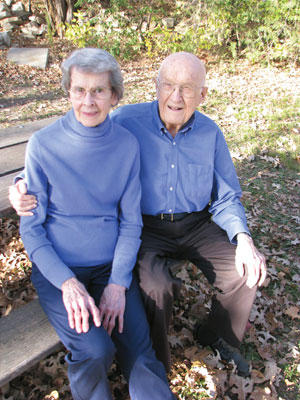
Robert Kreider helped shape the 20th-century Mennonite church.
Even though the Old Testament patriarch Abraham lived to be 175, it is not his longevity that most impresses Robert Kreider, 94, a long-time leader in the Mennonite church. What resonates with him is Abraham’s trust on a faith journey woven with God’s call to leave certainty and embrace change.
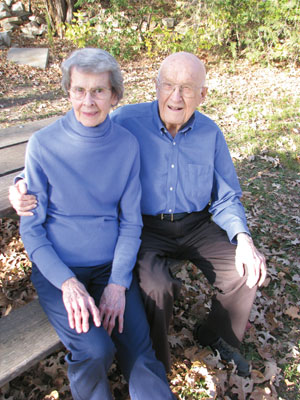
The New Testament journey motif of walking in the footsteps of Jesus—marked by exploring questions more than expounding answers—is one that Kreider, who lives with Lois (Sommer), his wife of 67 years, in North Newton, Kan., has always valued.
This spirit sustained him on a pilgrimage that led through the heart of the Mennonite story of the 20th century, when he served the church in education, administration and church leadership in the 1940s through the 1990s. In those decades, he and his peers grappled with the creep of urban influence into their largely-rural-based church, practiced nonresistance in a world gone to war and sought to navigate modernity while holding fast to their values of community, simplicity and discipleship.
One of few peers still alive in the 21st century to share stories of those times, Kreider, a teacher invited to share wisdom, is also a student, eager to learn more. God’s vast universe, which has evoked responses of resilient humility through 10 decades, is still presenting Kreider with new mysteries and questions.
A central motif for Kreider is seeking to live with the mind and spirit of Christ. “My responses about faith have been less on the side of the theological than they have been on the side of theological motifs,” he said during an interview at their apartment connected to the multigenerational home of son David, daughter-in-law Heidi Regier Kreider and grandsons Ben and Mark.
“One of those motifs is the story of walking in the footsteps of someone like Abraham, who when God called him, left the safety of the known for the risk of the unknown. A favored story in this motif is the one about the disciples walking with the stranger on the road to Emmaus.

“These stories tell us something about living in the faith, rather than needing to have it all figured out. … There is always an outer edge beyond us. And in my latter days, my journey is still filled with wonder. I live in awe and appreciation.”
His verve for joyful wonder in his twilight years witnesses to how his decades of fruitful service seeded his spirit for today’s reflections. His ministries included directing education programs and mental health units in Civilian Public Service (alternative service in World War II) as well as Mennonite Central Committee (MCC) relief work in postwar Germany and Europe. He earned master’s and doctoral degrees in history and taught history at Bluffton (Ohio) College (now University) (1952-1974), where he also served as dean and president. He later taught at Bethel College, North Newton, Kan., (1974-1985).
He served as recording secretary for Mennonite World Conference and traveled overseas on its behalf, and he served on the Executive Committee of MCC. In 1961-62 he helped establish in Africa the MCC Teacher’s Abroad Program, a program leading to 1,000 volunteers, and assisted Atlee Beechy in the beginnings of China Educational Exchange. He curated the Mirror of the Martyrs exhibit, which has itinerated to more than 70 venues in the United States and Canada, led scores of Mennonite history tours throughout south central Kansas, and authored many books and articles.
Building a bridge to common ground
Awe and appreciation by younger generations surround the story of Kreider and his generation, who helped to build a bridge from the past to today, says John A. Lapp, executive secretary emeritus of Mennonite Central Committee (MCC). Kreider’s life is a stone in the bridge that has led to the pathway on which Mennonite Church USA now walks.
This stone was shaped by several inter-Mennonite elements, Lapp says. Kreider’s ancestors have origins in the former Old Mennonite Church (later called Mennonite Church). His grandfather, J.S. Shoemaker, was a key player in that church through the 1920s, and his father, Amos, was a notable pastor and educator. Robert’s childhood and formative years are a bridge between his Old Mennonite roots and the former General Conference Mennonite Church. He has served in roles that criss-crossed the MC-GC worlds that in 2003 merged to create Mennonite Church USA.

“Robert was a bridge builder and made sure we heard each other properly when discussing our differences,” Lapp says. “He was a reconciling personality and clearly understood that there are multiple Mennonite traditions. He appreciates the multiplicity and diversity and strives to help all of us find common ground.
“Robert was as close to the center of things as you could get in the 1940s through the 1990s—and he is still with us. If anyone represents Mennonites in the 20th century, it is Robert.”
Leaving old lands for new territories
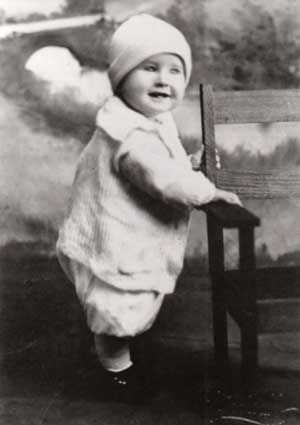
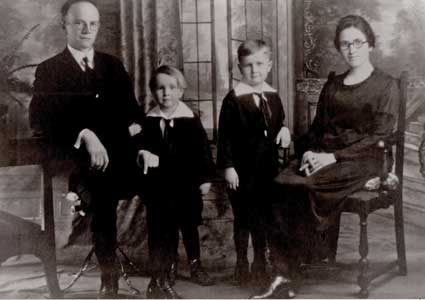
Kreider was born Jan. 2, 1919, to the farm and pastorate family of the late Amos (Ebersole) and Stella (Shoemaker) Kreider in Sterling, Ill. It was within the safe cocoon of a loving family and congregation—Science Ridge Mennonite Church—that he was nurtured as the eldest child of the family that 19 months later welcomed Gerald into its fold. The family moved to Goshen, Ind., in 1921 so his father could teach at Goshen College. Buffeted by church tensions, the college closed in 1923-1924.
“It was a daunting task for a separatist, top-down Mennonite establishment, most of whose leaders were limited in formal education, to redefine patterns of church life threatened by bewildering changes,” Kreider writes in his first autobiography, My Early Years (Pandora Press with Herald Press, 2003, $12.95).
His father commuted to teach at Witmarsum Theological Seminary at Bluffton and during the year of Goshen’s closing served as pastor at College Mennonite Church in Goshen. The family, remaining Old Mennonite, moved to Bluffton in 1926.
With the closing of the seminary in 1931, his father was invited to become pastor at First Mennonite Church. Robert’s parents then became General Conference. In 1935, when Robert graduated from high school, the family moved to North Newton, where his father accepted a professorship at Bethel College and where Robert enrolled as a freshman.
“These were all warm and stimulating church experiences in three or four different stages,” Kreider says. “Though the Goshen years were full of stress and strain for my father, I still have good memories of our neighborhood on South Eighth Street and our church home at the college.
“When we came to Bluffton, I experienced a fascinating world of Mennonite diversity, a community of Swiss Mennonites sprinkled with families of Russian, Old Mennonite and other ethnic backgrounds. At First Mennonite, there were stained-glass windows, an organ, a bell, German services once a month, a Sunday school orchestra, all kinds of modernity I had not known before.”
Venturing from the Mennonite web into the wider world
It was this formational web of varied Anabaptist groups that prepared Kreider, who graduated in 1939 from Bethel at 20 with a history degree, to launch into the wider world and church. In 1941, he graduated with a master’s degree in history from the University of Chicago. He then was conscripted as a conscientious objector to serve at the Colorado Springs (Colo.) CPS camp, where he was appointed assistant director and educational director, the first such appointments of draftees. In 1942, he began coordinating educational programs for MCC-CPS camps and in 1944 was appointed director of the 26 CPS mental hospital units of MCC.
At war’s end in 1945, he and Lois Sommer, a Bluffton graduate in home economics, were married after an eight-month courtship. They served in postwar Europe from 1946 through 1949, where he was director of MCC relief work, first in Germany, then throughout Europe. Lois planned child feeding programs for 5,000 children at Kiel, Germany. Later she served as hostess of the MCC center in Basel, Germany. In that era, the church called young adults like the Kreiders and other couples they worked with in Europe—Atlee and Winifred Beechy and Peter and Elfreda Dyck—into responsible roles.
“It had been expected that the church could get enough pastors and church leaders to staff CPS camps,” Robert says, “but the demands were so great … it became necessary to risk with younger, more inexperienced men.
“I remember some reticence on my part, but I never forgot what the late Orie Miller told me when, as a deliberating 22-year-old, I was asked to take a staff appointment. He said, ‘When the church asks you to serve, let your answer be yes unless there is a good reason to say no.’
“The Europe years were some of the most intense and shaping of my whole life. In 1946 and 1947, MCC ranked first among private agencies shipping relief supplies to Germany. I recall negotiating with military authorities on behalf of Mennonite refugees stranded in Berlin, going all the way up to the U.S. commanding general in Berlin. … And then to be solidly backed by Akron leadership with ships for emigration, funds and commitment. The way Orie Miller undergirded young people in their 20s and 30s was unique in Mennonite history.”
With many others, the Kreiders etched a lasting mark on the Mennonite timeline. But the couple’s work was far from done. They began raising a family of five children (their first baby, Ruth Marie, died) as Robert began as history professor at Bluffton in 1952 and completed his doctoral work in history in 1953 at the University of Chicago.
During the Bluffton years, the couple forged a strong family life in the midst of Robert’s intense responsibilities. Lois kept a steady hand on the rudder of the home life in the house they built on the banks of Riley Creek while maintaining an active role in church and community life.
In the 1960s, she gave leadership to a Girl Scout troop and annual sales for MCC Self Help. In 1974, she and colleagues launched the Bluffton MCC thrift-Self Help (Ten Thousand Villages) shop—the first in the United States, and when they moved to Kansas, she helped establish a similar shop in Newton. Soon she was traveling for MCC to help establish 100 such shops in the United States and Canada, which in 2011 generated $13 million for MCC.
“Lois’ special contribution to our family was her ability to live simply, her tidy sense of economy, her generosity,” Robert says. “She worked with limited financial resources to take care of the children and to host a flow of college guests.”
The family experienced a reprieve from the daily grind when in 1970-1971 they traveled as campers for six months around the Mediterranean on Kreider’s sabbatical leave. They visited MCC units, lived for a month in Jerusalem, visited
Cappadocia, where Lois’ mother had been a missionary educator on the eve of World War I, penetrated the Sahara and set foot in 11 countries. The entourage that traveled in a VW bus included the couple and their five children, ranging in age from 9 to 19. It was an adventure of great impact, said son David during the family interview in North Newton last fall. The fourth of five children, his other siblings are, in birth order, Esther, Joan, Karen and Ruth Elinor, his younger sister.
“I’ll never forget as a sixth grader seeing the wall in the MCC house in east Jerusalem and the shell marks left in it from the Six-Day War, or standing next to no-man’s land, cleared of rubble, on the division between Israel and Jordan,” he said.
Robert and Lois moved to North Newton, with their two youngest in 1975, when Robert was invited by Bethel to teach peace studies and direct the Mennonite Library and Archives. In 1978, he became interim dean, then vice president of Bethel in 1984, after he retired from the faculty.
Reaping riches of community, family in twilight years
In their retirement decades, their schedules have overflowed. Robert has written books, traveled for Mennonite World Conference and MCC, curated museum exhibits, critiqued manuscripts submitted by scholars, taught Sunday school class and engaged in diverse causes. Lois, involved in the MCC gift-shop movement, has volunteered in a variety of church programs.
They took each of their adult children on a major overseas trip with an eye for remote places: the Arctic tundra of Alaska, the southern tip of New Zealand, the Orkney Islands in the North Sea. Even with all the wealth of their experiences, it is the riches of loving relationships they enjoy with their family that they count as most precious, they say. In 1978, they moved to a farmstead with a barn, garden and chickens in North Newton; in 2003, it became a multigenerational household when their son’s family moved into the main house and built an apartment for them on the north end.
“We’ve been incredibly blessed with our children,” Robert says. “And now with all the grandchildren, and two great-grandsons, those institutional years dwarf in comparison.”
Lois says: “There has been so much that has been providential on our journey. … There has always been a sense of leading and naturalness in the context of community.”
Today this community is filled with people much younger than they who have much to gain from the riches of their lives, says John Sharp, professor of history at Hesston (Kan.) College.
“The Kreiders and their contemporaries are keepers of our corporate memory, and their memory enriches us, informs us, guides us and corrects us—if we pay attention,” Sharp says. “Their stories become ours and become useful when we become stewards of that memory. … A people and a church without a memory is rootless and rudderless, and for that reason, Robert and Lois are such gifts to us.”
Laurie Oswald Robinson is a free-lance writer in Newton, Kan., and the author of Forever Family.


Have a comment on this story? Write to the editors. Include your full name, city and state. Selected comments will be edited for publication in print or online.