


Marilyn Miller’s fulfilled pastoral longing empowers other women pioneers.
When Marilyn Miller—one of the first women to be ordained in the Mennonite church—heard pleas in her childhood congregation in the 1940s for men to seek the pastorate, she asked God why she hadn’t been created a male so she could answer that call.
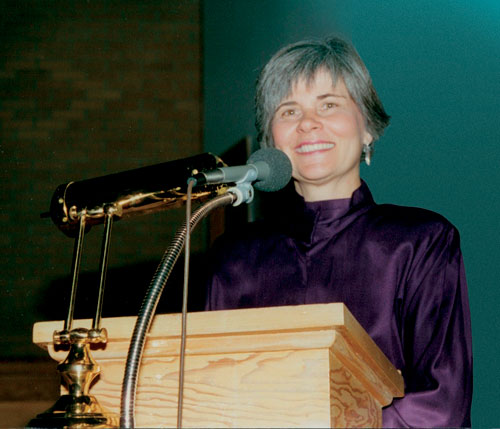
Decades later, that longing led her into seminary and the pastorate—a place once reserved for men—and her example lit the path for other female trailblazers. Because they were faithful to the call, it’s unlikely girls today pray like the 10-year-old Miller, listening for God beneath a silent prairie sky.
“A speaker at Hesston (Kan.) Mennonite Church encouraged the congregation—because of a shortage of pastors in the former Mennonite Church (MC)—to pray that God would open more young men’s hearts for the ministry,” said 76-year-old Miller during a Jan. 20 interview at her home in Boulder, Colo., where she lives with Maurice, her husband.
“After that service, I went into our backyard and looked up at the sky and said, ‘God, if you needed pastors so bad, why didn’t you make me a man?’ … I loved reading the Bible and would often preach to the chickens after my siblings got tired of me preaching to them.”
She would preach, study the Bible, counsel and pray for others—all without pay—if God would just give her the opportunity. When she dated Maurice at Bethel College in North Newton, Kan., she asked him if he was interested in being a pastor or a missionary, because that would allow her to be in ministry, too.
“He said he felt called to be neither, and if that was what I wanted, I would have to marry another man.” In the end, they got married, and it has been a good and complimentary fit, she said. “Maurice has a gentle strength and has been encouraging and supportive of my ministry.”

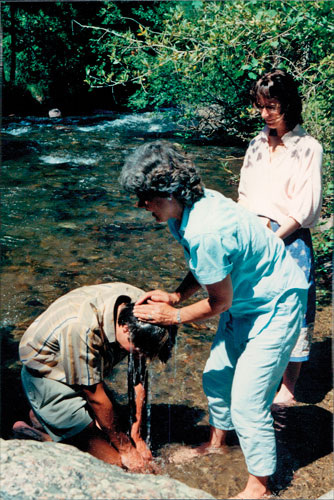
After they married in 1958, she finished her bachelor’s degree in elementary education and he received a bachelor’s and master’s degree in city planning. It was more than a decade later—after several elementary teaching jobs, giving birth to four children and a move from Wichita, Kan., to Colorado—that her desire fully flowered.
In 1976, after she earned a Master of Divinity degree at Iliff School of Theology in Denver, Western District Conference (WDC) ordained her as co-pastor to serve with the late Peter Ediger at Arvada (Colo.) Mennonite Church. She served there nine years part-time before she was called as WDC’s first female church planter to start Boulder (Colo.) Mennonite Church, where she pastored for five years.
She left congregational ministry for a church-wide focus in 1989. She served with the former Commission on Home Ministries, a ministry of the former General Conference Mennonite Church (GC) that included work in evangelism, church planting and peace. After 12 years in that role, Miller, who holds a Doctor of Ministry degree, served as associate conference minister for WDC congregations in Colorado. In 2004, she retired from formal ministry.
“I stayed home with our small children for nine years,” she said. “But when our youngest was getting preschool age, I felt restless. … I was active at Lorraine Avenue Mennonite Church [in Wichita] in such things as a neighborhood after school Bible program and a women’s prayer group, but I felt there was something more.”
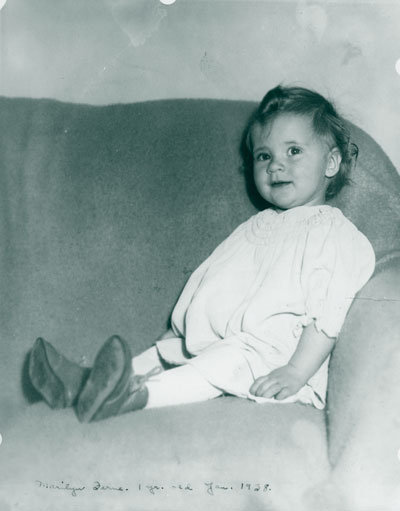
Marilyn said she asked Walt Friesen what she needed to do to teach religion, and he said, “Go to seminary.” The closest seminary at that time was in Denver, and she knew there was no way. “One morning,” she said, “I knelt by my bed and told God that when all the children were in school I wanted to do something else besides homemaking. … I said I would do anything and go anywhere if God would just lead me. … I sensed God said, Don’t worry, just keep doing what you are doing, and when I want you somewhere else, you will know it.”
That very evening, Maurice said he’d just been asked to move to Denver to open a new consulting, planning office. It was painful to uproot their lives in 1972 from Kansas, where both sets of parents lived, but they felt God moving them west.
Seal of exclusivity loosens
Three years later, she became the first GC woman to be ordained in current memory. The ordination of Ann Jemima Allebach in 1911 predated the journeys of Miller and Emma Richards. Six decades earlier, Allebach’s ordination at First Mennonite Church of Philadelphia never received the support of Eastern District Conference. And she never pastored a Mennonite congregation. Richards was the first woman in the former Mennonite Church (MC) to be ordained, in 1973 by Illinois Mennonite Conference.
After Miller and Richards pushed through once-barred entries, the door for women opened wider—though still only a “crack” in many quarters. But enough “firsts” ensued by the mid-1980s that the tight seal of exclusivity was loosened. According to the Mennonite Church Yearbook, by 1987, the GCs had licensed or ordained 66 women as pastors. By 1988, the MCs had done the same for 62 women.
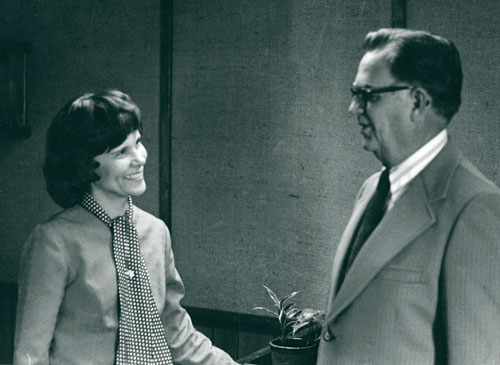
“I was really surprised when I actually got a job as a pastor in a congregation,” Miller said. “I told my professors at Iliff that the only thing Mennonite women are paid to do in churches is secretarial or janitorial work and that I didn’t expect to get a job … but had come to seminary because I was so hungry to learn.”
She attributed the answer to prayers for a pastorate to the deep openness and affirmation of WDC. “WDC and congregations like Arvada—[which] employed me as their first female pastor—believed that equality and inclusiveness were important in an era when many other regions and congregations did not,” she said.
Miller suffered with pastorate-ready women who found no pastorates. She remembers how at one meeting a man described female pastors as wolves in sheep’s clothing. Theological disagreement sometimes came from family, as was the case with her mother, the late Clara (Fricke) Kauffman.
“At the sharing time before my ordination, Mother stood and held up her Bible and said, ‘Marilyn has my blessing, but I still believe that a woman’s role is to be a helpmate for her husband.’ I told her that for someone who didn’t believe in females preaching, she did a great job.”
But Miller still felt loved by her and was grateful that they gave each other freedom to be who God called them to be. Her father [the late Milo Kauffman] was a different story. “When someone asked him if he heard that a woman was going to preach at a Mennonite college graduation, he said, ‘Yes, I know—she’s my daughter. … Like Peter in the Bible, who am I to fight against the Spirit?’ ”
Miller rejoices that the door of opportunity has been flung wide open in many sectors of Mennonite Church USA. Women today are not only lead pastors but seminary presidents and churchwide ministry leaders. Several of the many women who joined Miller and Richards in paving the way into this new world were Patty Shelly, Lois Barrett and Dorothy Nickel Friesen, all ordained in 1985.
“The news about Marilyn was affirming in light of my being advised not to go to seminary,” says Friesen, a retired pastor, assistant dean at Anabaptist Mennonite Biblical Seminary and WDC conference minister. “The message was, After all, what are you going to do with a Master of Divinity degree, since women do not get jobs as pastors?
“In those days, at every turn, we were studying and discussing the role of women in leadership and the image of God. … We realized we had missed part of the gospel by silencing women. … Theologically, biblically and practically we needed a new vision.
“Yet we can’t suggest all the men were the problem and all the women were the answer. … Strong male leadership also paved the way. … We need to strive for a collaborative and inclusive gender community.”
John Esau, former GC director of ministerial leadership from 1985 through 1999, says the inclusion of women in pastoral ministry was well under way by the time he took the job. This new reality resonated with his longtime views that women brought many gifts to ministry.
“Women have moved the church from the domination of male leadership; they have also brought valuable new perceptions of substance and style,” he says. “Despite the resistance from biblical literalists and the habits of tradition, the church has responded positively. … We have all been enriched by the perspective that women bring to ministry.”
Valuing models, balancing life
Miller’s joyful perseverance seems linked to the values of love of God, community and service imparted to her as the eldest daughter of 10 children born to the Kauffmans. Her father served as president of Hesston (Kan.) College for 19 years and as a pastor and conference minister in South Central Conference. Her mother felt strongly about being keeper of hearth and home and gave undivided attention to her children.
Miller imbibed the modeling of both parents and has sought a healthy—though often elusive—balance between her Mary and Martha, her being and doing, sides.
“My father gave his whole self to the church, and my mother gave herself totally to the family, and so I grew up knowing it was important to be wholehearted in whatever you did,” she said. “I’ve struggled all my life with wanting to be a great homemaker and give to those close to me, like my mother, and a church worker and give to the world, like my father.
“At different seasons of my life, I’ve moved closer to one end of the continuum than the other, and I have some regrets about not always achieving a healthy balance. But I’ve learned what is most important is to be who I really am and not what others want me to be.”
Though she’s gained much on her pilgrimage, she’s learned that it is her losses—in both her family of origin and her own family—that have shaped her ministry with compassion, empathy and a desire to be real about death. Her older brother died of a brain tumor his last year of medical school. Her baby brother, with Down’s Syndrome, died just before he turned 2.
“When my mother wanted to bring him up for dedication, she was told she could not bring a blemished lamb to the altar,” Miller said. “But as all the little ‘normal’ kids were blessed, my mother’s tears fell on my brother’s face and he looked up at her and smiled.
“My mother’s unconditional love for all her kids, whether it was my physician brother or this special needs son, taught me about the importance of loving and including all others and striving to make that happen in whatever place of the church I am called to be.”
Miller had a miscarriage and delivered a stillborn child before she gave birth to her other three children—Michael, Michelle and Monica. On Mother’s Day 1996, she lost 32-year-old Michael in a kayaking tragedy.
“About 7 p.m. on that Mother’s Day, the phone rang, and I thought Michael was calling to wish me a happy Mother’s Day,” she said. “Instead, it was the sheriff, telling me that our son had been in a kayaking accident on the Animas River near Durango, and his body had not been found. … That was one of the worst moments of my life. I suddenly knew what people meant when they talked about a broken heart.
“There is anger in loss and death. … We quell this powerful emotion by saying, ‘They are in a better place, and God knows best.’ Instead, we need to help each other lament as they did in the Old Testament. … When we are open to lament, we also open ourselves to the praise that comes from an honest release.”
Sharing an unvarnished and beloved self with other unvarnished and beloved creatures of God is the heartbeat of Miller today. Hers is not a “retirement” but a resting in the joy of living a less structured life that still includes much lay ministry. She has more time to enjoy and nurture her children and five grandchildren and revel in nature with Maurice, who spent 21 years working for The U.S. National Park Service. She also expresses her love of cooking and healthy food in a homeless ministry at Boulder Mennonite.
Her elusive balance has found a centered rhythm. Miller is grateful God brought her through the pioneering and pain to a homestead of the heart that still searches the sky for the next calling of love.
“The older I get, the more I realize that life is simpler than we make it,” she said. “We don’t need to fix others or ourselves. … I used to read so many books on how to show care, but what it comes down to in the end for me is just listening to others and accepting their life stories, including the parts I don’t get.
“When we truly love others, we can disagree and remain present to each other in grace. Real love allows you to speak your truth and me to speak mine, and we both are respected. I may be right about some things, and you may be right about others. The goal is to learn from each other and grow in love and truth. ”
Laurie Oswald Robinson is a free-lance writer in Newton, Kan., and the author of Forever Family.


Have a comment on this story? Write to the editors. Include your full name, city and state. Selected comments will be edited for publication in print or online.