



How a dyed-in-the-wool Catholic came to feel comfortable and welcomed in a Mennonite community
Historians of immigration often identify “push” and “pull” factors when trying to explain an individual or group’s decision to pick up and go as well as their choice of destination. This helps explain what led me to knock on Mennonite doors. While my experience has been unique in many ways, I would be surprised if it didn’t share at least some similarities with others’ experiences—I’m not that weird. Perhaps our community might find ways to engage others in similar circumstances.
 While we may not have control over what pushes people out of other faith traditions, we can better understand and walk with people facing these circumstances if we listen to each other’s stories. The goal is to find a way to be authentic without being insular and inviting without selling out.
Before I go on, understand that I am not an expert on anything religious. I know only the basics about Mennonite faith and history. Also, my faith is in serious crisis. In 2008, my mother lost a brief, intense battle with colon cancer. The diagnosis was unexpected, and the illness ravaged her body and her mind in a matter of months. As I helped my mother during her last weeks, I saw things I wish I hadn’t seen, things that brought my faith tumbling down. I know most children will experience the death of their parents and that it’s hard, but I was not prepared for this. And I sense that many people around me wish I would just get over it already and move on. But watching my mother die in such a horrific manner exploded my worldview. I am not the same person, and I may never be. I am painfully in limbo.
I say this not to garner your sympathy but to make clear that anything I say when it comes to faith should be taken with a whole shaker full of salt. I’m no longer a Roman Catholic but can’t help but think of myself as Catholic in many ways. I worship with a Mennonite congregation but don’t consider myself Mennonite in the ways outlined by Confession of Faith in a Mennonite Perspective. The bitterness brought on by my mother’s death prevents me from identifying myself as a seeker, but I did change religious communities. So I am in a weird place—stuck between past and present, between frustration and longing.
Nevertheless, in the last eight years I have found a wonderful sense of place and belonging among Mennonites. As I began to walk with Mennonites, I found I could explore new issues and test old assumptions—the key to a good religious life. I found also that I could keep some of my Catholic heritage I still held dear.
My gravitation toward community with Mennonites was in large part due to being pushed out of the Catholic Church. My reservations about some of its practices and behavior eventually forced me to make a decision. I still believe the Catholic Church to be a wonderful institution and faith practice. It does infinitely more good than harm, and I will never regret having grown up in that church. For better or worse, I am who I am in large part because of the Catholic Church. Leaving it is the hardest decision I’ve ever made—I can’t overstate how hard it was.

 One reason it was hard is that I felt like a wimp for leaving. Faith is supposed to be a struggle, and religious observance is supposed to be challenging, so giving up on the Catholic Church felt like a copout. I could do Lenten fasting. I could do dozens of rosaries. I could kneel at length on hard floors. But I couldn’t hack remaining in the church. To what extent should people suppress feelings fundamental to their being for the sake of maintaining a religious identity? How do we live our faith with integrity? Are we obligated to work within our faith for change no matter what? Is giving up ever justified? For years I had grown increasingly frustrated with the Catholic Church’s refusal to recognize women as equal to men. I had also become frustrated with its seeming to put its temporal identity over its spiritual tenets, as I felt was the case with the pedophilia scandal. And having researched an aspect of the Catholic peace movement for my dissertation, I was frustrated by how radical Catholic peacemaking was—that is, how out of the ordinary it was. I wanted my church to—as an institution—be bolder about peacemaking. I was fed up with how the Catholic Church could be so unequivocal when it came to the issue of abortion but endlessly split hairs when it came to war.
So I’d go to Mass and stew. As I watched the all-male clergy lead Mass, I had this vigorous internal dialogue: Was I to give up feminism as a life philosophy—one that for me at least is rooted in Christ’s teaching—to remain in concert with the Catholic Church’s position on women? How was I going to explain to my daughter that women could never be priests? Was I supposed to root for “my team” when the Catholic Church chose litigation over radical reconciliation in the priest sex scandal? Was I to continue publicly praying for our troops upon request—a request that happened almost every time I went to Mass—and simply pray silently for the victims of war? Was worship even worship if you ended up angry when you left Mass?
Two other reasons leaving the Catholic Church was so hard were that I believed in hell and my mother was a super-Catholic. If one believes in hell and is a member of a church that proclaims itself the “one true Church,” then leaving has to earn you an instant invite to the fiery party down below. Growing up Catholic, about the only thing I believed with confidence was that hell existed.
But even more prohibitive than the prospect of eternal damnation in the molten pits of hell was the hurt I knew I would cause my mother if I left. Before she married my father, she was a Sister of Mercy. She left the convent on good terms to marry my father and raised four daughters in the Catholic Church. We attended church like clockwork; I never remember missing Mass, not even for illness, and it wasn’t for lack of trying. My mother gave to the church, taught at Catholic schools and eagerly saw to the religious education of her daughters. She was hardcore. Leaving the church would crush her. How could I do that to her?
And I didn’t want to leave. I loved the church and felt at home in Catholic churches.
Anywhere I went—Europe, South Africa, Tennessee—I could walk into a Catholic Church and understand what was going on. I cherished the visual feast that is most Catholic churches. Their statues and stained glass, their mosaics and textiles, their chalices and vestments taught me about the Bible, imbued in me a reverence for tradition and served as clear evidence of the transcendent in this temporal world. Perhaps above all, I loved the ritual that is Catholic practice. I loved how the Catholic faith walked me slowly through the year, encouraged me to anticipate, how it celebrated the drama of Christmas and Easter with a quiet, humble, purgative buildup. I loved the ritual so much that I used to go to Mass daily—eagerly awaiting my lunch hour when I worked at the University of Notre Dame so that I could bike over to Sacred Heart Basilica and share the quickest of masses with 10 strangers. Daily Mass reminded me that my life was paltry compared with the life of the Mass. In that big, almost empty basilica, I was drenched in otherworldly beauty and inevitably thought about the wonder of creation.
So I found myself seriously conflicted about what to do. Had it not been for the beauty of the Mennonite community around me, I would have simply slipped into that nebulous state known as lapsed Catholicism. I had been around other religious communities—I taught at a Southern Baptist college in Arizona and hadn’t been tempted away from my Catholicism. I never felt as if I wanted to “shop around” to find another faith, even as I was growing frustrated with my own church. I figured I’d just practice my faith on my own. But encountering Mennonite faith and practice offered me a beautiful alternative—one that seemed to incorporate some of the beauty of my own tradition but also stressed things I felt were lacking in my own church life. The Mennonites I encountered—I’ll call them “my Mennos”—welcomed me as I was, offering me an opportunity to find ways to follow Christ that felt genuine and meaningful.
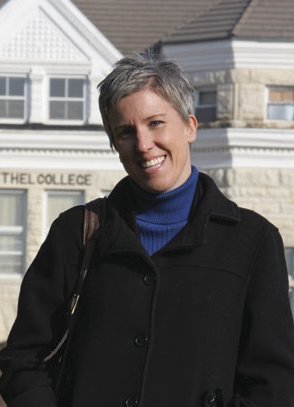
 One of the strongest pull factors into Mennonite community for me—and this may seem shallow, but oh well—was the singing. When I came to Bethel College (North Newton, Kan.), I remember hearing four-part singing for the first time. I’ll never forget that moment—standing on the steps of the administration building at Bethel at the end of a day of faculty retreat and hearing my colleagues break into song before a meal. I was stunned. The singing was breathtaking to me. It took a good deal of willpower not to let the tears that had welled up in my eyes roll down my cheeks. I remember thinking, Good God, what is this place? I had never heard people spontaneously engage in four-part singing before, particularly not in church. Catholics aren’t really known for their singing—although there’s a truckload of great, transcendent music we owe to Catholics. While my Mennos are sadly lacking in transcendent visual aids—my church is taupe. I love taupe, but come on!—Mennonite singing is wonderfully transcendent. If I was going to make the leap from Catholic to something else, that something else would have to meet my needs for transcendence in the absence of the Catholic visual tradition. Mennonite singing filled that void almost completely.
There was—there is—lots of singing at Bethel College. As I navigated through my first few years at Bethel, I began to understand that the singing I heard was simply a reflection of the community’s values, and those values were rooted in Mennonite faith and practice.
I know this is not a new observation, but four-part singing beautifully models Christian community. It requires cooperation, love, acceptance of difference and humility. It requires us to admit we need each other, are better in community and that difference doesn’t need to mean discord but can actually produce harmony. My encounter with Mennonite singing seemed to me like a glimpse of what Christians might expect in heaven—lots of different people and cultures getting along and singing well together.
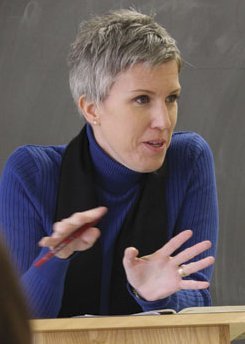
The singing at Bethel was just one aspect of a larger practice of Mennonite hospitality I encountered. Just as four-part singing requires a group and individuals to welcome others who sing different parts, my Mennos at Bethel practiced these values in nonsinging contexts. If you’ve ever been to Bethel, you know it is an amazingly hospitable place. I felt immediately at home there—even as a non-Mennonite feminist Catholic military brat from Arizona. I felt as if I’d known the people I met during my interview for years. My Mennos welcomed me with food—always the food—and conversation. But more than that, they seemed genuinely interested in my perspective as a Catholic and welcomed religious dialogue. From the get go I was invited to speak—often from a Catholic perspective—in chapel and at convocation. I was invited to teach the senior-level religion course at Bethel—Basic Issues of Faith and Life. Me.
My Mennos worked hard to make those who were different feel comfortable. Bethel’s chapel services embody this ethic of hospitality. Chapel routinely incorporated meaningful rites from Judaism, Islam and Catholicism, encouraging the community to explore faith from a host of directions. Even as I felt increasingly uncomfortable with my own faith, I never felt that my Catholic identity was something I had to hide in chapel. What this type of hospitality told me is that my Mennos practiced what Jesus preached. They were open to the possibility that truth might not necessarily come only in the form of zwiebach and verenike, but taste more like chana Punjabi or even a grilled cheese sandwich. My Mennos embraced the grilled cheese sandwich because they knew it was part of creation and might open up new channels of observation and understanding. This form of hospitality benefited everyone involved—it welcomed outsiders as Christ—though I think Christ would have been fat as a house had he been welcomed by my Mennos—and it provided the community another lens through which to search for truth.
This welcoming of difference—welcoming in general—is tied to what my Mennos routinely refer to as “discernment.” When I first heard this term, I didn’t know what to think. I’d been raised in educational environments that valued critical thinking, but you might say that my religious practice was less about discernment and more about discipline. For example, I once attended the investment of a new pastor at my Catholic Church in Newton. The ritual called for the new pastor to answer questions asked by the bishop in the affirmative. One question in particular shocked me. The bishop said, as I recall, “Do you promise to uphold and fulfill the teachings of the Church without question?” Without question? Everything I had been taught in school and everything I preached in my professional life placed high value on thinking critically, carefully and methodically analyzing the truthfulness of statements and not taking things at face value. Yet here was the bishop expecting the pastor to not question the Church’s teaching. Increasingly I felt that if those teachings and traditions were so right on, what was the harm in subjecting them to a little scrutiny?
But my Mennos had no trouble scrutinizing things—just go to a faculty meeting at Bethel and you’ll see what I mean. This practice of discernment seemed to solve one of the major issues I had with the Catholic Church. Discernment has to do with judging the veracity of something, working toward insight, determining the truthfulness of any given statement. I loved that these Mennonites were Christians who seemed to openly admit that they didn’t necessarily have the final say on anything—be it the Bible, the position of women in the church, the morality of homosexuality, anything. The humility involved in that was like a breath of fresh air. It also felt so entirely genuine to me because even as a Catholic, I never felt comfortable making truly definitive statements about matters of faith. After all, it’s faith. We can’t know for sure. For me, who at the time felt rudderless when it came to faith, the practice of discernment was not simply an admission that no one has all the answers; it was an invitation to join others in seeking answers anyway.
My Mennos’ process of discernment, I learned, was intimately tied to the congregational, free-church nature of Mennonite communities. Unlike the clear chain of command in the Catholic Church, Mennonites had to figure things out for themselves. This was a discipline just as rigorous as the various forms of discipline I loved in the Catholic Church.
I would be eating lunch with my mostly-Menno colleagues at Bethel and listen to how their congregations were struggling with difficult issues and that the process was sticky and messy and heartbreaking, but it was a process. There was no foregone conclusion. I found this beautiful.
My colleagues at Bethel were among the primary reasons I gravitated toward Shalom Mennonite Church in Newton. Early in my career I became aware that Bethel had a reputation as the “liberal” Mennonite college, which I think is code for secular humanist. But this reputation is unwarranted. My colleagues at Bethel were inspiring models of Christian love and service. I learned that many of my favorite colleagues, such as John McCabe-Juhnke, attended this church called Shalom. Right off the bat, I liked the name. It was an ambiguous term that suggested love, peace, welcoming and an interest in things international. I knew John volunteered and experimented with prison theater. I knew that another colleague, Merle Schlabaugh, attended Shalom and headed up Amnesty International at Bethel. I thought, If these giving people all go to Shalom, it must be a special place. So one of the draws into a Mennonite congregation for me was not blatant evangelizing or even an ice cream social (although that’s a start) but the unconscious modeling of love I witnessed in my colleagues at Bethel.
I decided that it was time to check Shalom out. I attended my first worship there more than four years ago. I don’t remember too many specifics about it, but I was entranced by pastor Eric Massanari’s sermon. I felt energized and challenged when I left worship—a big change from what my post-Mass state of mind had been for the previous few years. It was a wonderful combination of intellectual inquiry and heartfelt searching. His sermons were often timely—incorporating current events and contemporary cultural references—and suggested that faith was practiced among the living and in the moment. They also incorporated exegesis and historical analysis to reveal the reading as part of a tradition. Over the next few years, Eric delivered sermon after sermon that challenged me and my husband to think about difficult issues—the meaning of Sabbath, the lure and the lie of materialism, the cause of peacemaking, the challenge of living amid difference. His measured, soft-spoken style could be calming and reassuring but also contain admonishments to more fully practice the more difficult aspects of hospitality. Like the rest of worship, Eric’s sermons, along with the sermons of associate pastor Sara Dick, were often inventive, again embracing different traditions and genres to move the message from pulpit to pew. I appreciated their energy and how much effort they put in crafting good, meaningful sermons. But I most appreciated that these weren’t pastors who simply toted the party line—their sermons were full of searching and questions and were beautiful.
One of the weirdest parts of that first worship meeting was “sharing time.” This was something new for me—the congregants were actually invited to stand up and share their joys and concerns and their thoughts on the day’s sermon. This was, to use a current figure of speech, whack! As the famed Catholic journalist John Cogley once noted, Catholic worship is a pulpit tradition, a one-way conversation. Catholics don’t “dialogue” during Mass. But my Mennos were discerning right there in public in front of everyone; they had their discernment hanging out all over the place. More than that, they were practicing hospitality without food. They were inviting others to share their perspectives. It was remarkable, even if it was a bit frightening. I was used to being anonymous at Mass—and that’s not always a bad thing. But now I was in a church where people knew my name and hoped I would be comfortable sharing about my life. This was crazy new to me.
But with all the newness I experienced during those first few worship meetings, I also found many familiar and therefore comforting elements in Shalom’s worship. The singing, while not like Catholic singing, was rooted in a long tradition, and Catholics are big on tradition. There was an organ; that was good. There were candles—excellent. There was a recognizable and fairly consistent flow to worship. While there wasn’t the march of sit, kneel, stand, that I had known from the Catholic Church, there was some consistency in worship from Sunday to Sunday. Over time, Shalom even instituted a processional that helped center people at the beginning of worship and that looked and felt much like the beginning of a Catholic Mass. These familiar elements helped me make the transition without too much homesickness. I’m wondering if we might be well advised to ask people in transition who are exploring our congregations what elements they find similar or new from their previous practice. For me, the familiar elements suggested I was continuing on a journey instead of abruptly ending one trip and taking a drastic, jarring turn on to something else.
Before choosing to attend regularly, I met with Eric and shared how I was feeling. I told him I didn’t share all of the beliefs outlined in the confession of faith and that I still held dearly to many tenets of Catholic belief and practice. I also inquired if my husband, a nonbeliever, would be welcome at Shalom. Eric assured me that we were both welcome. He noted that Shalom was a church full of people, many of whom had shifted in their faith, many had been wounded by their religious upbringings, and the congregation as a whole was all over the map in terms of where people were on their Christian journey. I would not be required to mark off all the boxes on the Mennonite checklist; I need not learn the secret Mennonite handshake or get the Mennonite tattoo in order to attend. In short, I was welcome as I was.
Before I close, here is one of the most moving examples of how I was welcomed as I was into my Mennonite community. It occurred when I was scheduled to a have a disk replaced in my neck a few years ago. The surgery is pretty gruesome and carries some risk that your carotid artery might get nicked. I’m not a doctor, but my sense is that the carotid artery is a pretty important one and that nicking it is not advisable. I was scared. I felt I had to prepare for the worst, and my upbringing taught me that that preparation needed to include confession.
So I approached Eric and asked if he would hear my confession as a priest would have done in a Catholic setting. If Eric was uncomfortable with this request, he never let on but immediately agreed to participate. To this day I tear up when I think of how difficult and moving that confession was and how Eric prayed with and over me. I went into surgery with wracked nerves but a calm soul. Eric had allowed me to find ways to draw upon the best of my tradition, but in a context that now felt more genuine. I found myself confessing things to Eric that I would have not been able to confess to a priest. I confessed things I had walked around with for decades and felt a sense of relief after. Eric was more approachable than any priest I had ever met. He was like the rest of his congregants—walking and searching. That was a beautiful experience for me, and I remember thinking, I’ve found a good place.
Dale Schrag, director of church relations at Bethel, likes to tell anyone who will listen that Mennonites believe that when Christ spoke, he was talking to us—to you, me, that smelly guy sitting next to you. My Mennos seem to take Christ seriously. They don’t always succeed, but they seem conscious of the task in front of them. They read about Christ’s radical hospitality and seek to put that into practice. They hear Christ boldly telling it like it is but also gently teaching those around him, and they seem prepared to do the same when it comes to a host of issues, not the least of which are war and injustice. They see Christ simultaneously embrace tradition and venture into new territory, and as a result they cultivate a worship meeting that reaches out, in, back and forward, even as it is rooted in the moment. But most importantly, just as Christ walked everywhere—back and forth across the Holy Land—my Mennos are a people on a journey, and they have been nice enough to invite me along.
Penelope Adams Moon is associate professor of history at Bethel College, North Newton, Kan. This article is adapted from a seminar she gave at Mennonite Church USA Convention 2009 in Columbus, Ohio, last summer.


Have a comment on this story? Write to the editors. Include your full name, city and state. Selected comments will be edited for publication in print or online.