


Miscellany: Items of interest from the broader church and world
Mennonites in Paraguay find themselves in the midst of a controversy over deforestation in the Chaco region of the country. As Simon Romero writes in the March 24 issue of the New York Times: “Huge tracts of the Chaco are being razed in a scramble into one of South America’s most remote corners by cattle ranchers from Brazil, Paraguay’s giant neighbor, and German-speaking Mennonites, descendants of colonists who arrived here nearly a century ago and work as farmers and ranchers.”
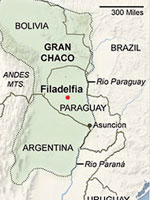
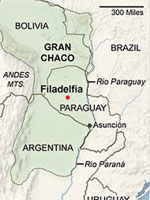 The Chaco thorn forest, often called “the green hell,” covers an area roughly the size of Poland. Mennonites, who first arrived in the 1920s, having left starvation in Russia, settled in this area and tamed part of this wilderness in order to grow crops and raise livestock. They created communities such as Filadelfia, Neuland, Friedensfeld and Neu-Halbstadt.
As a result of the Mennonites’ hard work over the decades, they have experienced a degree of prosperity. They have also developed relationships with indigenous tribes, and many of these people have become Christians. See Garden in the Wilderness: Mennonite Communities in the Paraguayan Chaco 1927-1997 by Edgar Stoesz and Muriel T. Stackley (CMBC Publications, 1999) and Like a Mustard Seed: Mennonites in Paraguay by Edgar Stoesz (Herald Press, 2003).
Now that developers are destroying huge tracts of land in the Chaco in order to make room for vast herds of cattle, environmentalists and anthropologists are expressing alarm about the destruction of endangered plant and animal life.
“Scientists fear that the expansion of cattle ranching could wipe out what is a beguiling frontier for the discovery of new species,” writes Romero. There is also concern for “the Chaco’s indigenous peoples, who number in the thousands and have been grappling for decades with forays by foreign missionaries, the rising clout of the Mennonites and infighting among different tribes.”
José Luis Casaccia, a prosecutor and former environment minister, has been outspoken and active in opposing this destruction. “If we continue with this insanity,” he says, “nearly all of the Chaco’s forests could be destroyed within 30 years.”

One group of hunter-gatherers, the Ayoreo, is under particular stress from the changes. They have felt hounded by bulldozers. Their word for bulldozer, “eapajocacade,” means “attackers of the world.”
While the Mennonite communities are the focus of attention in this destruction, “they deny that they are to blame, contending that they abide by Paraguayan law, which requires landowners to keep a quarter of Chaco properties forested,” writes Romero.
The greater amount of development is being carried out by Brazilian landowners.
Tranquilo Favero, a Brazilian soybean farmer and rancher who is one of Paraguay’s richest men, controls an estimated 615,000 acres of land in the Chaco.
One rancher says “there are now 1 million heads (sic) of cattle in Alto Paraguay, whereas 15 years ago there were just 50,000.”
Patrick Friesen, communications manager for a Mennonite cooperative in Filadelfia, says property prices had surged fivefold in recent years. Meanwhile, the Ayoreo’s way of life is disappearing.


Have a comment on this story? Write to the editors. Include your full name, city and state. Selected comments will be edited for publication in print or online.