


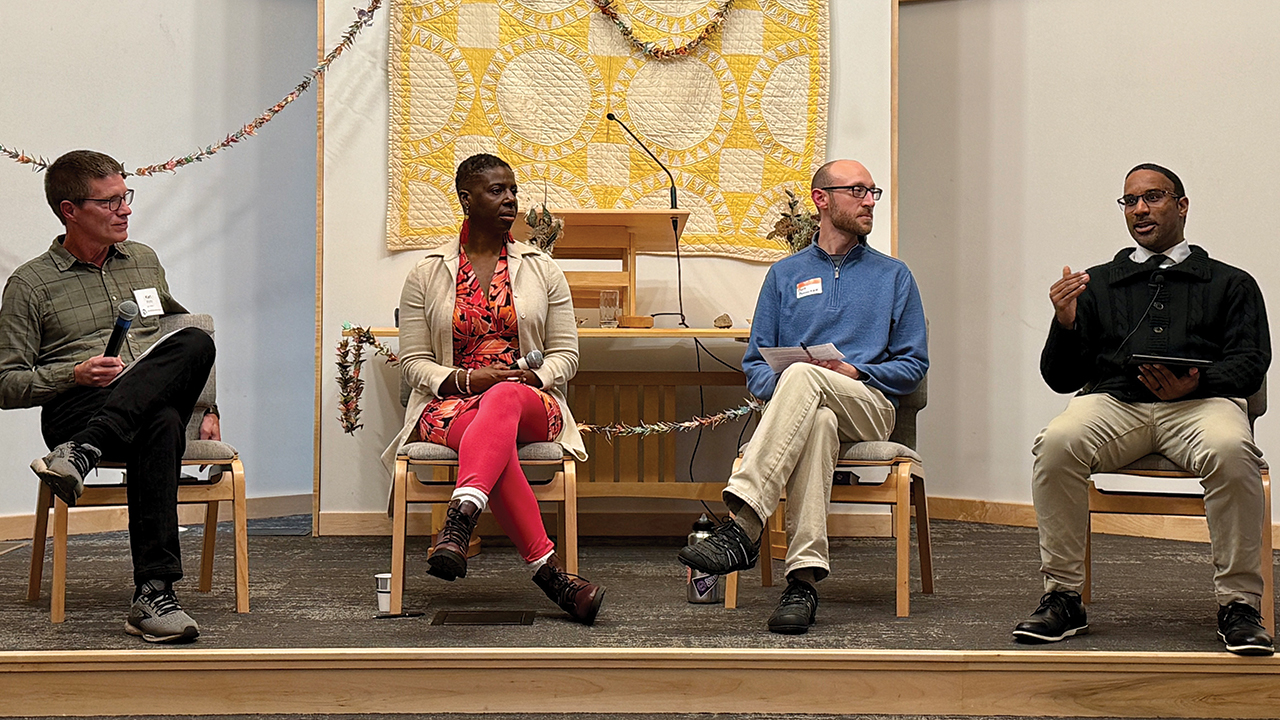
A room full of Anabaptists weary of the world’s empires gathered Nov. 15 at Assembly Mennonite Church in Goshen, Ind., to imagine the future of Anabaptism at a Reparations Summit.
Pastors Karl Shelly and Julia Gingerich welcomed 125 people with these words: “The call to reparations for the massive, multigenerational theft of power, agency, wealth, land, hope and truth about Black and Indigenous lives in this nation has been made for hundreds of years by Black and Indigenous peoples. Today is an invitation to our churches to stop ignoring that call.”
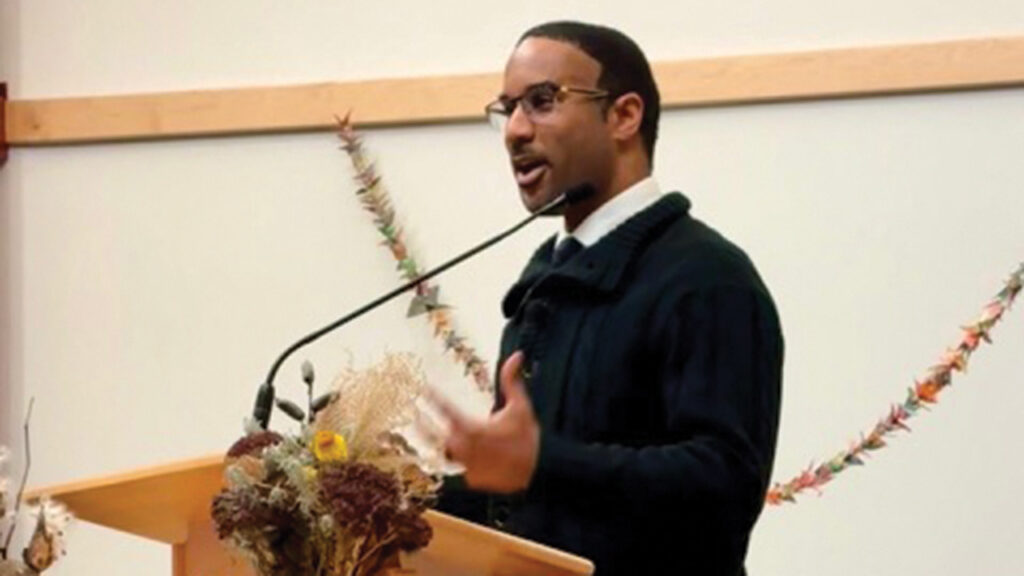
Building on the efforts of other Black Anabaptists, Drew G.I. Hart, a professor at Messiah University, called on Anabaptist churches to reclaim their historic courage by teaching history honestly, without sanitizing the church’s involvement with slavery, segregation, Indigenous land theft, white supremacy and colonialism.
Hart called Anabaptists to embrace Jubilee principles of redistribution, land return and economic repair as core expressions of the Bible’s moral grammar of repairing and restoring God’s creation.
“You cannot heal from a story you refuse to tell,” Hart said. Some political leaders today brand honest accounts of slavery and Indigenous dispossession as anti-American, even as their legacy still devastates communities. Hart challenges Mennonites to practice a faith grounded in truth-telling about empire, even when that truth implicates us.
Like many other White settlers, European Mennonites who arrived in the Americas were complicit in the tangled traumas of White genocide against Indigenous peoples, the enslavement of Africans and extensive ecological destruction. In my hometown of Bluffton, Ohio, President Andrew Jackson’s troops forcibly removed Indigenous nations. Jackson himself signed the land deeds for Mennonite settlers. Wealth generated from timber, minerals and farmland flowed overwhelmingly to White settlers like European Mennonites.

Through the collective sin of slavery, Black people laid the groundwork for the U.S. economy, generating immense wealth that White people systematically withheld from them. All White people — including many Mennonites — have reaped the benefits of America’s slave-driven economy. Even today, housing markets, zoning laws and patterns of inherited wealth continue to favor White families, while Black and Indigenous communities endure the legacy of their stolen labor and stolen land.
Today’s migration crisis stems from decades of U.S. colonial policies that destabilized Latin America, Africa and Asia while bringing wealth to many North Americans, including Mennonites. Cold War interventions, support for dictatorships, unequal trade and severe climate change weakened rural economies. These forces drove families to migrate, while Immigration and Customs Enforcement criminalizes people fleeing conditions shaped by U.S. policy.
The sins of racial thinking inspired Hitler to mobilize hatred toward Jews while simultaneously extracting their labor in concentration work camps. Most European Mennonites were silent bystanders complicit with Nazism while hundreds actively participated in carrying out the Holocaust. Today, Jews for Racial and Economic Justice ask not for economic reparations but for the study of antisemitism as the foundation of White supremacy.
Two million Mennonites worldwide are just a 10th of the global Jewish population. But in Latin America alone, 200 Mennonite colonies own land surpassing the size of the Netherlands and larger than historic Palestine. Mennonites rightly protest Israeli occupation and genocide in Gaza, but Jews wonder why we have been almost completely silent in trying to stop our own Mennonite siblings from harming land and people.
In Canada, Mennonite-led mines like Northern Dynasty threaten First Nations and pristine ecologies. In Latin America, a 2024 New York Times report revealed that Mennonite colonies are a leading factor burning down Amazon forests and encroaching on first-contact Indigenous communities. In November 2025, reporters at the global UN climate summit in Brazil blamed Mennonite colonies for mass deforestation and forest fires.
The Reparations Summit in Goshen closed with the announcement of a Reparations-Inspired Fund of Elkhart County proposing churches make reparative debt payments to the local Black community. This year the Coalition to Dismantle the Doctrine of Discovery’s Rematriation Landback Fund began collecting and disbursing money to return land for an Indigenous Jubilee. Mennonite Central Committee recently published stories of other Mennonite-led reparative initiatives.
Imagining a reparative Anabaptist future
Let’s imagine how Mennonites might expand these efforts. Mennonites have long turned conviction into concrete action. We helped reform modern mental-health care and pioneered restorative justice, proving that moral imagination can transform systems.
Imagine that we heed the Coalition to Dismantle the Doctrine of Discovery’s call to rethink Mennonite stewardship of wealth and refuse to invest in extractive industry. Imagine that Mennonites sponsor more learning tours and delegations to stand in solidarity with Indigenous communities.
Let’s further imagine that:
— Mennonites understand reparations involve more than giving money. They listen to scholar Nekeisha Alayna Alexis’ call to show up at town hall meetings to advocate for local communities’ priorities. Mennonite congregations partner with Black, Latino and Indigenous neighbors to launch cooperative native plant nurseries rooted in community ownership.
— Indigenous, Black and conservative Mennonites work together to share traditional knowledge about edible native plants and herbal healing. They offer outdoor classes where youth learn, grow and reconnect with the land. Food forests line the streets, cared for by neighborhood youth. Sanctuaries filled with edible greens and medicinal plants transform worship spaces into oxygen-rich ecosystems where “nothing is lost on the breath of God.”
— Mennonite churches transform their grounds into living classrooms and shared harvest spaces. Church members begin tithing at least 10% of their yards to native species that feed insects and birds, tending to “all our relations.” Churches hold friendly competitions with prizes to those who convert the most lawn and public park space into native habitats and food forests.
— Once we taste the sweet redemption of land justice, Mennonites begin making yearly multimillion-dollar donations to reparation and land-back funds serving as reparative debt payments (not charity) to local organizations run by Black, Indigenous and Latinx people and finance the purchase of more land to return to Indigenous communities, restoring both sovereignty and presence.
— Where invited, Mennonites combine land justice and ecological land trusts. Learning that cities spend roughly a thousand dollars for every indigent, unclaimed cremation burial, Mennonite churches recognize an opportunity. We launch regenerative burial forests — places where unembalmed bodies are returned directly to the soil, wrapped only in shrouds and honored by newly planted trees rather than steel vaults or polished caskets. These living cemeteries offer free or sliding-scale burial as part of reparation payments, saving thousands in burial costs. They become a shared venture across North America, funding reparations and embodying a quiet, earthy form of ecological repair.
— Mennonites rediscover that early Anabaptists learned from Judaism. Our new understanding of Jesus as a Jewish rabbi deepens our faith. We honor Robert Friedmann, the Jewish refugee whose influence shaped Harold S. Bender’s classic 1943 “Anabaptist Vision” statement toward discipleship, nonviolence, social justice and human dignity. We confront antisemitism in our theologies and join Jewish neighbors in working for collective liberation with Palestinians. We realize our most prophetic peace witness manifests in our reparations and in the humility we show by paying these social and economic debts.
In dangerous times, the movement for Reparative Anabaptist Futures Together (as I imagine we could call it) offers a life raft, a new Noah’s ark. If we turn these visions into realities, Anabaptists will find a deeper purpose in relationship with Black, Indigenous, migrant, Jewish and Muslim neighbors and in repairing local ecologies. We will grow food where we sing hymns. We will sequester carbon and restore ecologies where we carry our grief. We will revive our communities by reviving local ecologies. We will discover hope and belonging through a holy connection with people, the land and God.
Lisa Schirch is a professor at the University of Notre Dame, where she teaches peace studies, and attends Assembly Mennonite Church in Goshen, Ind.


Have a comment on this story? Write to the editors. Include your full name, city and state. Selected comments will be edited for publication in print or online.