


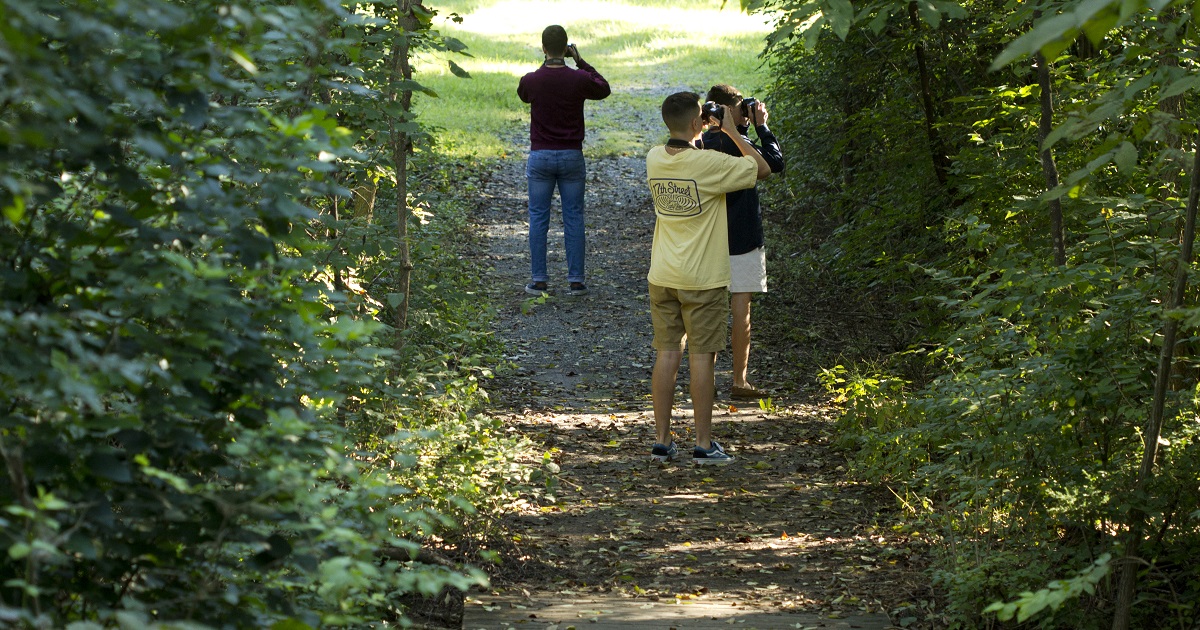
Photo: Student photographers focus on nature’s beauty in Park Woods near Eastern Mennonite School. Photo by Andrew Gascho.
How do we make time for rest and renewal when our world draws us into busy-ness of mind and body?
This is a question students, faculty and staff at Eastern Mennonite School in Harrisonburg, Virginia, will explore throughout the academic year 2019-20.
“Our high school students are dealing with a ton of pressure,” says Justin King, high school principal. “Whether it’s pressure academically, on the field or court, to get into the ‘right’ college or career path, or among friends and social circles, it’s real. We want to be honest about the toll that takes and think creatively about how we make time to rest and renew our bodies, minds and souls as God calls us to do.”
The word “sabbath” comes from Exodus 16:23. On the seventh day of creation, it says, God rested. The literal Hebrew translation of “sabbath” is “he rested.” In the Jewish tradition, families observe shabbat, meaning “to rest from labor.” A day of rest is honored in many faith traditions.
In the opening fall conference for faculty and staff, Joyce Peachey Lind read an excerpt from the book Little House in the Big Woods, in which Laura recounts the Ingalls’ family Sunday rules: no running shouting, laughter or play beyond reading and paper dolls.
That kind of Sabbath practice can be torturous for young children, she said. So what is relevant and meaningful for us today—of all ages—as we honor God’s command to make time for rest and renewal?
A former first grade Eastern Mennonite Elementary School teacher and current seminary student, Joyce passed out mathematics flash cards on the last day of the conference and invited staff to list things they hope to add as sabbath practices in the coming year, as well as those they want to subtract. For her, subtracting interaction with her cell phone for a Sunday was an exercise in sabbath practice she found both challenging and revealing.
Sabbath is a discipline, a practice, she said. “We won’t always succeed in the goals we may set for sabbath. But we learn a bit each time and realize what can feed and nurture us.” She shared a word cloud of words staff listed in an earlier exercise, highlighting ways they want to experience sabbath. These included naps, nature, music and time with family.
“It’s easy for a Sunday to go by and be busy all day with homework and other things,” says Liam Hughes ’21, a student member of the chapel planning committee. “I think it’s really good we are talking about this as a school. It’s important to be reminded that this is something God wants us to do.”
The youngest community members will benefit from reminders about sabbath practices too. Maria Archer, K-8 principal, read the students Psalm 46:10 when she introduced the concept during a weekly gathering: “Be still and know that I am God.” Then they sang the words in a song. She also read the book Verdi by Janelle Cannon. It is about a snake that is always on the move but is forced to take a break and rest, watch and listen. (Watch a YouTube video of Verdi being read aloud.)


Have a comment on this story? Write to the editors. Include your full name, city and state. Selected comments will be edited for publication in print or online.