


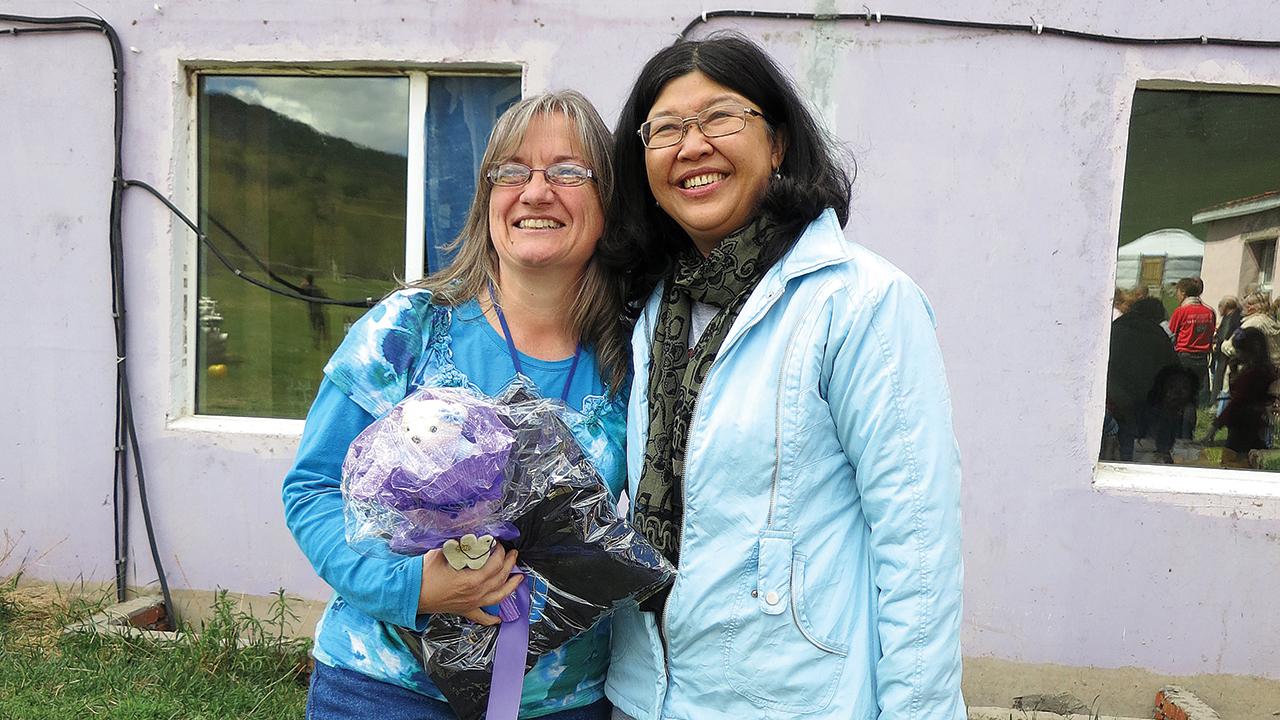
When Laura Schlabach arrived in Mongolia in 1993, there were only about 1,000 Christians in the sparsely populated country tucked between Russia and China. By 2025 that number had blossomed to an estimated 60,000, about 2% of the population.
As she concludes 32 years in Mongolia as a Mennonite Mission Network worker with JCS International, Schlabach attributes much of that growth to Mongolians’ desire to fill a spiritual emptiness left by decades of religious suppression.
“There was a void for people, and so they were seeking to fill it,” said Schlabach, who completed her term in March. Throughout her work, Schlabach witnessed enthusiasm for the gospel.
She recalled a community gathering about Christian missions where a man stood up mid-discussion and made his way for the door. When asked where he was going, he replied, “We need to share this with others! I’m going out to share.”
“Mongolians are natural evangelists,” she said. “They’re just on fire to go spread it.”
Schlabach served in numerous roles — including accounting, human resources and interim executive director of JCS International — as she witnessed a country emerge from decades of communist rule.

Mongolia was closely aligned with the Soviet Union for much of the 20th century. After declaring independence from China in 1921, it established a single-party communist government, which violently suppressed the public practice of religion.
As the USSR crumbled in 1990, Mongolians staged a peaceful democratic revolution and opened the country to the rest of the world. Christian mission organizations began to explore ways to have a presence in a country that had just five known Christians in 1990.
Three years later, that presence became manifest through JCS International, which registered as a development and relief organization. (Originally intended to be named Joint Christian Services International, a government official recommended leaving out the explicit reference to Christianity.) Mennonite Board of Missions, a predecessor of MMN, was one of nine supporting agencies.
JCS International needed someone in-country with accounting skills, and Schlabach heard about MBM’s search for an accountant. When she called to get more information, each detail felt like a confirmation of God’s call for her to serve, though she admits she wasn’t sure where Mongolia was.
Another sign of God’s providence soon came. Seven churches in northeast Ohio, including the one Schlabach grew up in, were exploring a new partnership model with MBM. Instead of a congregation giving money to MBM to support several ministries and workers, the churches wanted to focus on a specific country and grow in relationship with the people. Mongolia Mission Partnership was born, and Schlabach arrived in December 1993.
MMP was “another confirmation that God’s preparing the way and God’s directing,” Schlabach said. “The partnership has been wonderful.”
San Antonio Mennonite Church, which hosted Schlabach during an earlier Voluntary Service term and where she later became a member, also supported her financially.
MMP hosted worship services and fundraising events to learn from and support JCS International, Schlabach and other workers in Mongolia. Individuals and teams from MMP traveled to Mongolia to visit locations and people.
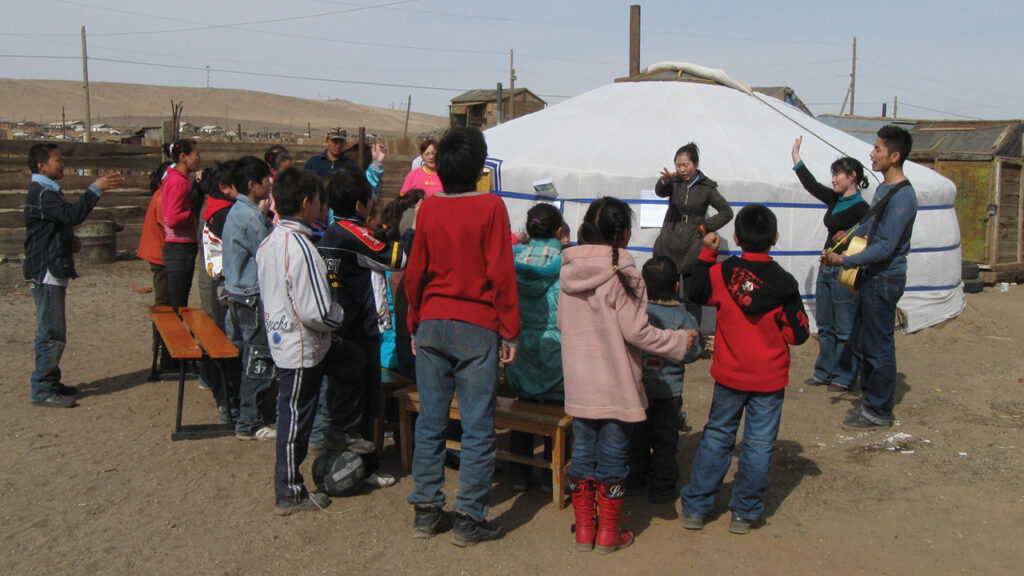
After serving in accounting and human resources, Schlabach spent two years in a remote area with a project to equip families to grow gardens and raise new herds of livestock after catastrophic winter storms. She served 10 years in the countryside, walking alongside a local church and assisting with development projects.
Eventually, she returned to JCS headquarters in the capital, Ulaanbaatar, taking on roles in finance, information technology and even serving as interim executive director.
“I came full circle and then some,” she said.
While JCS International does not start or lead churches, Schlabach says it inspired Mongolian Christians. It brings together organizations from different denominational backgrounds to focus on community development projects.
“That’s been a real witness for [Mongolian Christians], with the church working together,” she said.
At a gathering at the MMN offices in Elkhart, Ind., Schlabach reflected on changes she had seen in Mongolia.
Many families have shifted from a nomadic lifestyle of raising livestock to urban apartments and city jobs. They’ve replaced their gers — movable tent-like houses made from cloth and wood — with wood and metal houses transported by truck instead of camel. Supermarkets have replaced the small, sporadically stocked shops in the cities.
These changes bring both opportunities and challenges for Mongolian Christians and JCS International.
“Thankfully, God has not changed,” Schlabach said. “And whatever is happening, God is at work.”



Have a comment on this story? Write to the editors. Include your full name, city and state. Selected comments will be edited for publication in print or online.