


Rifqa Al-Hamalawi was coming home from her work in Gaza one day when she noticed a family, lying in the sand, covered only with a blanket. She was used to seeing people living in tents and makeshift dwellings since the Israeli military’s invasion of Gaza in 2023, but this family seemed especially vulnerable.
When she stopped to speak with them, she learned that months before, the mother, father and two children were riding in a donkey cart when it was struck by a missile. (Except for Al- Hamalawi, no names of people living in Gaza are used.)
The father’s legs both had to be amputated. Although their daughter survived, the mother was severely traumatized because the missile attack caused her infant son to fall from her arms and die on the spot. In the mayhem she wasn’t able to retrieve her son’s body and bury him.
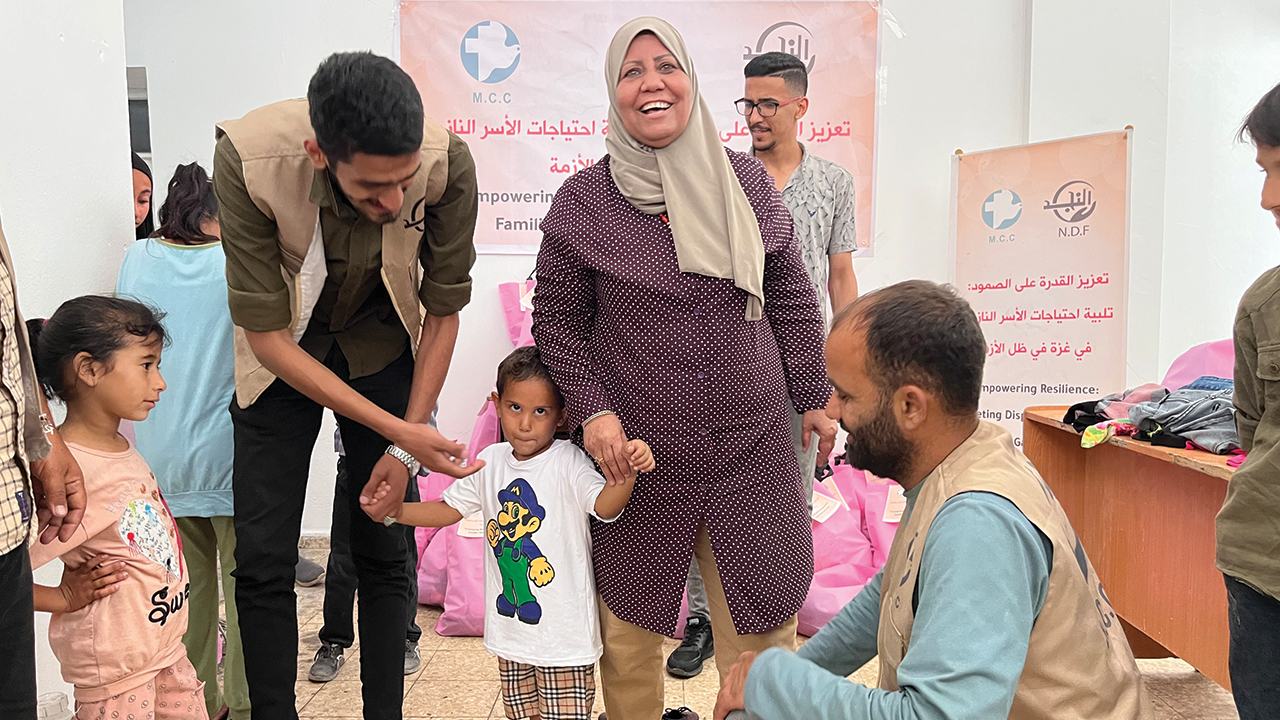
Al-Hamalawi, director and founder of Al-Najd Developmental Forum, a humanitarian organization and a Mennonite Central Committee partner, gave them some money and promised to return. The next day, she and her staff brought mattresses, blankets and food, and they set up a tent for the family. Al-Najd continues to support the family with supplies as they are available, but especially with emotional support for the mother.
“We talk with her, try to comfort her, ask about her, and see how we can help. If she needs anything, we are here to listen,” Al-Hamalawi said. “We also give her emotional support, reminding her that God has better things in store for her, and that she still has a beautiful daughter by her side.”
To Al-Hamalawi, this is what being a peacemaker looks like in Gaza during relentless bombardment and blockades by Israel of urgently needed food and supplies.

MCC has awarded Al-Hamalawi the 2025 Michael J. Sharp Global Peacemaker Award. The award is given annually to a person or organization who exemplifies MCC’s commitment to peace and justice across the world. Sharp was a former MCC staff person, who devoted his life to peacebuilding in the Democratic Republic of Congo.
“The most basic human instinct in times of horror is self-preservation, using whatever means available to protect oneself,” said Seth Malone, who with his wife, Sarah Funkhouser, serve as MCC representatives for Jordan, Palestine and Israel.
“But Rifqa elevated herself from fear and selfishness, turning to serve her neighbors suffering from immense violence. Her resilience and strength despite the danger to herself is truly inspiring.”
The danger that Al-Hamalawi and her staff deal with was evident during a Sept. 2 video interview with MCC from Gaza City. Al-Hamalawi was talking about peacebuilding and her work, when she suddenly cringed and brought her hand to her right ear.
A missile landed nearby, she said, pausing to listen before continuing the conversation.
“I don’t fear for myself,” Al-Hamalawi said. “I think about the victims of the missiles and bombing. Will they die? Will they be injured or amputated? Who died? A whole family? Specific people? Children? I hope it was a strike with no casualties, but there are never strikes without casualties.”
She heard the sound of ambulances outside her door, a sign to her that people had been injured or killed.
As Israel prepared to seize the city, this was just one of many attacks.
“Not just day after day, hour after hour — every 10 minutes,” she said. “It’s 24/7. What can we do?”
Carry on. That’s what she and the Al-Najd staff do.
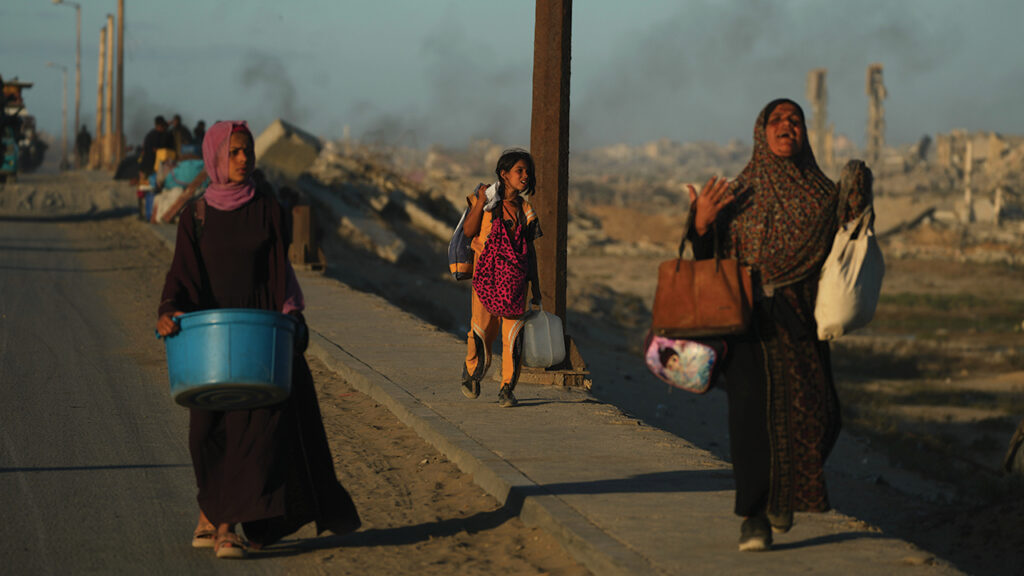
Since the invasion began in October 2023, she and her team have distributed some form of humanitarian aid — food baskets, bedding, shelter material, clothing and cooking gas cylinders — to more than 73,000 people.
Al-Hamalawi and her team have persisted despite deaths among their own families, injuries to themselves and being displaced multiple times. Each time violence forces them to move, they regroup and visit the people around them to find those with the greatest needs.
Just days after the invasion began, Funkhouser remembers, MCC’s team in Palestine and Israel reached out to partners in Gaza. The first thing Al-Hamalawi said to them was, “Can you help us help?” Funkhouser says she couldn’t believe that despite all that was happening around them, Al-Najd staff were already focusing on how to aid their neighbors.
MCC promised the funding, Al-Hamalawi purchased bedding and emergency food, and her staff distributed it to people nearby who were displaced or lost their homes.
Throughout the past two years, Israel severely restricted the flow of food and supplies that humanitarian groups could get into Gaza. As local supplies became more scarce and more expensive, she has persisted in searching out items families need. Just this year, she has been able to find and purchase gas cooking stoves, children’s clothes and shoes and fresh vegetables for distribution.
“I go from merchant to merchant to find the best goods and negotiate prices,” she said. “I prefer to do it personally, so I don’t put my team at risk.”
Al-Hamalawi was born and raised in Gaza. Her compassion and outreach to others, especially women, grew out of her experience of getting divorced as a young woman. Although cultural stigma called for her to stay at home in shame, Al-Hamalawi’s father encouraged her to find work. Using her diploma in business administration, Al-Hamalawi worked throughout the 1990s and into the next decade for organizations that focused on empowering women.
In 2007, she started Al-Najd Developmental Forum, an organization providing job opportunities and income generation projects for women, including making pastries and sewing. With MCC’s support, Al-Najd provided rabbits and information on rabbit- rearing so women could raise and sell them for profit.
“Our lifelong mission has been to help people: delivering aid, whether relief assistance, development projects, medical support or psychosocial support,” she said. “This is the mission of Al-Najd, and we do not back down, especially now that people are in the greatest need of us.”
During the week after her September interview with MCC, her house in Gaza City was bombed, forcing her to relocate. It wasn’t the first time she’d been displaced. Earlier in the war, her house and those of her six brothers were destroyed. Her sister, sister-in-law and nephew, as well as 25 to 30 relatives in her extended family, have been killed.
“I push through my own pain to give people a spark of hope,” she said. “I have to stay strong for my people, because they look to me for hope and positivity. But honestly, sometimes I too need someone to give me that hope and strength.”
She finds strength in her dependence on God and faith that one day the suffering will end. She is happiest when she accompanies her staff to give out supplies, like a recent distribution of children’s clothing and shoes.
“I feel inner peace because I see the happiness on children’s faces,” Al-Hamalawi said. “I was happy because they were happy. I felt extremely content seeing them running around, wearing new clothes and enjoying them. That filled me with so much joy.”
She is encouraged, too, by the peacebuilding award.
“This means a lot to me,” Al-Hamalawi said. “It showed that my efforts were recognized and led to something meaningful, that my work truly mattered.”


Have a comment on this story? Write to the editors. Include your full name, city and state. Selected comments will be edited for publication in print or online.