



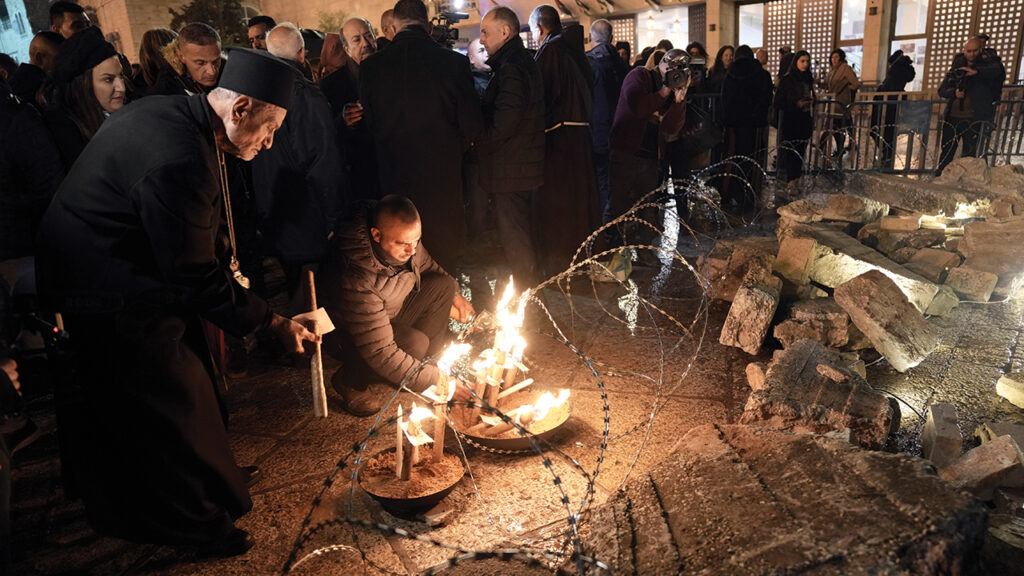
Advent begins in twilight. Candles are lit one by one, small flames trembling against the dark. We read Isaiah’s promise of a people who walked in darkness seeing a great light, and we long for that light to break into our world.
The question that lingers beneath the surface of our worship is the one Advent dares to name: How do we wait with hope when the world is wounded and God’s promises seem unfulfilled?
For me, hope in Advent is less an emotion than a practice — an act of faithfulness. To light a candle, to sing “O Come, O Come Emmanuel,” to pray for peace in a season of war — these are not sentimental gestures. They are confessions of trust that God is still at work in the world.
Hope, as theologian Jürgen Moltmann wrote, “finds in the promise of God the possibility of something new.” It does not deny grief but holds it within the horizon of redemption.
In my own life, this balance of grief and joy comes into focus each Advent when our church lights the candles of the wreath. The first Sunday, hope feels fragile. Some years it feels forced. But as the weeks unfold, that fragile light grows stronger, until on Christmas Eve the room glows with dozens of small flames reflected in tearful faces.
The light has not erased the darkness. It has refused to surrender to it.

Advent may be the most contemplative time of the year. We step away from the strident rhythms of contemporary worship and make space for lament as well as celebration.
We reflect on Mary’s song (Luke 1:46-55). Mary sang to her son while he was still in her womb. Perhaps she also sang to the newborn Jesus — not so much as a lullaby but a song that defined how the Messiah would navigate the space between the progressive Sadducees and the conservative Pharisees.
“He has brought down the mighty from their thrones and lifted up the lowly.” Across centuries and languages, her song reverberates: the proud scattered, the hungry filled, the humble lifted.
It is a hymn of justice and joy, a melody that rises from the margins and insists that God is turning the world right side up. That, too, is the sound of Advent.
The first Christmas was profoundly subversive. The Messiah came not to Caesar’s palace but to a borrowed manger. God chose poverty, displacement and human vulnerability as the place of divine presence.
The incarnation exposes the delusion that power and violence can save us. It tells a different story: God’s kingdom begins not with a throne but a cradle, not with domination but self-giving love.
I am not a person of resistance so much as a person in between — trying to navigate the space between progressives and conservatives, between those who claim certainty and those who live with questions.
Like many Anabaptists, I long for a faith large enough to hold truth and tenderness together. I am a global disciple, shaped by life among believers from many nations.
I see that God’s kingdom is far larger than our American polarizations. I see hope for a world — and a church — where we can again be people of hospitality and reconciliation.
I think of the songs that sustained believers in darker times: the martyr hymns of the Ausbund, sung softly in prison cells, and the spirituals that rose from the fields of slavery — songs like “There Is a Balm in Gilead,” where lament and hope are woven together.
Both traditions sang faith into being, not as escape but as endurance. Their music teaches us that Advent joy is not naïve. It is born in waiting, in witness, in the trust that God’s promises still hold.
Advent teaches us that joy and sorrow are not opposites. They are companions. To feel the ache of what is broken is also to recognize how deeply we long for healing.
Some congregations hold a “Blue Christmas” service, a space for those who grieve during the holidays. Candles are lit for loved ones lost, for dreams deferred, for the many invisible wounds people carry.
Paradoxically, these moments of lament deepen our capacity for joy. They remind us that Emmanuel — God with us — means precisely this: God with us in the darkness, God with us in the waiting, God with us even when hope feels far away.
The prophetic heart of Advent is not escape from the world’s pain but engagement with it. The Christ child born into Herod’s empire still comes to unsettle every empire — political, economic or spiritual — that thrives on fear and exclusion.
The revolution we celebrate each December is the revolution of love: a kingdom that advances not by conquest but by compassion, not by force but by faithfulness.
To celebrate Advent is to align our lives with that kingdom, however small our actions may seem.
For me, during Advent, simple things bring joy: The smell of pine in the sanctuary and in our living room. The a cappella resonance of “Lo, How a Rose E’er Blooming.” Our grandson’s delight as he reaches for a Christmas ornament.
I watch the Advent candle flicker against the darkness, and I remember: This is how God works. Quietly. Patiently. In the shadows before dawn.
The light shines in the darkness, and the darkness has not overcome it. That is not merely a statement of faith. It is the heartbeat of Advent, the subversive joy that dares to believe that love, still, has the final word.
Nate Showalter is a pastor, historian and writer based in Los Angeles. He has served international congregations in Nairobi, Kenya; Taipei, Taiwan; Shanghai, China; and Hong Kong; and LMC congregations in Lancaster, Pa., and Boston.


Have a comment on this story? Write to the editors. Include your full name, city and state. Selected comments will be edited for publication in print or online.