


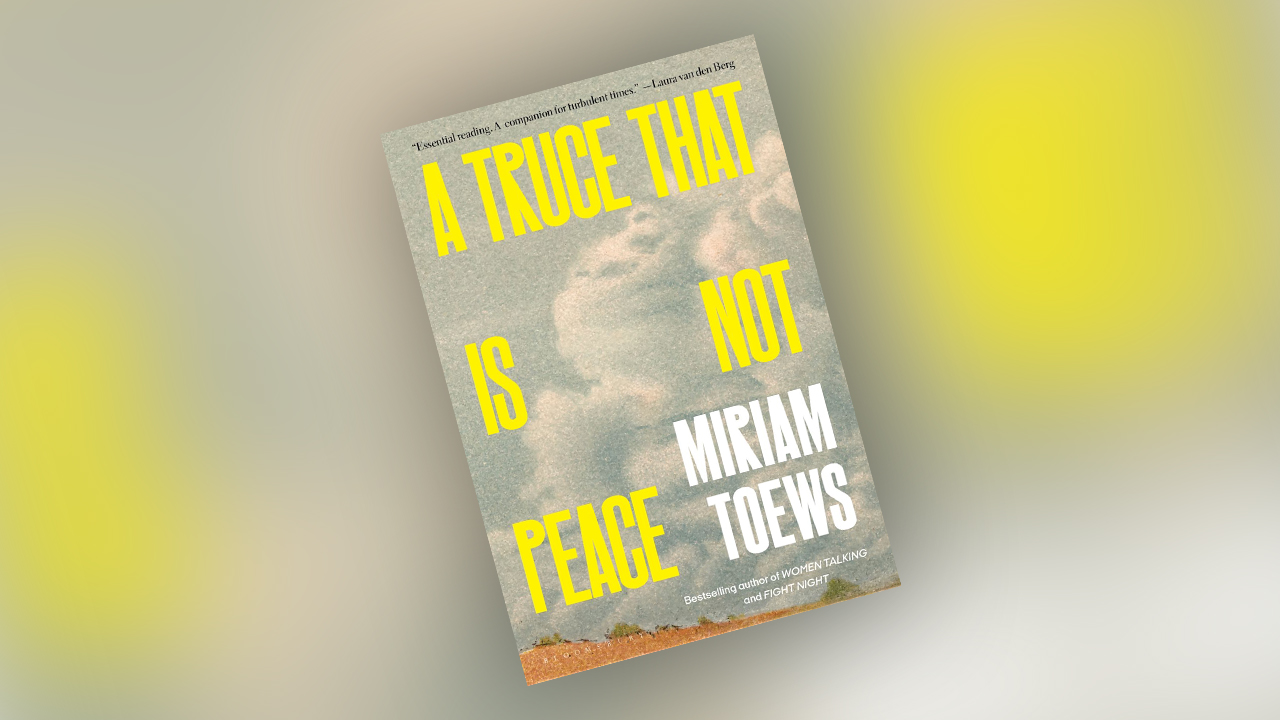
Miriam Toews has published eight novels; A Truce That Is Not Peace is her second nonfiction memoir, after Swing Low: A Life (2000). Seven of her books, including A Truce, can be classified as Canadian Mennonite literature. Two of her novels, All My Puny Sorrows and Women Talking, have been made into films. The film Women Talking won an Oscar for best adapted screenplay (which Toews wrote) at the 2023 Academy Awards.
A Truce addresses why Toews writes. Ostensibly, she does so in reply to the organizers of an event in Mexico City in 2023 that invites writers to respond to the question: Why do they write? A Truce is Toews’ answer. But it’s not good enough for the organizers in Mexico; she gets herself “uninvited.”
Toews has said one of the reasons she writes is to process her family’s trauma. Her father, Melvin Toews, committed suicide at 62 by stepping into the path of a moving train; Swing Low is a memoir in her father’s voice. Ten years later, in 2008, her sister Marj took her own life in the same way, as Toews’s semi-autobiographical novel All My Puny Sorrows recounts.
Toews writes at intersections of genres. Her diary-type entries intermingle with quotations from famous authors like Chekhov and Pushkin, perhaps nodding to her connection to the Mennonite Russian experience. Her “Russian Jungian Shrink” prompts Toews to answer questions such as “Have you noticed recently that the things that normally make you happy no longer do?” to determine the state of her patient’s mental health. But Toews answers in her own way — again, not as the “organizers” of such questionnaires would expect. She replies in memories of her sister, her father, her childhood, her family. She interlaces these memories with thoughts, dreams, nightmares and days in her present life — five of her six chapters begin with the date April 2023 — with her grandchildren and with three generations of the Toews family living together in Toronto.
Interposed everywhere are old letters to Marj. A Truce is dedicated to Marj. Toews writes because of Marj. Marj had asked her younger sister to write to her while Toews and her then- boyfriend traveled in Europe in the 1980s. Instead of explaining why she writes, Toews inserts her old letters to Marj into her text. “Why do I write? Because she asked me to,” Toews says. “My sister . . . begged me to write her letters . . . and in that asking was an offering. She taught me how to stay alive.” What began as a reluctant assignment became her life’s purpose.
Toews makes a truce with herself to keep her sister present and included with her family in her house in Toronto and to remember Marj with less pain or grief. Toews makes a truce with grief. She may not be at peace, but she has her grandchildren.

There are at least two other reasons Toews writes. “The writing is the reason,” she says. “And 42.” I shall leave it to the reader to figure out the significance of the number 42 and the recurring narrow white corridor “where writing lives.”
With A Truce, readers are in familiar territory if they have read some of Toews’ previous books. This memoir uses some of the same themes and events as her novels: Plautdietsch (Low German), rage, the silence of the father, family holidays, Steinbach (a small town in Manitoba where the Toews family originally lived). A Truce reads a little like notes and journal entries before one writes a novel. It’s almost like having the sketches for a book to come. The memoir sheds light on her previous books, which were written while she felt urgency to process what happened. With A Truce, Toews revisits the beginning, the one she has been silent about for so long. She breaks her silence some 15 years after the first memoir, writing this one in her own voice, because she has hope. She feels healed and brave enough to do so. A Truce comes full circle with her Mennonite novels. It makes me want to go back to the beginning and read her books again.
In A Truce, Toews offers clarity and gentleness, inasmuch as it is an homage to Marj and to writing. New readers of Toews might find it a bit bizarre because her style does not lend itself to a traditional memoir style. It is abrupt, uneven, nonlinear, sometimes seemingly full of incidental minutiae, like a stranger coming to their house on Christmas day and realizing shortly thereafter that he is at the wrong house. The style is only seemingly haphazard, for readers of her previous books will know the significance of homes and strangers helping members of the Toews family. A Truce is the key to all her other Mennonite novels and memoirs. It is a beautiful reclamation of art, life and family in the face of life-long grief and asking why.
Rita Dirks is associate professor of English at St. Mary’s University in Calgary, Alberta.


Have a comment on this story? Write to the editors. Include your full name, city and state. Selected comments will be edited for publication in print or online.