


How a reluctant student became a longtime Mennonite educator
Stanley Shenk devoted his working life to the Mennonite church, including several decades in Mennonite higher education. His own experiences at a Mennonite college set him on that course.
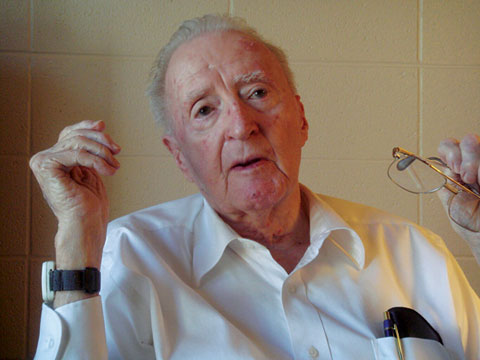 Stanley’s early years showed little promise of what was to come. His mother, Icie Pearl (Shank) Shenk, died in February 1922, just a month short of her son’s third birthday. Stanley’s father, Coffman Shenk, was “broken emotionally by [my mother’s] death and by the loss of his poultry business,” Stanley says.
Relatives in the Denbigh, Va., area took care of little Stanley for a few months, before sending him to Versailles, Mo., and “my wonderful Missouri grandmother,” Emma Driver Shank. He lived with her for two years before returning to his father, now remarried and working as a Fuller Brush salesman in Norfolk, Va.
For the next number of years, Stanley never settled in any one place for long. He fell in with “a Norfolk street gang—it sounds worse than it was, but it was bad enough,” at the tender age of 7, which resulted in his being sent to live with a couple near Harrisonburg, Va., for a time. From age 9 to 10, he lived with his grandmother Emma again.
He then returned to the home of his father and stepmother (with stepbrothers Charles, who became a Mennonite missionary to Japan, and Martin) in the Maryland suburbs of Washington, D.C. The family attended Cottage City Mennonite Church. Stanley’s stepmother, Retta, had secured a good job as a secretary to a Washington lawyer—a special boon in the midst of the Great Depression.
Almost from the time Stanley started school, his teachers dubbed him “a bright boy.” He was skipped over grades twice—”stupid,” he says now, “but they did it in those days.” He “read ferociously,” he says, especially newspapers and magazines, since he enjoyed keeping up with current national and world events.

 By the time he was in high school, he “read everything in sight.” However, he says, “I was not interested in school but only in my friends, most of them D.C. Catholics. I almost flunked out three years, but I always [managed to pass].”
Meanwhile, Coffman and Retta had moved back to Retta’s hometown of Biglerville, Pa. Stanley didn’t want to go, so he stayed with a friend’s family. He decided he had had enough school and quit, going to work for a Mennonite from Hyattsville, Md.
But Stanley’s family hadn’t given up on their boy. One of Coffman’s brothers was Deacon Jacob A. Shenk, a strong supporter of Virginia Mennonite Mission Board and Eastern Mennonite School (forerunner of Eastern Mennonite University). Jacob offered to pay his nephew’s way if he would finish high school at EMS.
Stanley refused at first. But when he found he could no longer make his way financially on his own and was forced to go live with his parents in Biglerville, he reconsidered. He had fond memories of his time as a young boy living in the Shenandoah Valley. When he got to EMS, “I liked the place,” he says, “and I liked the faculty. I began to study and work to make grades more like what I should have done all along.”
However, he says, “I suspect I was the only student at EMS who wasn’t a Christian.” He was still, in his own words, something of a rebel. No one knew quite what to make of him. He became famous for his speeches and good arguments. Several fellow students tried to convert him, he says, “but I would out-argue them.”
With high school finished, Stanley thought he would go to college to become a forest ranger, but he knew most schools wouldn’t accept his poor overall high school record. Instead he returned to Harrisonburg and Eastern Mennonite College. He signed up for classes he would need for forestry but didn’t like them. He also enrolled in four introductory courses: philosophy, sociology, psychology and music. He soon dropped his chemistry and math courses and never looked back.
Several significant things happened in Stanley’s first few months at EMC. He read a series of articles on Christianity in the Saturday Evening Post by American philosopher Will Durant “that spoke to me as going to church never had.” He met freshman student Doris Sell, a devout young Mennonite woman from Souderton, Pa. He had some serious conversations on becoming a Christian with several EMC professors.
He and Doris (pictured) started dating, but she broke it off because she was, he says, just too conflicted about going with a man who wasn’t a Christian. Sometime later, he was talking with M.T. Brackbill, an EMC science faculty member. “Maybe he thought I was just trying to get Doris back,” Stanley recalls, “but I wanted answers. I put the most direct question to him: ‘If you accept Christ as sin-forgiver, as Lord of life, then do you become a Christian?’ I didn’t know if it was a stupid question or not. I had no confidence in myself in spiritual matters.
 “He said, ‘Yes.’ I slapped one fist into the other palm and said, ‘I’ll do it.’ It was a big decision [to be so] spontaneous, but I meant it.” A few days later, he attended a revival meeting and went forward—although he felt he had already made his commitment, he understood this as a way of making it public to the many people he knew had been praying for just this.
He and Doris began dating again, but once again she broke it off. They got back together in the fall of their sophomore year, and that spring he proposed. They were married on June 20, 1942, in the first wedding performed at Souderton (Pa.) Mennonite Church, with Bishop John E. Lapp officiating. Their marriage lasted 62 years, until Doris’s death in 2004. They had four children: Dave Shenk, Dan Shenk, Rhoda Keener and Phil Shenk. “God knew I needed Doris,” Stanley says.
Stanley graduated from EMC (then a junior college) in 1943 and got his B.A. in Bible at Goshen (Ind.) College in 1944. He entered Eastern Baptist Theological Seminary that same summer but left after a few weeks in response to a desperate plea from EMC—World War II had left the school seriously short of faculty. He taught at EMC three years and ultimately earned his seminary degree from the Biblical Seminary in New York in 1949—the same year he was ordained to the ministry and moved to West Liberty, Ohio, to become pastor of South Union Mennonite Church.
At Goshen, he particularly remembers Harold S. Bender, J.C. Wenger and Paul Erb, “some of the best teachers I ever had. [At seminary in New York] some of the teachers were almost as good, but none was any better.”
The Shenk family moved to Souderton in 1957 and returned to Goshen in 1965. Stanley taught Bible at Goshen College for 20 years. Several generations of students are unlikely to forget the inductive method of Bible study he taught them—first learned in New York.
Melanie Zuercher is a member of Shalom Mennonite Church in Newton, Kan.


Have a comment on this story? Write to the editors. Include your full name, city and state. Selected comments will be edited for publication in print or online.