


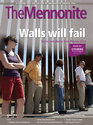
Speakers call convention-goers to be faithful citizens of God’s kingdom while overcoming barriers to God’s grace.
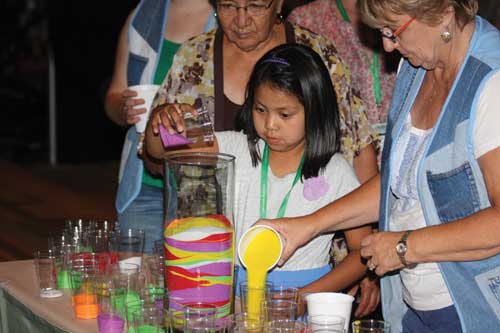
After a long period of deciding whether or not to come to Phoenix for Mennonite Church USA’s biennial convention July 1-5, more than 4,600 came to celebrate being “Citizens of God’s Kingdom: Healed in Hope,” the convention’s theme.
At the opening adult worship service on July 1, Tina Begay, a Navajo and a member of the Executive Board of Mennonite Church USA, welcomed people to the Southwest, where Apaches, Arapahos, Navajos, Hopis, Pueblos, Zunis and other tribes reside.
Iris de León-Hartshorn, Carol Roth and Erica Littlewolf paid tribute to Richard Twiss, a Native leader who was to be the opening speaker but who died in February. Roth said that Twiss encouraged Native Christians to embrace their own culture while also following Jesus Christ.
Cheryl Bear, who took his place as speaker, sang a song she wrote in honor of Twiss, accompanying herself on a drum. She then presented bad news and good news.
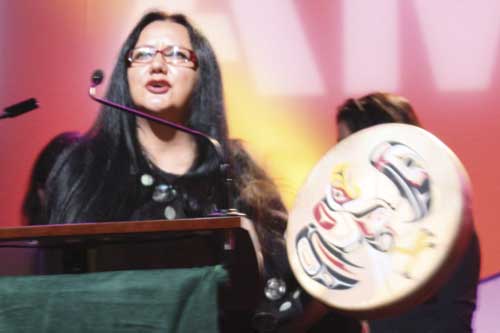 She recounted some of the history of Native peoples’ encounter with Europeans in North America. “Evangelism and assimilation went hand in hand,” she said.
Assimilation meant that Native culture was considered invalid. The doctrine of discovery taught that the land was empty, ignoring the fact that more than 1,000 Native tribes inhabited North America.
One of the most destructive acts of whites toward Natives was removing Native children from their homes and placing them in boarding schools, where the teachers sought to “kill the Indian within,” not allowing them to speak their language or dress in Native clothes.
Bear, who is a member of Nadleh Whut’en, a tribe in northern British Columbia, talked about four foundations of the Native worldview: Creator, creation, community and culture. The good news, she said, is that God sent Jesus to bring life, not to destroy Native culture.
Native Christians have learned to do re-evangelism, telling the gospel in a Native way. For example, some have presented Jesus as the cleansing ceremony.
She invited people to adopt a posture of humility as we welcome others to faith. She concluded with the image of Jesus offshore in a canoe, waiting for our sign of welcome.
The July 2 adult worship service focused on the plight of undocumented immigrants in the United States.
After showing a video about undocumented young adults, Iris de León-Hartshorn asked for support for a DREAMERs fund. The money will be placed in a fund to help undocumented Mennonite youth, called DREAMERs, pay for the cost of applying for U.S. Citizenship.
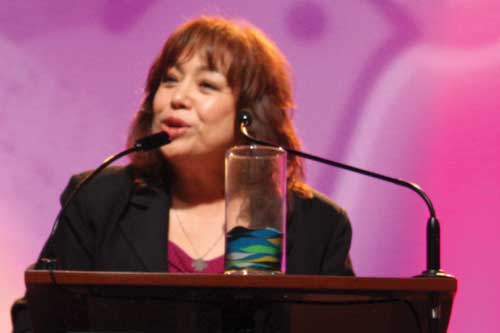
The morning’s speaker, Bishop Minerva G. Carcaño of the United Methodist Church, called on the audience to stand with immigrants, whose suffering grows each day.
She has been amazed, she said, at the opposition of Christians to immigration reform.
Some of the comments she has heard have been “nasty and vile.”
 One church member reacted to her call to care for immigrant children suffering in the desert by shoving the Communion wafer back at her during a worship service Carcaño led.
This man then asked the church’s pastor to kick her out. The pastor said he couldn’t because, he said, “She is the bishop; the pulpit is hers.”
Carcaño expressed concern that sometimes the church lets others define us and miss who we are. “We sojourn in the world, but we are not of the world,” she said.
She looked at various Scriptures and said that “welcoming the stranger … is a mandate from God’s own heart.”
She carried out a correspondence with a Christian who finally wrote that he “longed for the day when the church would defend U.S. democracy.”
But that is not our task, she said. We are to proclaim the good news of Jesus Christ, and “though we are citizens of various countries, above all we are citizens of God’s kingdom.”
The service concluded with an offering for the DREAMERs fund. This, plus the offering from the youth worship, brought in more than $25,000.
During the shared worship services on July 3, Mennonite Church USA denominational ministers Terry Shue and Nancy Kauffmann invited all pastors and conference ministers to stand along the front of the auditorium.
Shue and Kauffmann expressed thanks for their following the call to serve as pastors and prayed a prayer of blessing.
Representatives from each agency of Mennonite Church USA and The Mennonite gave the hundreds of pastors and conference ministers ribbons that said, “I said yes” (drawn from Numbers) to attach to their name tags.
These gave them a $25 discount on items at the MennoMedia bookstore at the convention. The agencies and The Mennonite provided the funds to cover these discounts.
As the pastors walked back to their seats, people applauded. In one of the worship services, youth formed an arch with their hands for the pastors to walk through.
In his address to both worship sessions, staggered because of space limitations, Ervin Stutzman, executive director of Mennonite Church USA, called on worshipers to commit all they have to Jesus because all our possessions belong to him anyway.
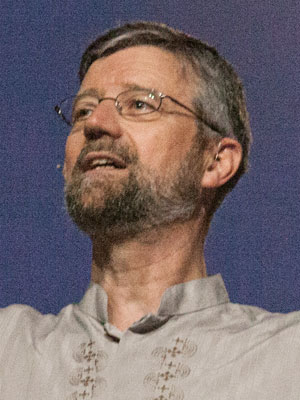 He compared entering the kingdom of God to going through airport security, “except when you get inside you can’t find where your stuff is.” He held out his watch, wallet, cell phone and keys and pointed out how these represent parts of our lives that are on loan from Jesus.
Stutzman said, “We are called to live as faithful citizens of the kingdom of God while also being citizens of, say, the United States.”
He closed by inviting people to come forward to commit themselves to God’s kingdom.
In the July 4 evening adult worship service, Meghan Good, pastor of Albany (Ore.) Mennonite Church, recounted the Bible’s tradition of God refusing to be held captive by walls. She went on to challenge the church not to work against God’s mission of breaking down the walls we build.
“Using humorous, poetic language, Good told of Israel’s repeated attempts to build a temple where God dwelt, only to have it torn down. She noted that “it’s easy for us to read Israel’s mind [because] we need only read our own.”
 We tend to believe, she said, that “barbed wire and stone walls are a small price to pay for the future of our children.”
The church knows this logic every bit as much as the nation. Even our architecture shows our theology, Good said.
Our church buildings tend to have high walls and frosted glass windows that prevent us from looking outward. And we have developed subtle ways of keeping others away.
“We live in an age when walls are crumbling at an alarming rate,” Good said. And it seems that no matter how much the church builds up its programs, fewer people join us.
We have made border patrol our mission, she said, and in doing so “we have lined ourselves up against God [because] Jesus lives to tear walls down.”
This is not new news, Good said. It’s been this way from the beginning. God has been turning our holy systems into holy rubble. God’s mission is bigger than simple preservation, she said. “[God] is building a world where truth is not a possession, … where holiness is not what we avoid but what we embrace.”
We join God’s mission when we loosen our grip and let the walls we’ve built fall down.
“The borders we die to hold, Jesus died to tear down.” Our choice is either to fight God and fail or join God in making holy rubble.
Lives have been shattered in the defense of walls, Good said. Meanwhile, “we’ve neglected the triumph of the truth and celebrated our grasp of it.”
Good closed by inviting people to come forward and wash their hands as a symbolic way of repenting of our sins of wall-building and being cleansed by God’s grace.
Good closed by inviting people to come forward and wash their hands as a symbolic way of repenting of our sins of wall-building and being cleansed by God’s grace.
On July 5, following the adult worship service in the evening, between 1,500 and 2,000 convention-goers took to the streets on a 1.5-mile walk through downtown Phoenix to pray and sing.
Evening speaker and new moderator of Mennonite Church USA Elizabeth Soto Albrecht led the procession. Many wore or held light sticks handed out during the worship.
Local police blocked off the route for the crowd, which sang and prayed while passing “places of suffering and hope.”
The group walked past hotels and prayed for restaurant and hotel workers, passed a county jail and detention facility and prayed for detainees, prisoners, guards and their families, and passed the offices of Wells Fargo and prayed about banks and the for-profit detention system.
At Civic Space Park, the crowd gathered in small groups to pray for their local communities, and the larger group sang several songs and prayed the Lord’s Prayer in English and Spanish. They were joined by some who chose a shorter, half-mile route.
Others had the option to stay in the convention center and pray there. Given the triple-digit heat, some chose not to walk.
In her sermon, Soto Albrecht emphasized that “we are connected.” We included herself with immigrants who came to the United States “not with the American dream but with God’s dream.” They came because they had no job.
She called on hearers to share the light God has given. “Don’t let the darkness keep you from showing the light of God in your life,” she said.
She introduced the prayer walk by noting that “we walk for immigrants who cannot walk the streets of Phoenix.”


Have a comment on this story? Write to the editors. Include your full name, city and state. Selected comments will be edited for publication in print or online.