


On Oct. 8, the U.S. Secretary of Defense, Pete Hegseth, announced that the firing-squad execution of Nidal Hasan will be livestreamed for public viewing. “People need to understand that there’s serious consequences for these types of things,” he said. A week later, President Trump backed away from the broadcast: “Many very good and well meaning people would rather not watch him die, through streaming, or through any other visual device.” The last fully public execution in the U.S. was in 1936.
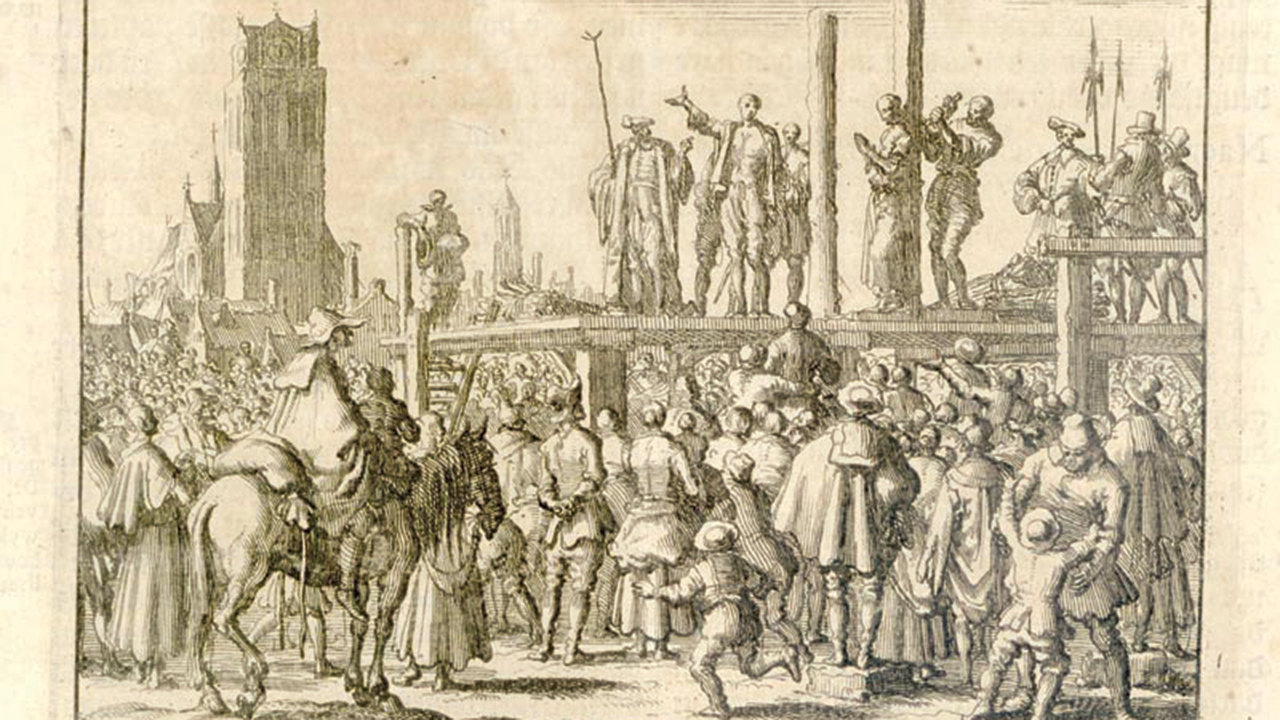
As a Mennonite professor, my first reaction was visual. Anyone who has opened Thieleman van Braght’s Martyrs Mirror (1660) remembers Jan Luyken’s etchings: Anabaptists bound to stakes, drowned in rivers or led to the scaffold with iron screws clamping their tongues so they could not sing to the crowd.
For centuries our community has read these stories from the martyr’s side of the ledger, asking what faithfulness looks like when the sword falls. But if we turn the picture around to look at the magistrate holding the sword, a deeper question emerges: Why did the authorities feel such urgency to kill heretics in public?
Historian Gary Waite shows that 16th-century magistrates were not merely deterring crime; they were acting out of apocalyptic fear. They inhabited a covenantal imagination where a nation stood in fragile relationship with God. Tolerating “agents of the devil” (heretics, sorcerers, rebels) invited divine judgment — plagues, crop failures, war. Public execution was a civic ritual to purge the land and restore God’s favor. The crowd was a participant, and the Anabaptists were terrifying precisely because they were viewed as a spiritual contagion.
If your goal is purification, moral objections fail. Within a covenantal framework, visibility and severity are the point.
That worldview did not die in the 17th century. It was rebuilt in the 20th by Christian Reconstructionists. R.J. Rushdoony’s Institutes of Biblical Law (1973) argued that Old Testament civil penal codes — including capital crimes — still bind modern states, treating human rights as apostasy. His colleague Gary North (The Sinai Strategy, 1986) defended public execution as a declaration of submission to God’s law, objecting to hidden, clinical executions behind prison walls.

Reconstructionism is built so that moral outrage confirms its premise. To Reconstructionists, those who call such punishments barbaric have been captured by secular humanism. To Reconstructionists, moral revulsion is not an argument against their position; it is proof of cultural decay.
As religious studies scholar Julie Ingersoll documents in Building God’s Kingdom (2015), these ideas moved outward through classical Christian schools and pastoral networks — most notably via Doug Wilson of Moscow, Idaho, and his Communion of Reformed Evangelical Churches.
Hegseth belongs to churches in this network and promoted its educational vision in his 2022 book Battle for the American Mind.
While Hegseth frames his call for public execution around deterrence, his arguments draw from a well-established theological lineage. Yet there is a crucial shift in mood. The 16th-century magistrate acted out of fear to hold back impending wrath. Reconstructionists act out of confidence: Public execution is not a defense but an offensive down payment on building God’s kingdom on Earth, preparing a cadre to step into the vacuum of inevitable secular collapse.
Reconstructionists dismiss appeals to the Sermon on the Mount or New Testament ethics as sentimental humanism when applied to civil governance. In their view, Jesus did not alter the magistrate’s duty to enforce Old Testament penal sanctions.
What does this have to do with Luyken’s etchings? The Martyrs Mirror preserves a warning about what happens when a state believes it can cleanse a community through public violence.
Today, postmillennialism — the idea that Jesus will return after an era of Christian triumph — claims history belongs to those who wield the sword with confidence. But Luyken’s etchings offer a quiet, devastating counter-truth: Every time the state uses public violence to establish “purity,” it merely reproduces the ancient tyranny of Rome and Münster.
If our tradition has anything to offer, it is the insight that purity achieved by violence is an idol. It cannot be argued out of itself, because every objection is digested as confirmation. It can only be refused, publicly and without panic, by people who will not stand in the crowd and call the spectacle justice.
Five centuries later, those images still have something to teach us. We should look at them carefully before deciding that we have left their world behind.
Arnold Neufeldt-Fast is associate professor of theology at Tyndale University in Toronto.


Have a comment on this story? Write to the editors. Include your full name, city and state. Selected comments will be edited for publication in print or online.