


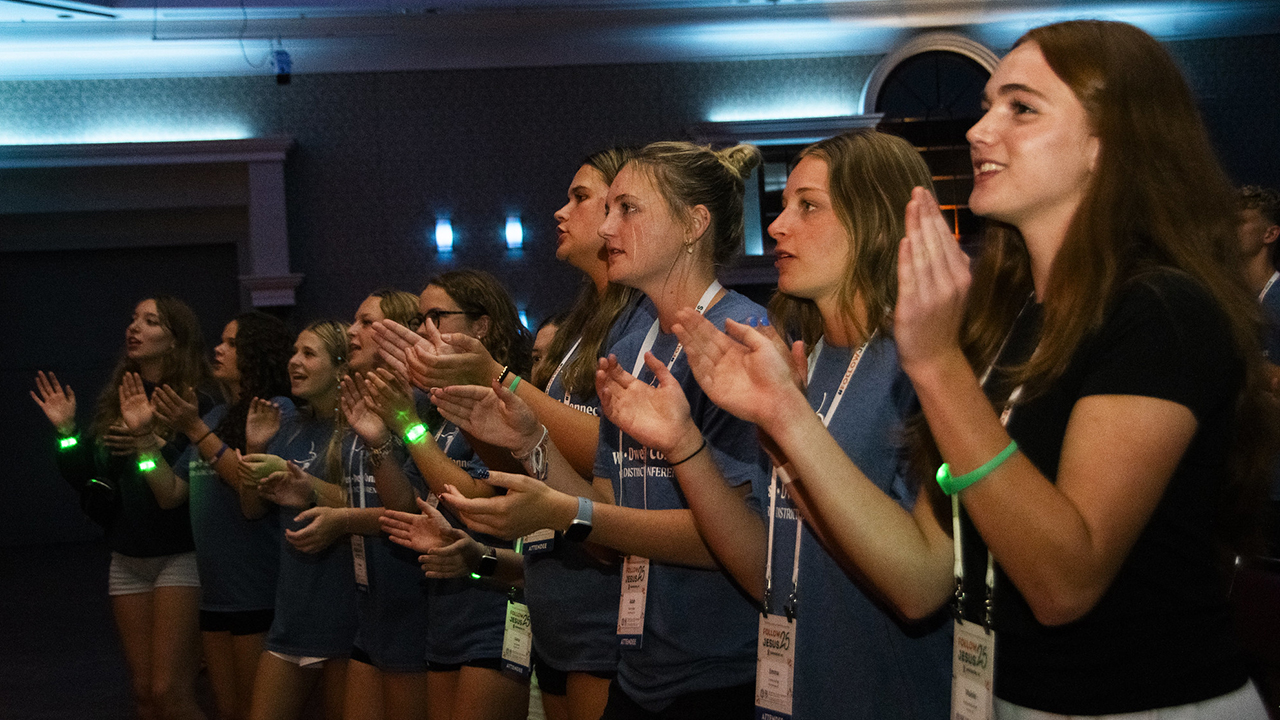
Of the 1,640 people at the Mennonite Church USA convention, 555 were high school youth, with 188 youth sponsors. There were seminars and even a party tailored to youth. For many, the convention was a place to build relationships, learn and grow in faith.
Sofia Brubaker of Lancaster, Pa., appreciated seminars that presented “ways I wouldn’t have thought about situations and ways that we can solve those situations and work our way through them peacefully and in a way that is sharing God’s word and promoting Christianity and being a Mennonite in a way that is doing good work.”
One of the seminars Brubaker attended was “What to Do About Gun Violence,” led by Mike Martin, founder and executive director of RAWtools.
RAWtools offers programs and resources to safely destroy guns and turn them into garden tools — a reference to Isaiah 2:4: “They shall beat their swords into plowshares.”
While the guns are being turned into garden tools, Martin said, RAWtools also provides nonviolence training. It’s “our responsibility to help learn new skills to solve conflict,” he said.
Brubaker said: “I really like promoting pacifism and getting violence out of neighborhoods and providing ways that help different people feel safer in other places and reducing the violence from firearms. . . . I think it’s really meaningful and a really good way to do God’s work.”

Another seminar that addressed gun violence was “Arms 2 Art: Collagemaking with Recycled Gun Cases.” Lisa Longacher, vice president of advancement for Hesston College, has been working with RAWtools for years on making art with fabric and other pieces from old gun cases. She said she wanted to teach the youth to artistically express their opinions.
“I hope that they can go and feel really good about what they created and apply that going forward, even if they’re going to a march instead of just drawing [and] writing out some words — make it pretty, make it fun,” Longacher said.
Many of the posters included messages like “peace,” “end gun violence” and “war no more.”
“I am so excited to see this many [youth] . . . and that they’re all doing it,” Longacher said. “Everyone is creating, and it’s just making my heart full.”
Multiple seminars addressed the internet and social media. “Socially Smart: Exercising Wisdom in a Digital Age” was led by Trey Ferguson, a pastor at The Intention Church, an online church, and the executive pastor at the Refuge Church in Homestead, Fla.
Ferguson suspects the internet is a terrible place. “They call it social media because of the connections with people, but then they also have this double-edge thing where sometimes we can disconnect with other people,” he said. “Because at the end of the day, it wasn’t designed for any purpose other than monetizing your attention.”
Reflecting on what he learned from the seminar, Omar Perdomo of Lancaster, Pa., said, “Social media can be dangerous, but there’s also ways to spread the gospel, to share peace and love to others and to just be a good person online.”
Through the convention, Perdomo said, “I hope to grow closer to the Lord to know more about him and to get to know more people and friends.”

Going further into theology, Eli Reimer, a 2022 graduate of Goshen College and a student at Yale Divinity School, led a seminar on “How to Stump Your Pastor: Why Doubt Matters.”
“I’m not giving you any answers,” Reimer said. The people to do that are the youths’ pastors. Reimer said doubt is important because questioning is a way to learn.
They argued that doubt is good theology. Doubt is shown throughout the Bible. It can be seen from Job to Matthew 27 and Mark 15, where Jesus’ last words on the cross are, “My God, my God, why have you forsaken me?”
Reimer said Anabaptists’ belief in faith as an active choice and interpreting the Bible as a community are great reasons to have doubt.
“It’s not a true choice if you’re just being raised in a faith and never question it,” they said. “The idea of questioning your pastor is very Anabaptist because that’s kind of the whole deal, as you’re supposed to be talking back and forth with each other.”
Some of the questions Reimer offered to youth to ask their pastors included: “Why do bad things happen to good people?” “Are Mennonites the only right religion?” and “What makes you qualified to be a pastor?”
Touching on current events and contrasting theology, another seminar covered “Why the Bible Matters for Challenging Christian Nationalism.” Drew Strait, associate professor of New Testament and Christian origins at Anabaptist Mennonite Biblical Seminary, introduced Christian nationalism and how the Bible is used within a Christian nationalist context.
Strait said that while Christian nationalists use reductions or selections of scripture to justify their actions, the most important way to counter that is to “bear witness to the whole life of Jesus.”
While there is an assumption that older people are the main advocates of Christian nationalism, Strait said it is also seen among young people, especially in the “Theobro” movement — YouTube channels and podcasters radicalizing youth into Christian nationalism.
“White Christian nationalism is a Christian problem,” Strait said. “This is an in-house problem, and I think that the church or churches are ground zero for mobilizing a nonviolent resistance movement against it.”
In addition to the seminars, there was a party for youth titled THE BOP. Hosted in Club Fifth at the convention center, the party included free popcorn, line dancing and karaoke.
Mia Gredler of Harrisonburg, Va., said, “When I first walked in, I was very shocked. I was not expecting all the lights, all the seating, like the smoke, the really cool stage — it was just so fun to walk in and feel like, oh, this is a party.”
Gredler said THE BOP and the convention as a whole helped her grow new and old relationships, especially through singing and dancing together.
Initially hesitant to do karaoke, she later said, “Why not? What do I have to lose? . . . That stage felt very fun and getting people hyped and just singing along, too. . . This has been my favorite part of the summer, and I’m always looking forward to this experience. It just makes me really, really happy.”



Have a comment on this story? Write to the editors. Include your full name, city and state. Selected comments will be edited for publication in print or online.