


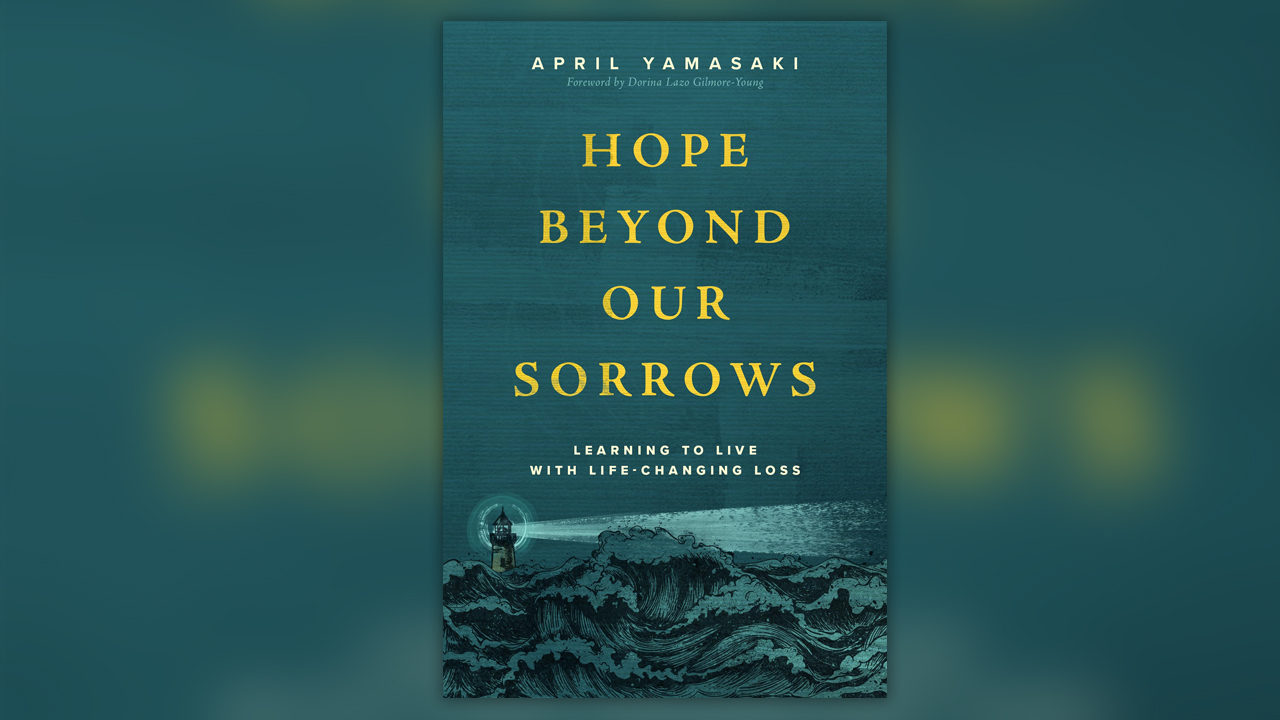
In the aftermath of her husband’s death, April Yamasaki couldn’t finish reading a book, let alone start writing one. Her heart was shattered, her mind scattered. An author, pastor and editor, she wondered whether she could continue those joy-giving roles. She questioned whether she could even carry on with life, as the life she’d known was irrevocably gone.
Still, God’s goodness and mercy sustained her through her grief. Hope Beyond Our Sorrows traces this goodness and mercy through Yamasaki’s grief journey, providing comfort for others facing loss: of a partner, a parent, a child; of a cherished job or home; of health or marriage. It speaks to all of us, because facing loss and seeking comfort are parts of what it means to be human.
Yamasaki and her husband, whom she calls “Dearheart” in the book, married when they were 21 and had almost 45 years together before he succumbed to complications from cancer. He had already survived one bout of cancer and, after a three-week hospital stay that interrupted his chemotherapy, seemed to be improving. They were looking forward to his homecoming and to continuing the life they shared in British Columbia. But he took a turn for the worse and, just when he seemed to be getting better, was suddenly gone.
Thirteen months would pass before Yamasaki wondered if she could write more than a short blog post or review. After seven more months, she put together a book proposal about grief at the invitation of Herald Press. Then another seven months passed before she wrote an initial chapter. Some days she wondered if she was capable of completing a book about grief. And yet she succeeded, creating a volume that not only charts her own grief but offers guidance for others to recover hope and joy.
The slim length of the book, and of each short chapter, is intentional. Yamasaki knows how difficult concentrating could be after experiencing loss, and she wanted to write short chapters accessible to grieving readers. The first section’s chapters are particularly brief, offering readers easily digestible (and empathetic) wisdom to carry them through the shock and pain of “early grief.”
In the immediate weeks and months, a person’s focus should be on the elemental parts of survival: learning how to breathe when taking breath feels impossible, eating food for sustenance, finding space to rest and leaning on others to help provide care.

Subsequent chapters, organized into sections around “middle” and “present” grief, reflect the movement Yamasaki herself took through the stages of grief. She affirms that grief is not linear, and that everyone’s grief journey will unfold differently. The book’s structure reflects this reality, and readers are invited to dip into chapters that speak to their relationship with grief rather than adhering to a predictable timeline.
Even Elisabeth Kübler-Ross’ well-known stages of grief were not meant to be prescriptive, Yamasaki argues, noting that Kübler-Ross believed “our grief is as individual as our lives.” When she read Kübler-Ross’ words, Yamasaki felt she’d been given permission to grieve in her own way. Hope Beyond Our Sorrows extends that permission to readers with reminders that while our grief journeys are individual and unique, grief is a universal experience best navigated through relationship with others and with God.
Yamasaki turns to scripture to illuminate what can feel to those in grief like a darkened path. She provides examples to show that we are not alone: Job, Naomi, Ruth, David and Jesus experienced profound sorrow; and God remains present to those who grieve. The resurrection story itself reflects God’s comforting presence, Yamasaki says, as Mary expresses her grief at an empty tomb. When Mary encounters the risen Jesus, he affirms her sorrow — asking her why she is crying — and then calls her by name. “That’s how God’s resurrection power works,” she says. “While it’s still dark, when we’re numb with grief, when confusion reigns, when tears blur our vision, God is at work to bring new life and renew our joy.”
Each chapter ends with “Hope Practices” to help readers process their grief through journaling and reading, how to memorialize loved ones who have died and how to express grief through giving to others and to God.
As the title suggests, this is ultimately a hope-filled book. Having experienced God’s presence in her own grief journey, Yamasaki ends with good news: “When we feel paralyzed, when we feel too tired or weak or wounded to move, God comes to you. God comes to you now, even in this moment.”
Melanie Springer Mock is professor of English at George Fox University in Newberg, Ore.


Have a comment on this story? Write to the editors. Include your full name, city and state. Selected comments will be edited for publication in print or online.