


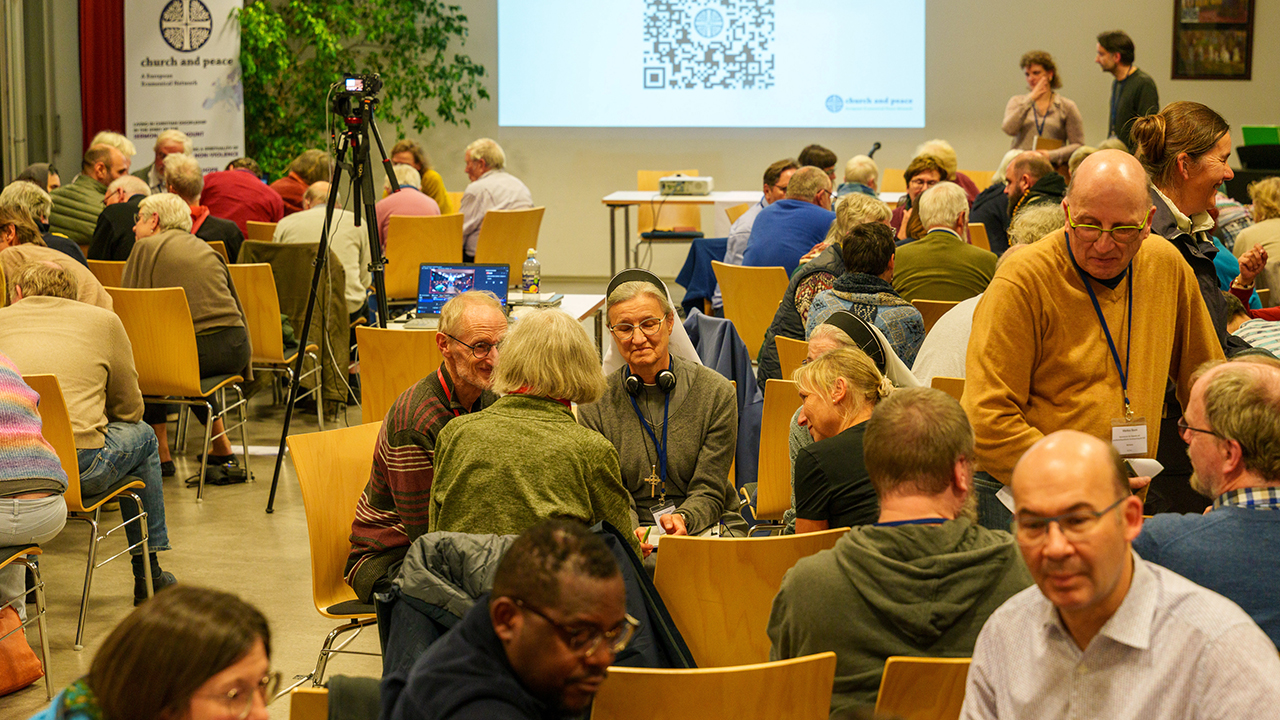
Church and Peace, a European ecumenical network that includes several Anabaptist organizations, learned about East European experiences of transformation at its annual European Conference Oct. 24-26 in Herrnhut, Germany.
The Herrnhut Moravian Church welcomed around 120 participants from 19 countries to the gathering under the theme “Don’t let yourself be hardened in these hard times … Resist, reconcile, transform.” Herrnhut Moravian Church is considered the birthplace and “spiritual home” of the global Moravian Church after exiles from Moravia fled to Saxony in 1722.
In her words of greeting, Herrnhut’s Pastor Jill Vogt recalled Bishop Johann Amos Comenius, who in 1667 circulated the memorandum angelus pacis/Angel of Peace. Retiring Church and Peace chair Antje Heider-Rottwilm praised him as a peace diplomat, peace educator and founder of a peace ethic.
Marie Anne Subklew-Jeutner from the Institute of Peace Church Theology at the University of Hamburg and Benigna Carstens, pastor of the Moravian Church in Dresden, recalled the hardened time of the Cold War when, in 1981, Pershing II missiles in the West stood facing SS-20 missiles in the East.
They shared about what helped them not become hardened, but involved, through years of doing peace theology in congregations and of church leaders making clear statements. Other factors were the rejection of the spirit, logic and practice of military deterrence and the conviction that conscientious objection is one of the clearest signs of a Christian commitment to peace.
Participants underlined the call for all European states — and beyond — to protect the right to conscientious objection to military service as a human right, as recognized by the United Nations, particularly in view of the current debates about compulsory military service. Alternatives such as peace services and social defense, similar to civilian service, should be urgently expanded.

“When did we Germans ever successfully carry out a revolution — without bloodshed, without war and victory and humiliation of other human beings and nations?” asked Subklew-Jeutner. “It is a miracle of biblical dimensions, says the theologian in me. It was the multifactorial interplay of configurations at home and abroad, says the political scientist in me. Both are true, I say from experience.”
Benigna Carstens described reconciliation, according to Comenius, as “the return of two or several parties to their original love after suffering hurt” to shed light on the two former German states. In East Germany, people did not get the feeling there was proper appreciation of what civil society had contributed to bringing down the Berlin Wall, so a critical attitude developed after the political system changed. She warned against our “despising the ‘masses’ from the ‘right standpoint of peace’ in view of their growing readiness to subject themselves to powerful, violent men.”
Roman Zábrodský, Hussite theologian from Prague, Czech Republic, spoke in his Bible study on Ezekiel 36:26 of the necessary inner transformation that leads to a new identity of the person and society. This new identity allows them to realize their own share in violence and deal with violence differently than merely exercising counter-violence. It leads to resisting violence and showing solidarity with the oppressed.
Bishop Friedrich Kramer, peace spokesman for the [Protestant Church in Germany] EKD Council, commented on the 1968 song by Wolf Biernmann that inspired the conference theme, “Du lass’ Dich nicht verhärten” (Don’t Let Yourself Get Hardened) from the perspective of Jesus in the Beatitudes. He named the challenge of not hardening our hearts today, either. It is crucial to diminish hate every day in order to see God’s face in other people. Referring to EKD’s new peace memorandum that appeared in November, Friedrich Kramer noted that “it maintains the ideal of just peace.”
Other presentations addressed nonviolent actions used by Democratic Republic of Congo student organization LUCHA to respond to rebel group occupation, a large nonviolent movement against corruption happening in Serbia, opportunities for political advocacy in Lithuania, countering right-wing extremism and xenophobia through entertainment in Germany, and an Orthodox view of how the Russian invasion of Ukraine has caused Belarus to regard even slight civic engagement as extremism.


Have a comment on this story? Write to the editors. Include your full name, city and state. Selected comments will be edited for publication in print or online.