


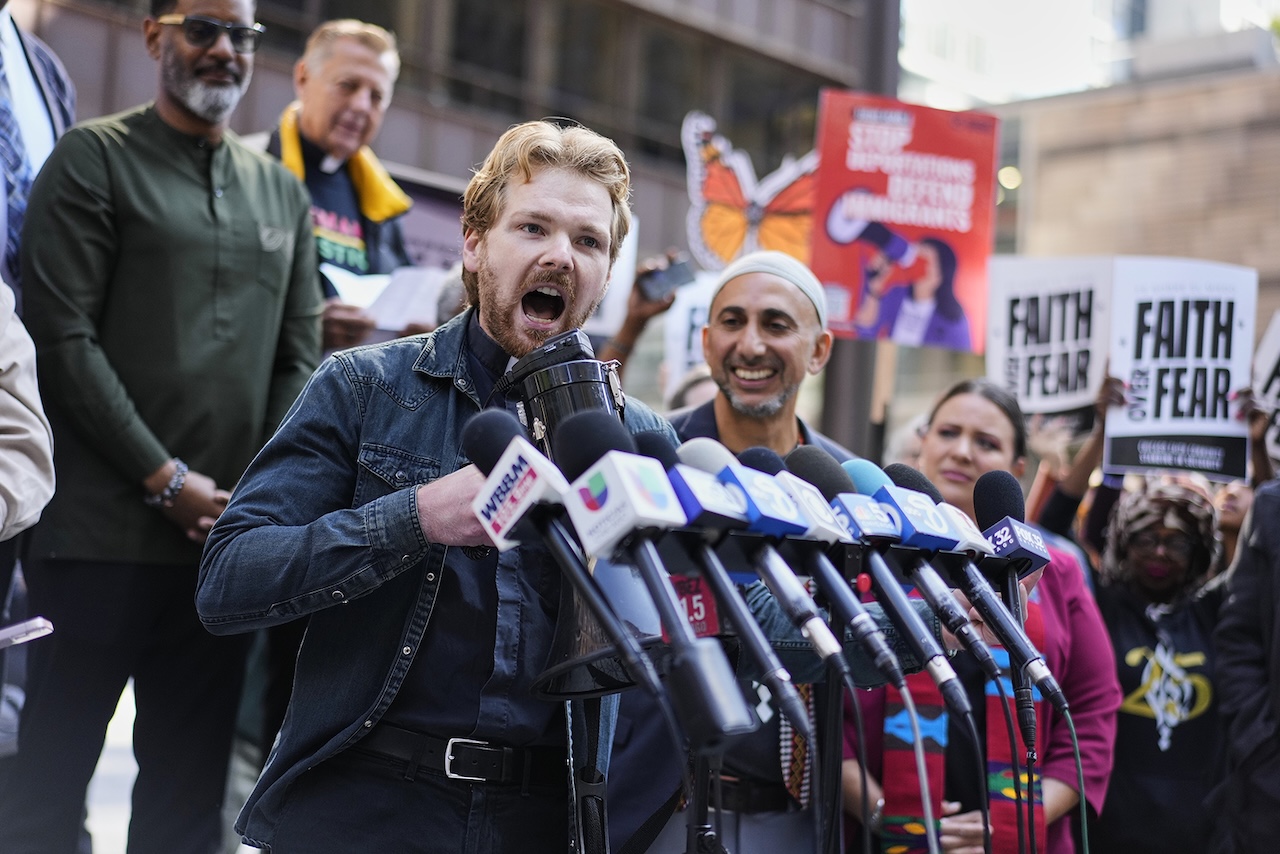
Near the end of David Black’s time on the stand in a federal courtroom in Chicago this month, the judge asked the Presbyterian Church (USA) minister how his faith was holding up.
Black was there to testify in an ongoing lawsuit against President Donald Trump’s administration regarding the use of force by federal immigration agents against protesters. That includes Black himself: he was shot in the head and body with pepper balls as he was praying outside an Immigration and Customs Enforcement detention center in Broadview, Illinois, in September, according to a video captured that day.
According to Chicago journalist Dave Byrnes, Black responded to the judge by saying his experience in Broadview had only deepened his faith, adding, “This is the consequence of preaching the gospel to a government that is not unlike the Empire of Rome.”
It was the kind of radical spiritual defiance Black has come to be known for since he was thrust into the national spotlight for his activism outside the Broadview facility, where critics allege immigrants inside are being mistreated and where a growing number of fellow faith leaders have repeatedly protested the actions of ICE and Department of Homeland Security agents. Images of Black, who has been lauded by politicians and fellow activists, being shot with pepper balls and pepper-sprayed by police have come to represent faith-based opposition to Trump’s mass deportation agenda and earned renewed attention to liberal-leaning religious beliefs.
But in a pair of phone interviews with Religion News Service, Black, who has protested at Broadview numerous times, insisted his spiritual message isn’t new and that the focus should ultimately remain on immigrants, and not just aggressions against clergy. He also stressed that he is not alone, and that a wide network of faith leaders continues to show up at Broadview, despite the danger. He referenced Hannah Kardon, a Chicago-area Methodist minister who was recently arrested while protesting outside the Broadview facility, and noted other clergy have also been struck with pepper balls while protesting there.
Black, who “grew up in evangelical missionary churches all around the world” before becoming a Quaker in college and eventually being ordained as a Presbyterian minister, is quick to argue that while messages he preaches at Broadview are attracting attention today, they’re rooted in an old, widely known theology which he frames as “fundamentalist.”
“Fundamentalism is just talking about the basics of what Jesus says, what the Bible instructs us, and what our theology and doctrine calls us to do to believe,” he said. “When we are fundamentalists about those things, it really provokes us to be taking a very progressive stance in the world — or at least a stance that reads to the world as politically progressive — because it’s a stance that’s fundamentally nonjudgmental, fundamentally rooted in love, solidarity and interest in mutual aid and compassion.”
Black pointed to the church where he serves as senior pastor, the First Presbyterian Church of Chicago, as an example of this tradition, calling it a “church of troublemakers, misfits and mystics.” Believed by many to be the oldest congregation in the Chicago area, the church — often referred to as First Church — has also long been among the city’s most unapologetically progressive. It is said to have organized the region’s first abolitionist society and been active in the local temperance efforts — the latter out of concern that workers were being exploited by bosses who would “ply them full of alcohol and then gradually not pay them and only give them alcohol in return for their work,” Black said.
The church also helped organize Chicago-area portions of the Underground Railroad, housed the area’s first public school and was among the first — if not the first — to integrate its classrooms. First Church, Black said, also publicly declared it would disobey the Fugitive Slave Act and later denounced and actively worked against the Chinese Exclusion Act of 1882, which prohibited the immigration of Chinese laborers. According to the church’s website, the congregation eventually hired an interpreter in the 1890s to translate services for the growing number of Chinese immigrants who had joined the church.
These days, First Church describes itself as a “progressive church with traditional theology.” Black says the congregation has seen lots of new faces after his activism made national news.
“We’ve had a lot of new visitors to our church, particularly people who will tell me they’ve never been to church before, or they haven’t been to church since they were little kids, or since they came out of the closet — or whatever the story may be,” Black said.
He added: “I’m seeing almost a revival of Christianity through what’s happening at Broadview in Chicago.”
Quincy Worthington, another Presbyterian minister who has attended protests at Broadview with Black on multiple occasions, said he understood why Black’s encounters with DHS agents have attracted so much attention.
“I think it causes a shock to the conscience of good people, moral people, people who are deeply faithful, to see a man who is just doing his best to follow Jesus and call for mercy to be met with such excessive violence,” Worthington told RNS in a text message.
He added: “I can’t help but think what happened was the kingdom’s way of bringing into the light what the empire is trying to do in the darkness.”
At the same time, Black’s activism has been derided by DHS, which called him a “pastor,” using quotation marks, in an X post that referred to the footage of him being shot with pepper balls. A Newsmax anchor accused him of being “an Antifa member masquerading as a pastor.” And concerns about the treatment of Black and other clergy protesting at Broadview have been dismissed by Republicans such as House Speaker Mike Johnson, a Southern Baptist.
Black has continued to demonstrate at Broadview, recently preaching a kind of sermon in front of police during a demonstration. And while Black himself is not at every protest, the numbers of faith leaders willing to demonstrate at the facility are only increasing: At least seven others were arrested at a single protest staged outside the building last week.
Meanwhile, Black said his church is beginning work on a “deliverance ministry” — an effort he says is a response to Jesus’ call to “heal people and cast out demons.” He argued activists who have protested at the Broadview facility “are recognizing that there is a demonic presence” associated with the building and that the Christian tradition “has very direct and plain ways of dealing with it.”
“For us, it’s about people’s personal experiences of oppression and repression and suppression being cast out of them in very literal, embodied ways — but also the ways that we’re doing that on a systemic level,” he said.
The task before them, Black said, is how to cast “demons out of American politics, and out of the institutions that enable things like ICE and ICE’s operations.”


Have a comment on this story? Write to the editors. Include your full name, city and state. Selected comments will be edited for publication in print or online.