


![Dickinson College certificates honor the 19 Cheyenne and Arapaho children: “This certificate is offered in recognition of [a] life full of promise, which continues to shape our shared memory and understanding. May who they were, and all they were meant to become, guide us toward truth, healing and justice.” — Camille Dager/MC USA](https://d1j7svwn1w6x2c.cloudfront.net/wp-content/uploads/2025/12/Dickinson-Certificates.jpg)
On a cool September evening in Carlisle, Pa., 19 folding chairs waited on the grass in front of Dickinson College’s historic Old West building. Each chair was draped with a tribal blanket and gifts, including delicately beaded name tags, hand-wrapped drumsticks, tribal clan blankets for the boys, shawls for the girls and brightly painted graduation caps.
They honored 19 Cheyenne and Arapaho children from Oklahoma whose lives ended more than a century ago at the Carlisle Indian Industrial School. Ages 10 to 28, they were among thousands of Native children taken from their homes under a government system designed to erase Native identity.
Carlisle, the first federally funded off-reservation Indian boarding school, operated from 1879 to 1918 and became the model for many of the 416 additional schools across the country.
Nearly 7,800 Native children passed through Carlisle. At least 234 died there, from typhoid, measles, mumps and other illnesses, coupled with harsh conditions and abuse. Of those, 190 were buried at the school, located on the grounds of the U.S. Army’s Carlisle Barracks.
In 2017, after decades of advocacy and litigation, the U.S. Army began returning children buried at Carlisle to their families, working tribe by tribe.
The repatriation of the children from the Cheyenne and Arapaho Tribes of Oklahoma, which began in 2023, prompted the ceremony — an unprecedented Native-led honoring created by Cheyenne Chief and tribal historian Gordon Yellowman, in collaboration with Dickinson College’s Center for the Future of Native Peoples and the U.S. Army.
People from Koinonia Indian Mennonite Church in Clinton, Okla., Mennonite Church USA Executive Board staff, Allegheny Mennonite Conference and Mennonite Central Committee East Coast stood alongside tribal members — not leading but following.
“This has never happened before . . . this type of honoring, this type of gathering, this type of remembrance that is Native-led in this capacity at a college,” said Amanda Ka’ow’dthu’ee Cheromiah of the Laguna Pueblo tribe and executive director of the Center for the Future of Native Peoples. “It is really unique, especially since Dickinson has had a role in and deep connection to the Carlisle Indian Industrial School.” Dickinson professors served as chaplains and faculty at Carlisle.
Mennonites have deep connections to the school. Mennonite missionaries helped transport children there, as a letter from U.S. Army Lt. Richard Henry Pratt, founder of the Carlisle school, indicates. Mennonite teachers and administrators staffed Carlisle and other Indian boarding schools, and Mennonite farmers participated in Carlisle’s summer Outing Program, which placed Native children in White households as child laborers.
That legacy made Mennonite participation in the honor ceremony both unexpected and deeply significant.
“This is the first time tribal leaders have invited MC USA to participate via Koinonia Indian Mennonite Church,” said Iris de León-Hartshorn, MC USA associate executive director of operations. “We are walking alongside Koinonia Mennonite Church, letting them lead, present, lament and celebrate. We intentionally did not take the lead. We assisted where we were asked.”
Koinonia Indian Mennonite Church is the oldest Indigenous Mennonite congregation in North America. It was founded on the Cheyenne and Arapaho reservation in 1894 by missionaries with the General Conference Mennonite Church Mission Board (now Mennonite Mission Network).
Koinonia pastor and MC USA Executive Board member Susan Hart coordinated preparations, mobilizing church members to create handmade gifts for each child. Hart, like many other members at Koinonia, are descendants of Carlisle students. Her great-grandfather, Cheyenne Principal Chief John Peakheart, attended the school.
The Koinonia youth group, guided by cultural director Roger Davis, hand-wrapped drumsticks for the boys. AJ Spottedwolf (Cheyenne name: Voestaa’e, meaning White Buffalo Calf Woman) and Eddie Heap of Birds painted the graduation caps in ledger art style, a Plains Indian tradition.
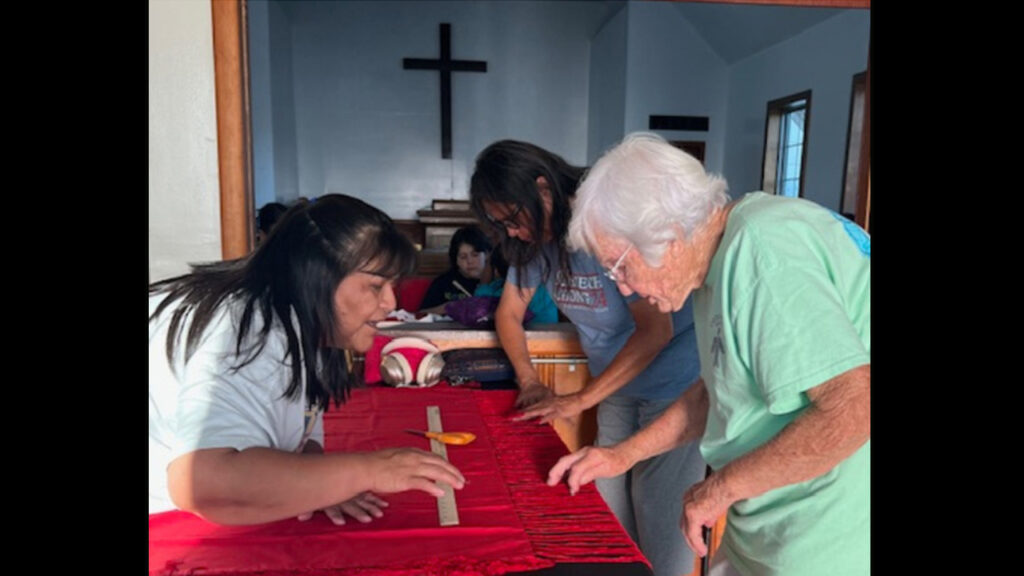
“I felt like I was honoring the kids, since they weren’t able to graduate or come home,” said 16-year-old Spottedwolf, who has won several youth art awards for her work.
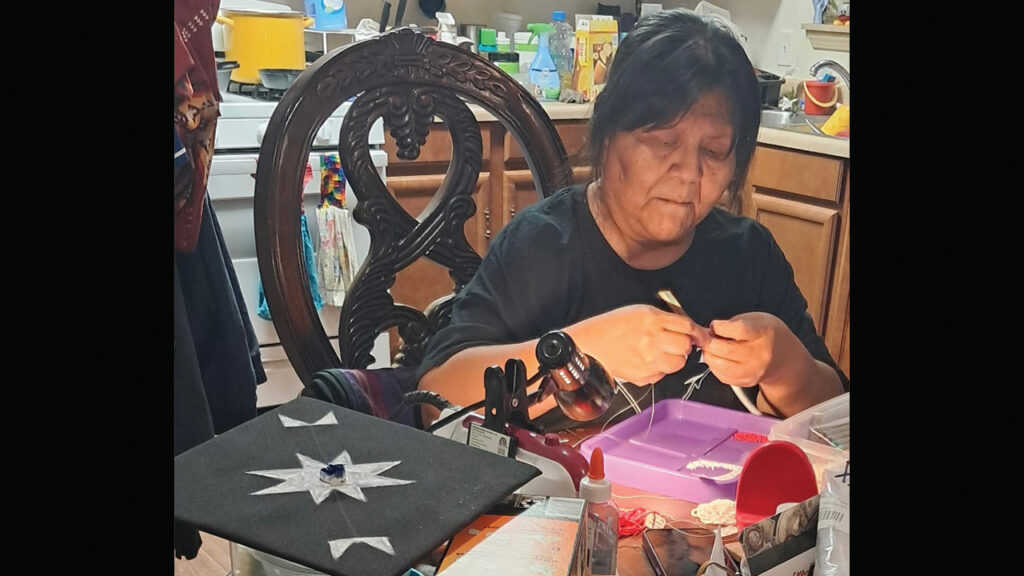
Older women prepared clan blankets and shawls and beaded the names of the children on the graduation caps.
Ruth Bearshield was one of the women who beaded the caps. “I made flowers and hearts in assorted colors, things I thought would be appropriate for little kids,” she said.
Though not related to the Carlisle children, she noted that their stories struck close to home: Her own ancestors were imprisoned by the U.S. Army at Fort Marion, Fla., and died there.
Allegheny Mennonite Conference helped raise funds for traditional burial regalia for the children’s burial.
“Susan asked for $1,000, and we raised $1,600 very easily,” said conference minister Amy Yoder McGloughlin. “We recognize that this is not final repair, but it feels like such a holy thing to be able to participate in something so tangible.”
Other donors included MC USA, MCC Central States and Boulder Mennonite Church in Colorado.
MC USA and MCC’s repair work with Koinonia extends beyond this ceremony. Since 2022, they have partnered in Project SACRED (Solidarity, Acknowledgement, Collaboration, Recognition, Education, Dignity), created to address the physical, mental and spiritual trauma resulting from Mennonite-run residential schools in the United States.
“This project provides assistance in creating a path for the Cheyenne and Arapaho Tribes’ Mennonite communities to properly address and begin to heal from the multigenerational trauma that has its roots in the Mennonite-run residential schools,” explained Hart, noting Mennonites operated several schools in both the U.S. and Canada.
MC USA staff, including Lorraine Stutzman Amstutz, denominational minister for peace and justice, have accompanied tribal researchers to the Mennonite Library and Archives at Bethel College in North Newton, Kan., provided transportation and offered logistical support — small acts, but steps toward repair.
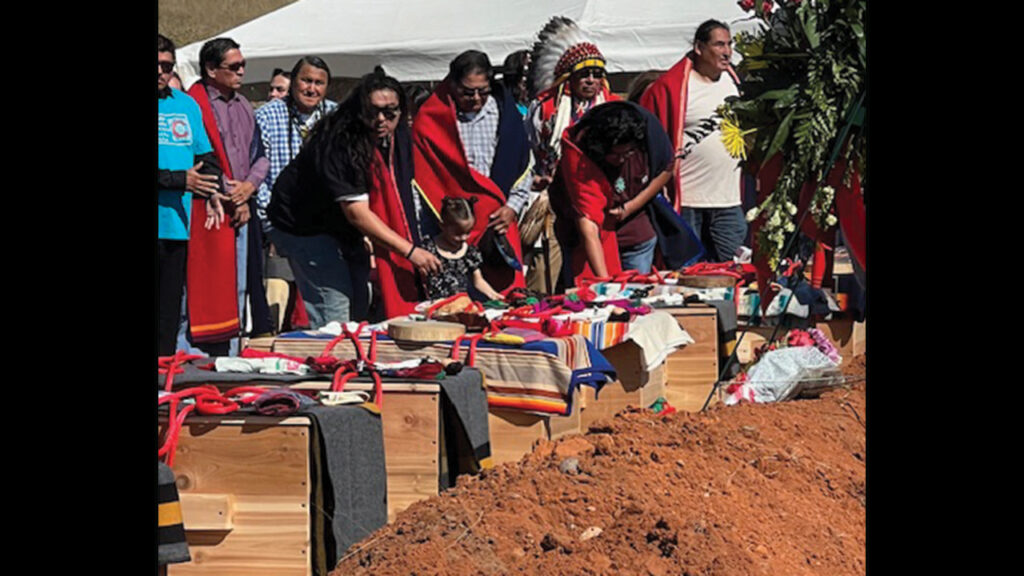
During the ceremony, tribal leaders spoke and prayed in their native languages, while families read biographies prepared by the Center for the Future of Native Peoples from fragmented historical records.
Each life was a world interrupted:
— Nannie Little Robe, daughter of Chief Little Robe, was known as a gifted pianist. She earned a standing ovation at a school exhibition. Her life “sunsetted” at age 17.
— William Ghost Leg Sammers, assigned to shoemaking, attempted escape but was arrested and returned. He died two years after arriving, at age 19, with his brother at his side.
— Percy Whitebear, who arrived at age 16, earned wages doing farmwork. Three years later, he contracted pneumonia on a work outing and died. The school withheld some of his wages to pay the doctor who treated him.
Stutzman Amstutz was invited as one of three storytellers.
“As a church, we are now coming forward to ask what we can do to help honor the children and families,” she said. “Living out our faith means respecting the value of restorative justice that calls us to an understanding of right relationships with one another that are interdependent and interconnected.”
The morning after the honoring, the Army began exhuming the children. Pastor Hart offered a graveside prayer: “May this act of disinterment be not only a lifting of the earth but a lifting of the pain carried for generations.”
Despite physical forensic analysis, three children (Willie Curley, George Harrison and Abe Lincoln) could not be positively identified — and are unlikely to be found, an irrevocable wound caused by poor recordkeeping.
The children’s remains were brought to a funeral home in Oklahoma on Oct. 5. A procession of white hearses traveled to a hilltop cemetery on the Cheyenne and Arapaho reservation, north of El Reno. Their plain wooden coffins were draped in clan blankets and placed in tipis, guarded through the night by members of the Dog Soldiers Society.
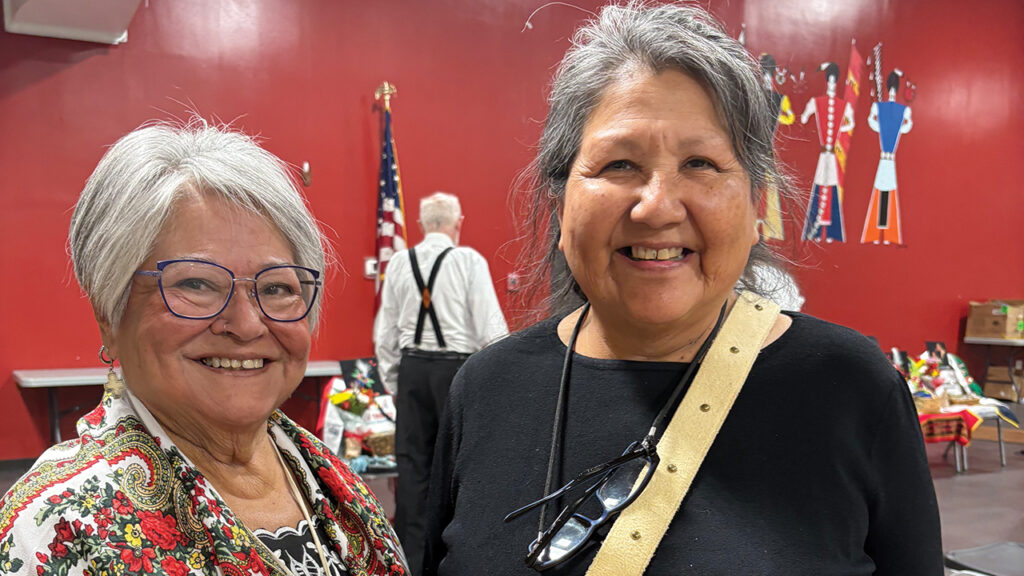
That evening, families and tribal leaders gathered at the nearby Concho Community Hall with members of Koinonia Indian Mennonite Church and leaders from MC USA, Western District Conference and MCC Central States for a wake.
Family members eulogized the children, speaking with rising emotion about the abuses their relatives endured. Children were forced to abandon their Native languages and punished for speaking them. They were marched through rigid schedules, dressed in uncomfortable uniforms and put to work making shoes, tailoring or farming for White families instead of learning traditional skills at their elders’ sides.
Visitors to the school recalled photographs in which none of the children smiled, and they viewed drawings — never shared with parents — of tipis, horses and home, revealing what the students longed for most.
The families honored the children’s courage, acknowledged the trauma endured by returning students and mourned the losses that rippled across generations.
They also proudly spoke of community resilience, noting that tribal women made the 1,300-mile journey to Carlisle and set up camps outside the school property to see their children.
“They lost their innocence,” said Lt. Gov. of the Cheyenne and Arapaho Tribes Hershel Gorham. “The children lost the very essence of who they were, because [the government] took them for one purpose — to destroy the Indian culture and language. They almost succeeded, but we’re still here. ‘Kill the Indian, save the man’ did not work.”
Gorham’s statement is a reference to Lt. Pratt, whose self-proclaimed mission was to separate Native children from their “savage language, superstition and life.”
De León-Hartshorn offered the final blessing. “May the Creator hear my heart of sorrow and commitment to walk,” she prayed. “May . . . the love of the Creator provide the comfort and love we need . . . as we lay these children in their final resting place, home at last.”
The following day, Cheyenne and Arapaho gathered one last time to honor the children at the small hillside cemetery. Prayers in Native tongues, solemn drumbeats and songs floated above the plains. Little girls in bright ribbon skirts and boys with long braids ran through the grass, with a freedom for which the Carlisle children longed.
Clan blankets were carefully tucked around the students’ caskets. Family members filed past each small grave, with handfuls of earth, offering heartfelt blessings. The children were finally home.
The Carlisle school was the flagship of the federal Indian boarding school system. The Federal Indian Boarding School Initiative’s 2024 report documents at least 973 student deaths across 417 schools, with more than $23 billion (in 2023 dollars) invested in the project of cultural destruction.
At Carlisle, children’s hair was cut, their names changed and their languages forbidden. Communication with families was discouraged, and letters home were often never sent. Survivors and descendants testified to sexual abuse, forced pregnancies and corporal punishment.
Yet the children endured. Their families followed them across the country. Their peoples’ culture, traditions, religion and language survived.
And today, Mennonites are beginning to reckon with their part in that history.
At the September honor ceremony, Stutzman Amstutz prayed: “May we never forget. May we honor the children by working for a future where every child is cherished, every culture respected and every community free to flourish.”
Through the leadership of Koinonia Indian Mennonite Church and the partnerships forming through Project SACRED, MC USA is taking small, imperfect and necessary steps toward repair.
The homecoming of the Cheyenne and Arapaho children is not an end. It is an invitation: to remember, to repent and to walk humbly in solidarity with Native communities as they reclaim what was taken and restore what can still be healed.


Have a comment on this story? Write to the editors. Include your full name, city and state. Selected comments will be edited for publication in print or online.