


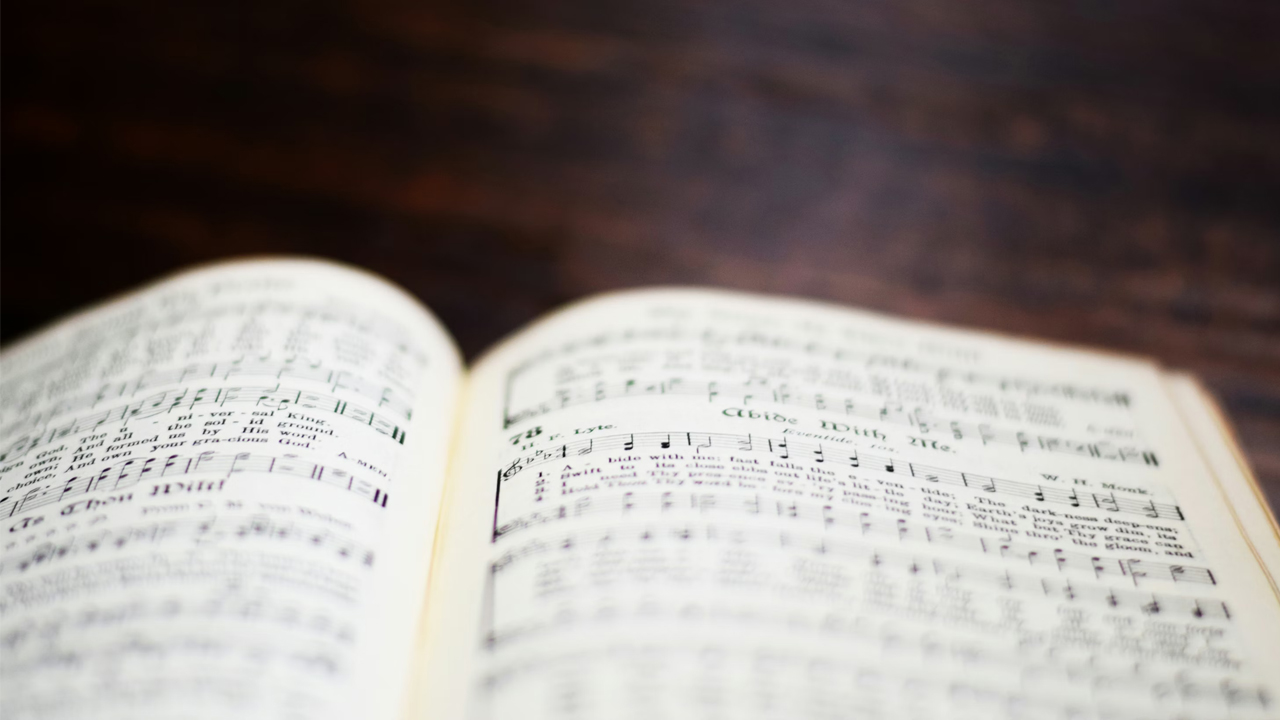
It is not enough to have a song on your lips. You must also have a song in your heart. ― Fanny Crosby
One of my earliest memories is of lying in bed in the morning, listening to my mother sing in the kitchen downstairs. Hearing her voice, combined with the sounds of food being prepared, made me feel safe and loved.
My mother loves singing, and she particularly loves hymns. She used to say the Bible is the most important book in the house, and the hymnal is a close second.
She sang with me and my siblings constantly. We sang hymns at church a couple of times a week. When I went to our local Mennonite school in seventh grade, we sang hymns in chapel and in choir every day.
Singing was an essential part of community life, socially and spiritually.
Mennonites aren’t the only denomination with a strong hymn tradition, though we are distinctive in our practice of a cappella singing.

Recently I went to Cleveland, Tenn., for the 75th anniversary celebration of the Church Hymnal, known as the Red Back Hymnal.
The Church Hymnal is published by the Church of God, a Protestant denomination of the holiness tradition, birthed in Tennessee in 1886. Yet it can be found in more than a few other denominations’ pew racks on a Sunday morning.
About 6 million copies have been printed since it was first published in 1951. It is particularly known for gospel hymns like “Blessed Assurance,” “Just a Little Talk with Jesus,” “What a Friend We Have in Jesus” and “I’ll Fly Away.”
Singing from the Red Back Hymnal at the celebration, many of the people had the words and music memorized.
Something magical happens when voices join together in song. When the singers draw meaning and emotional and spiritual significance from the music, it is miraculous.
I am fascinated by the theology squirreled away in the words of a hymn. While most gospel hymns preach atonement and salvation through grace, there are some outliers. In the mid-1800s, Horatius Bonar wrote that “when the Savior shall make up His jewels . . . his weary and faithful disciples will be remembered by what they have done.”
Another text from the same time period admonishes Christians to “work for the night is coming, when man works no more.”
A retired pastor here in Western North Carolina used to show up at Christian Harmony sings and deliver uninvited rants about the popular hymn, “Passing Away.” He took great offense at the works-based salvation the lyrics suggest: “And must I be in judgment brought, and answer in that day; for every vain and idle thought and every word I say?”
The subject of heaven pops up in most gospel hymns, as one would expect. Sometimes you have to wait for the final verse, such as in “It Is Well with My Soul,” with the clouds rolling back and trumpet sounding.
Other times, the whole hymn basks in the beauty and happiness of heaven, like “I’ll Meet You in the Morning” and “Shall We Gather at the River.”
“Come We That Love the Lord,” possibly my favorite heaven song, is about experiencing heaven while still on Earth — theology that feels extremely Anabaptist. Although not fully realized, we are experiencing God’s kingdom (heaven) here on Earth, right now, as we live faithful lives of sacrificial love and grace (Luke 17).
My Sunday school teachers often quoted Psalm 119, encouraging us to hide God’s word in our hearts. I do have some Bible verses memorized, but I have far more hymn texts buried deep in my gut. These are the words that come to me on a dark night or an overwhelming midday.
“In the darkest spot on Earth some love is found.”
“Strength for today and bright hope for tomorrow.”
“No more a stranger nor a guest, but like a child at home.”
“I know not why . . . but I know whom I have believed.”
“Neither life nor death shall ever, from the Lord his children sever.”
“I owe the Lord a morning song.”
“Love so unending, I’ll sing God’s praises. God loves his children, loves even me.”
What are the hymns that carry you through?
Congregational singing is less robust these days. A praise band or loud organ can drown out individual voices.
And still, people are gathering to sing. New hymns are being written and composed, and the old hymns are passed on.



Have a comment on this story? Write to the editors. Include your full name, city and state. Selected comments will be edited for publication in print or online.