


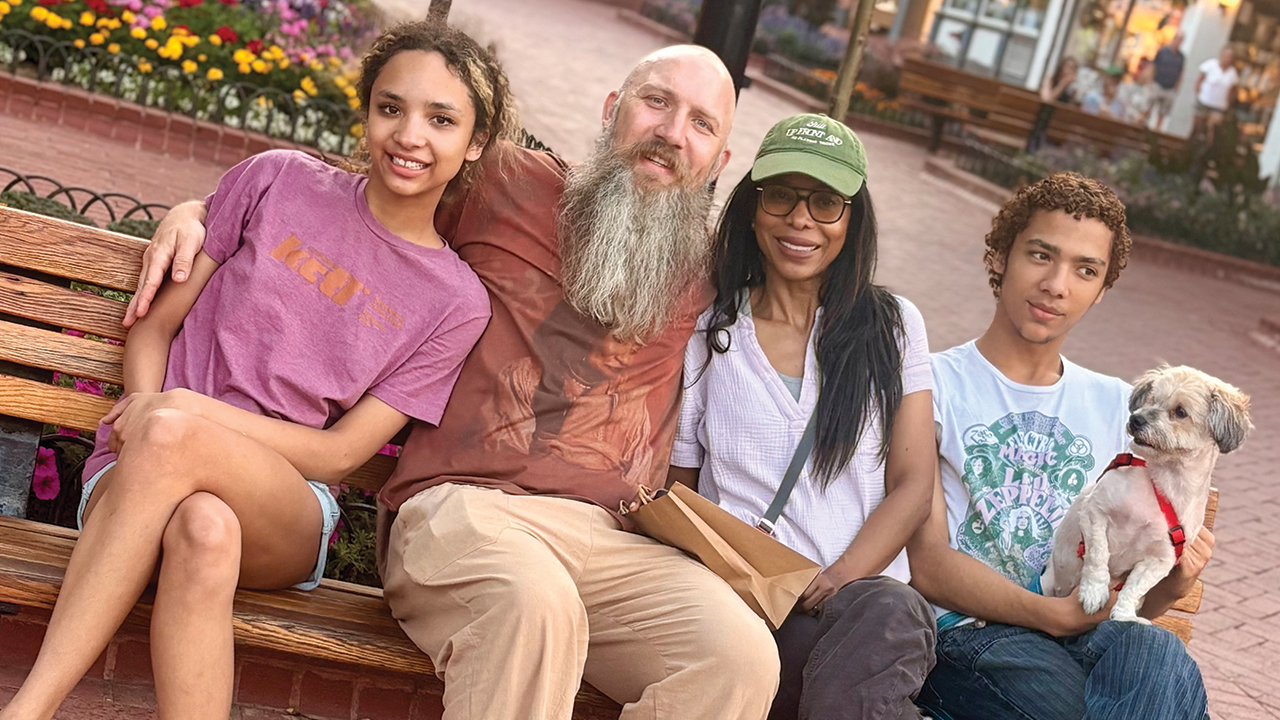
On a gray Monday morning in Manhattan, Jason Storbakken is smiling. We meet at a coffee shop at the intersection of Bowery and Prince, across from The Bowery Mission, where he works as a chaplain.
He’s just finished a chapel service, leading about 70 unhoused people in prayer and meditation. Each weekday he rides his bike from Brooklyn to the Bowery to pray with his congregants, making sure they are nourished physically and spiritually.
“This place is for mutual transformation,” he says of The Bowery Mission, one of the oldest nonprofits in New York City. “Everyone is getting saved one way or another.”
Storbakken — who was the pastor of Manhattan Mennonite Fellowship before concluding that role at the end of 2025 — traces his faith back to his mom. Sixteen years old and unwed when Jason was born, she raised him for the most part.
Although his father wasn’t around much — having become a parent at just 15 — Jason spent time with his grandfather, who waxed poetic about God as they stargazed in the backyard. On Sunday mornings, they went to church together.
“I didn’t enjoy it much, being a poor kid with a single mom living in a trailer park,” Storbakken said.

He felt out of place at Oakhill Bible Baptist Temple, where men wore suits and an American flag hung next to the cross.
He learned what love looked like at his grandparents’ dinner table, where they talked about religion and politics. He appreciated that they made space for different ideas and that things didn’t get personal when they disagreed.
“Even as an angsty teen challenging them, I knew they loved me,” he said.
Storbakken’s grandfather was raised Mennonite Brethren. His grandfather’s grandfather was Hutterite, a communal Anabaptist group. Stories of his ancestors’ spiritual legacy grounded young Jason. He grew up feeling rootless, moving around a lot, even being homeless with his mother for a while in middle school. But knowing his lineage went centuries deep gave him a deeper sense of self.
He left home at 17, two weeks after graduating high school. He traveled west then came back to Wisconsin to work at a cheese factory, saving $100 a week. Then he went backpacking through Europe and Asia, getting baptized in India at an uncle’s mission.
But he wasn’t ready to live a pious life. Returning to the U.S., he attended his grandparents’ church and went to the University of Wisconsin, where he earned a bachelor’s degree in international studies. He traveled in South America, North Africa and Europe until he ran out of money. He came back and worked at Wisconsin Southern Railroad seasonally for four years.
He picked up a Bible again in a South Korean prison. He had gone to South Korea to work as an English teacher. There he hung out with an English teacher named Sam, who, it turned out, was a drug trafficker.
After one of Sam’s packages was intercepted, all of the school’s English teachers had to take drug tests. Storbakken had enough cannabis in his system to fail the test and get arrested. In a jail cell, the biblical story of Jephthah (Judges 11-12) awakened him.
“[Jephthah’s] dad was a nobleman, and his mom was considered a harlot, and he was forced out,” Storbakken said. The story resonated with him because his dad came from a two-parent, middle-class household while his mom worked four jobs to survive.
Remembering his baptism in India, he decided to live his faith more seriously. Like Jonah spewed from the belly of a fish, South Korea deported him.
Back in Madison, in his mid-20s, he pondered the trajectory of his life. His best friends had moved to Brooklyn, and Storbakken joined them, finding work as a writer for publications.
One day, hearing a preacher on a train, he had a spiritual experience that he describes as being baptized in the Holy Spirit.
“I didn’t speak in tongues, but I received power from on high, and I was able to follow Jesus’ teachings somehow,” he said.
He told his girlfriend, Vonetta, that he had found Jesus. She thought he had lost his mind. Three months later, she had a similar experience. (Now they’ve been married for 18 years and have two children, Zipporah and Elgin.)
Feeling called to Christian ministry, Storbakken enrolled at Union Theological Seminary. He earned a master of divinity degree and later a doctor of ministry, writing his dissertation on A Liberation Theology of Sabbath (Boston University School of Theology).
In addition to his chaplaincy at The Bowery Mission, Storbakken directs Brooklyn Peace Center, a community organization for peacebuilding. The center upholds values such as listening for understanding, practicing compassion that leads to connection and recognizing that liberation precedes transformation.
“The decline of the church, to me, isn’t about graying congregations or dwindling membership numbers,” he said. “It’s about the Spirit moving into new spaces, third spaces, like cafés, galleries and community centers, wherever people gather to authentically connect.”
In his book Dhammapada: A Sacred Path Toward Liberation from Harm Cycles (University of Hawaii Press), Storbakken wrote: “To overturn violent systems, it is essential to start by cultivating inner peace and practicing this peace through interpersonal relationships, beginning with breath and the intention to listen to one another for understanding.”
He believes in miracles because of Lori, an unhoused woman who came to The Bowery Mission. He visited her when she was hospitalized after being hit by a car. She never walked the same again and limped slowly around the city. One day while riding his bike home, he saw her lying in an alley, smelling of urine, feces and alcohol.
“Lori, you gotta get up,” he told her. “You can’t stay here. You can go to the Bowery. I’ll tell them you’re coming. You can sleep on a pew for a while until you feel better.”
“No, just say a prayer for me, Pastor,” she insisted.
“It was a half-hearted prayer,” Storbakken recalled. “Like, what can you do about it? This is a horrible situation. But I prayed.”
A month later, Lori came in, clean and walking upright.
“Pastor, your prayer healed me,” she said.
Storbakken thought: It wasn’t me. Lori’s faith healed her.
“Her faith brought forth a miracle that was emotional, spiritual and physical,” he said. “It put her on the path of housing and restoration. To be a part of that, to bear witness to it, it’s nothing less than a miracle.”
Every day, Storbakken prays for faith. Every day, he sees brokenness and beauty. His faith that restoration and flourishing are possible for unhoused people in Manhattan sustains his belief in miracles.


Have a comment on this story? Write to the editors. Include your full name, city and state. Selected comments will be edited for publication in print or online.