


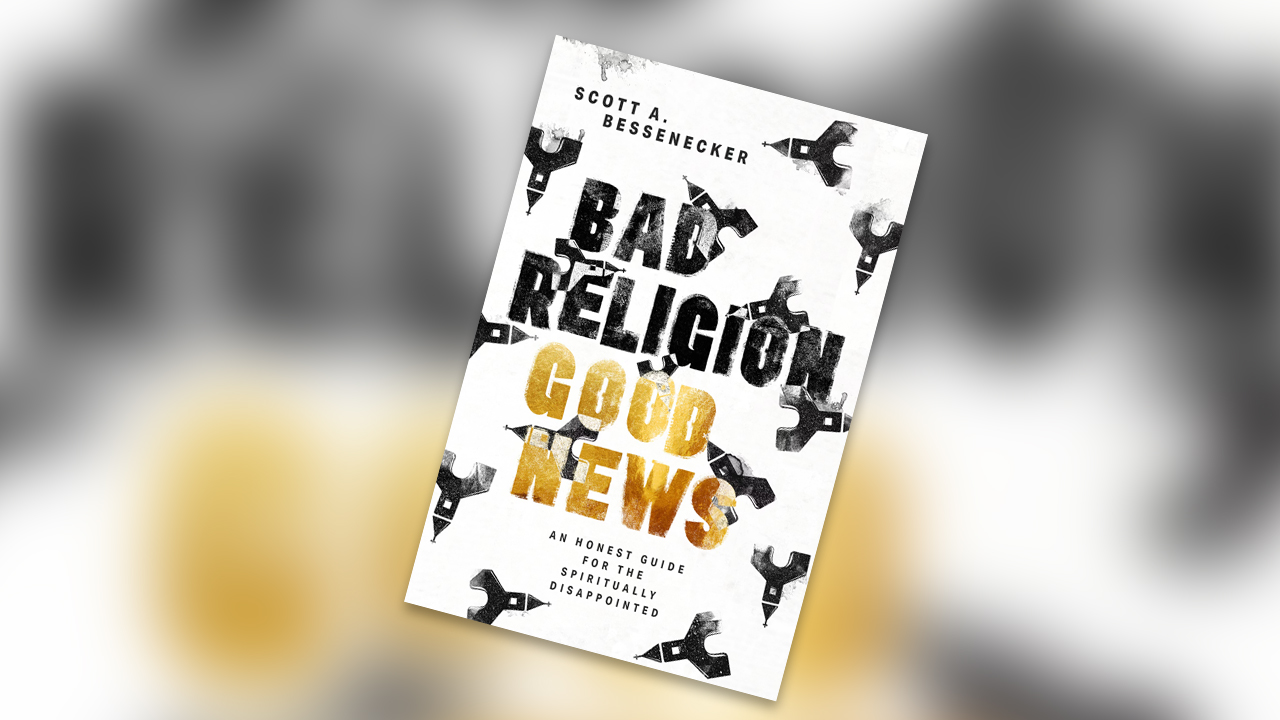
One might think that after a decade’s worth of White evangelical capitulation to President Donald Trump, I wouldn’t feel so much despair when people choose Trump’s empire over fidelity to Jesus and his teachings. Yet I’m anguished about the church in America, its support of cruel politicians and the many ways that Christians are causing suffering, all in the name of Christ. In the words of Scott Bessenecker, I count myself as one of the “spiritually disappointed” — which is why his new book, Bad Religion, Good News, is a necessary read for such a time as this.
Because “following Jesus is no guarantee of good behavior,” Bessenecker says, “the hard truth is that Christians individually and collectively create suffering.” History is replete with examples, including the Rwandan genocide in 1994, when Hutu extremists killed half a million Tutsis, and Christians there “were either complicit in the killings or actively participated in the slaughter.” He cites the sexual abuse scandals that have plagued Catholic and evangelical churches and the willingness of church leaders to cover for abusers. He recalls the Russian Orthodox patriarch’s unwavering support for Russia’s invasion of Ukraine in 2022, which the patriarch called a “holy war” — language echoed now in Secretary of Defense Pete Hegseth’s framing of U.S. attacks on Iran.
These unholy actions are compelled by a “spirit of empire,” Bessenecker writes: “Empire is the act of seeking to exercise power over others to benefit a subset of people. The spirit of empire is at work when people are exploited, when violence is present or when creation is plundered.” Although the spirit of empire leads to bad religion, there is still good news. By naming the pain the church inflicts on others, and by bringing the church’s transgressions into the open, Bessenecker believes we can begin a path toward redemption, affirming that “God is good even when God’s people are not.”
Each chapter explores the disappointments people carry with them: about God and about the church, about Christian missions and the prosperity gospel, about Christian violence and judgment. Bessenecker uses the lens of “empire” to consider these disappointments. He shows how the human impulse toward dominion has corrupted the Christian witness as Christians have acted out of arrogance, insularity and division. These actions, Bessenecker writes, “are driving those who want to follow Jesus away from our faith communities.”
Although Bessenecker has served in Christian organizations for much of his vocational life — he works for InterVarsity Christian Fellowship as director of global engagement and justice — he is unflinching in his critique of Christian institutions. I especially appreciated the chapter on “Disappointment with Church Missions,” as Bessenecker narrates the history of mission work, its initial grounding in non-Western culture and early missionaries’ willingness to speak truth to empire. He traces the shifts in mission work toward commercialism and an unholy marriage to colonialism, causing cultural genocide for those who were told by missionaries that they needed to abandon their cultures if they wanted to follow Jesus. “Good news became bad religion when it became syncretized with the commercial, cultural and political empires of European missionaries,” Bessenecker writes. He suggests the need for more holistic models of missional work, where “people experience justice and dignity through peace with God, others, themselves and creation.”
Each chapter ends with discussion questions. Some are intended for the individual reader: 1) to think about one’s own disappointments with Christians and Christian institutions; 2) to consider places where we hold pain in need of reconciliation; and 3) to reflect on our own complicity in causing others to suffer. Others are framed for discussion, pointing toward a communal journey of understanding and repentance. Bessenecker also includes suggestions for embodiment: that is, active steps readers can take to engage more fully with the ideals he explores while providing healing to those harmed by bad religion.
I appreciate Bessenecker’s hopefulness — a hope I desperately need when each day’s news brings another story of Christians behaving badly, choosing power over the gospel message. Rather than giving in to disappointment, Bessenecker challenges us to find healing in communities intent on following Jesus, opposing notions of empire found in bad religion and choosing good news, including the love and peace that Jesus offers to a world invested in dominion.


Have a comment on this story? Write to the editors. Include your full name, city and state. Selected comments will be edited for publication in print or online.