


Central District Conference of Mennonite Church USA is revisiting its relationship to the “Family, Singleness and Marriage” article in the denomination’s Confession of Faith. The reassessment is prompted by questions from congregations interested in joining the conference but hesitant because the Confession defines marriage as between a man and a woman.
The congregations are concerned that the Confession does not match denominational and conference statements on LGBTQ+ inclusion and marriage and family life.
Central District has begun discussions to refine its welcoming message, both for its own benefit and to help the discernment of congregations seeking to join the conference from outside the Anabaptist tradition.
While both MC USA and Central District have affirmed statements of repentance and transformation, the Confession’s language remains a barrier for those unfamiliar with the work of repair with LGBTQ+ people.
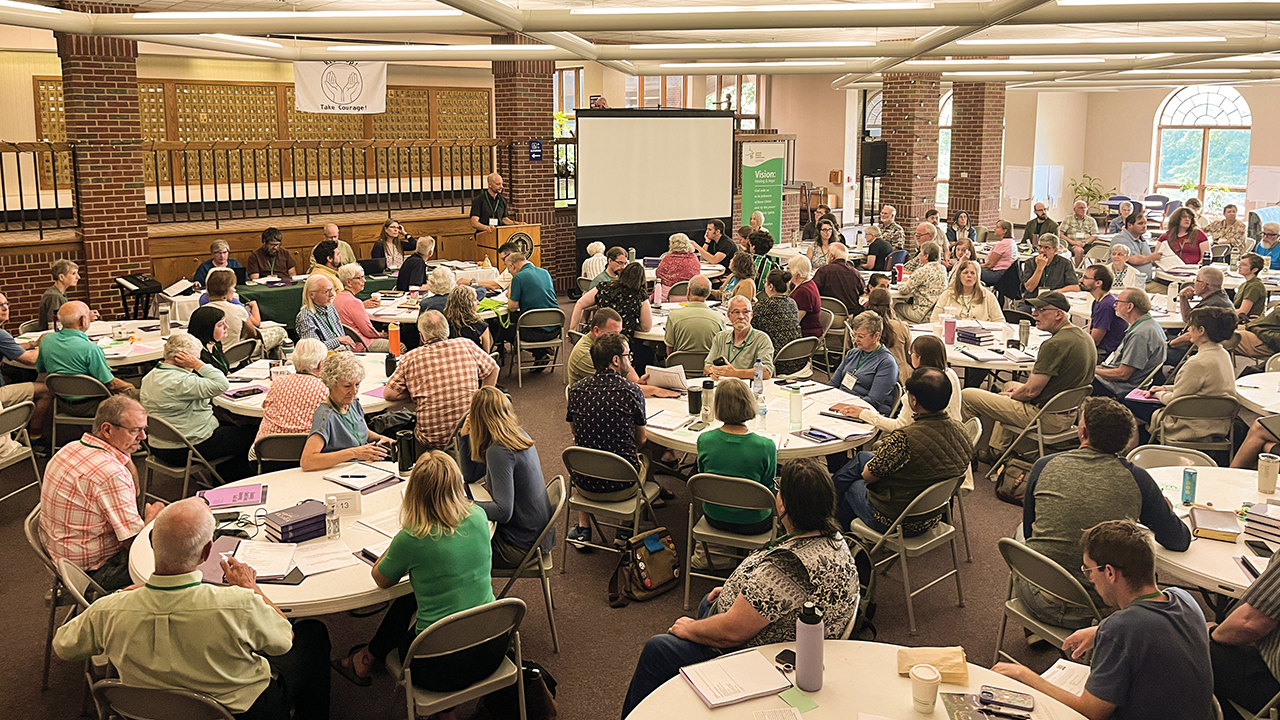
At their annual meeting June 25-27 at Eastern Mennonite University, Central District delegates discussed Article 19 in the Confession of Faith in a Mennonite Perspective, the 1995 document that serves MC USA and Mennonite Church Canada.
They shared a desire for a positive statement about the covenant relationship between two people and the valuing of many types of family beyond the traditional nuclear family.

One table expressed a concern that marriages in the Bible rarely fit the modern cultural stereotype and that a primary theme in the Gospels is the idea of chosen family. Covenant relationships between two people are important and occur within the family of God.
“Beloved community seems to be broader than the care for biological family,” one group stated. There are many types of families, which include adopted children or adopted parents, blended families and intergenerational families. All depend on caring relationships.
Delegates listed respect, equality, mutual care and consent as important features of a positive sexual ethic. One group noted Anabaptist commitments to nonviolence should inform all of life, including covenanted relationships. There was a desire for couples to consider how they are thriving together and how they can serve God and help the world to thrive.
Conference minister Doug Luginbill was impressed with participants’ energy and engagement.
“My pastor, Phil Yoder, told me this was the richest conversation about human sexuality he had in this kind of a setting,” Luginbill said. “He found it refreshing and hopeful. . . . I believe the open and honest reflection demonstrates our conference’s commitment to generous hospitality and our ability to engage in difficult conversations with respect and grace.”
Gerald Mast, professor of communication at Bluffton University, presented historical background on Anabaptist confessional statements. He said it was fitting that discussion of “current beliefs about sexuality, marriage and the family is oriented by the teachings expressed” in the 1995 Confession.
“At the same time, since Mennonites have never regarded confessional statements as final authorities on any topic, and because we are committed first of all to following Jesus Christ in the way of love, it is also fitting for us to consider ways in which our beliefs and practices cannot be contained by the ethical frameworks assumed in Article 19,” said Mast, who serves on a task force assigned to form a response to the article.
Discussion began at Central District’s midyear gathering in March. Participants were asked what they affirmed and did not affirm about Article 19 and what was most important to them in revisiting the Confession.
People said they appreciated the article’s emphasis on God creating people to be in relationships. Single people are given equal respect to married people, and there is emphasis on community beyond the nuclear family. Discussion groups noted that the language of marriage between a man and a woman does not reflect the conference’s welcome and inclusion of LGBTQ+ people. They were wary of language that views divorce as a failure.
Those present felt that covenanted relationships built on mutuality and care should be the basis of a statement on family life. They said purity culture has led to harms they do not want to perpetuate. A common theme was a desire for an aspirational document rather than a judgmental one.
Beyond Central District, discussion between MC USA and MC Canada has stalled around writing an updated introduction to the Confession or creating a new confessional document. A denominational release said the binational Joint Executive Committee had agreed not to pursue a new Confession.
A Central District delegate suggested MC USA might be better served by a series of statements of core beliefs like Mennonite World Conference’s Shared Convictions.
Central District plans to use the information gathered during the discussions to create a statement on Article 19 as a guide for congregations and those seeking to join.
Clayton Gladish, pastor of Silverwood Mennonite Church in Goshen, Ind., and member of the task force, said: “I want to be able to share with my congregation and people exploring our church a document that reflects the full expression of who we are. We may not all line up in the same place, but we try to create a table that is actually big enough and inclusive enough for all to feel part of the family in the fullness of who they are. That’s my hope for our work in revisiting Article 19.”



Have a comment on this story? Write to the editors. Include your full name, city and state. Selected comments will be edited for publication in print or online.