


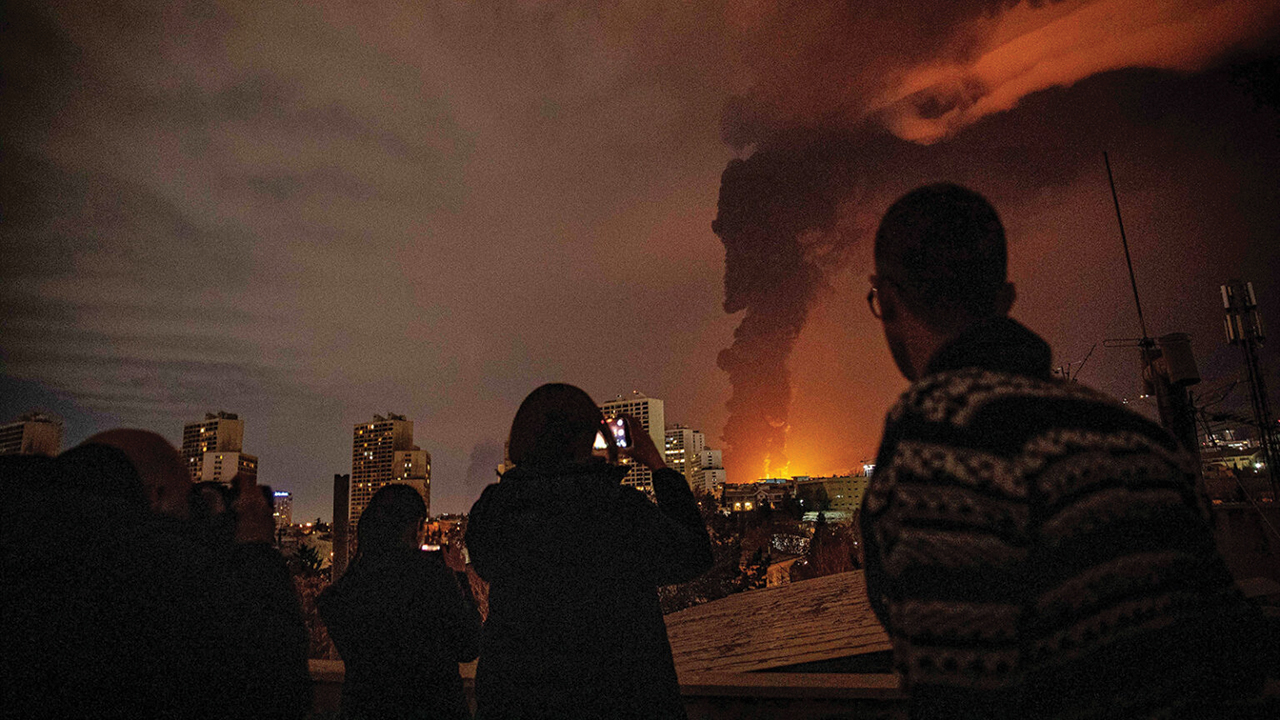
The residents of Tehran woke on March 8 to thick, black smoke engulfing their city after the Israeli military bombed fuel depots. The immediate human and environmental impacts of the war were disturbingly evident, but what about the broader climate impact?
A Climate and Community Institute analysis found that in the first two weeks, the U.S. and Israel bombardment of Iran and Iran’s retaliatory strikes produced more than 5 million metric tons of carbon dioxide equivalent (mmtCO2e) — more than Iceland produces in one year.
Beyond 35,000 missile strikes from all parties in the first 40 days, additional emissions will come from rebuilding damaged infrastructure. Strikes continued into a fifth month, despite an alleged ceasefire.
Other recent conflicts have come with similar climate impacts. According to one study, the ongoing Russian military invasion of Ukraine emitted 237 mmtCO2e in the first three years. The first 15 months of the Israeli assault on Gaza emitted 32 mmtCO2e — the equivalent of operating eight coal-fired power plants for a year or driving a car 83.6 billion miles.
The U.S. military has long acknowledged climate change and its impacts and has made strides in transitioning to renewable energy or nuclear power.
Gen. David Petraeus stated in a 2011 Department of Energy strategy paper that “energy is the lifeblood of our warfighting capabilities.” A 2023 Department of Defense report estimated conservatively that the U.S. military consumes over 4 billion gallons of fossil fuels annually to support its operations, more than the total consumption of most medium-sized countries

And yet, as Neta Crawford lays out in her book, The Pentagon, Climate Change and War, the U.S. military continues to engage in a dangerous cycle: fossil fuel use, military expansion to secure fossil fuel access for its operations, and war — often because of its support for totalitarian regimes that produce oil. This cycle locks the U.S. military into being a significant contributor to climate change, the effects of which can be considered a form of slow violence.
Mennonite Central Committee’s international partners bear witness to these effects daily. While making adaptations in agriculture and livelihoods in response to drought, flooding, extreme heat and rising sea levels, communities share that these climate pressures are driving food insecurity, health concerns, migration, conflict and gender violence. Breaking free from the cycle Crawford describes is essential to preventing current and future suffering.
How can the U.S. free itself from this loop of fossil fuel use and war? One step is to commit to a just transition from fossil fuels across all sectors. This includes a shift from an economy that is dependent on fossil fuel and mineral extraction to an economy that is regenerative and rooted in ecological healing. A second step is to prioritize peacebuilding and diplomacy to prevent war and reallocate funding from the military to humanitarian, ecological and climate needs.
MCC’s recent statement on the war on Iran roots us in faith as we take action: “We know a better world is possible — because Jesus showed us the way. We cannot passively wait for this better world to emerge but must work together to turn away from a path toward mutual destruction and onto a path toward mutual flourishing.”
In the short term, people in the U.S. can take immediate action, in addition to praying for peace, by urging members of Congress to:
— Oppose supplemental spending bills for waging war against Iran.
— Insist the administration seek congressional authorization for military action.
— Publicly oppose U.S. military aggression in the Middle East and beyond.
— Reappropriate to human and ecological needs the proposed $1.5 trillion Pentagon budget.
Kirstin De Mello is the climate advocacy and education coordinator for National Peace & Justice Ministries, MCC U.S.



Have a comment on this story? Write to the editors. Include your full name, city and state. Selected comments will be edited for publication in print or online.