



In the first quarter of the 21st century, mainstream Anabaptists in the United States have reshuffled like a pack of Dutch Blitz cards.
Call it an era of realignment.
By “realignment” we mean mergers, splits, changes of affiliation and births of new denominations.
By “mainstream” we mean Anabaptists who aren’t Plain — not the Amish, nor the Hutterites, nor the Old Order Mennonites, to name a few.
By “denomination” we mean any group, no matter how small, that isn’t subordinate to another. We know this isn’t everyone’s preferred term. “Network” and “fellowship” are increasingly popular.
Some of the shifts this article describes were underway before the turn of the century but sped up in the past 25 years.

Why has realignment happened? Conflicts over sexuality, while crucial, don’t tell the whole story. Reaffiliations arise from differences of theology, biblical interpretation, church polity (rules and governance), beliefs about diversity and definitions of unity.
Realignment in the church reflects polarization in society. Denominations, conferences and congregations that once held greater diversity have split along conservative/progressive lines.
Beyond a picture of the shifting landscape, this article offers a glimpse of trends shaping mainstream Anabaptism as denominations establish new identities and chart new paths of ministry.
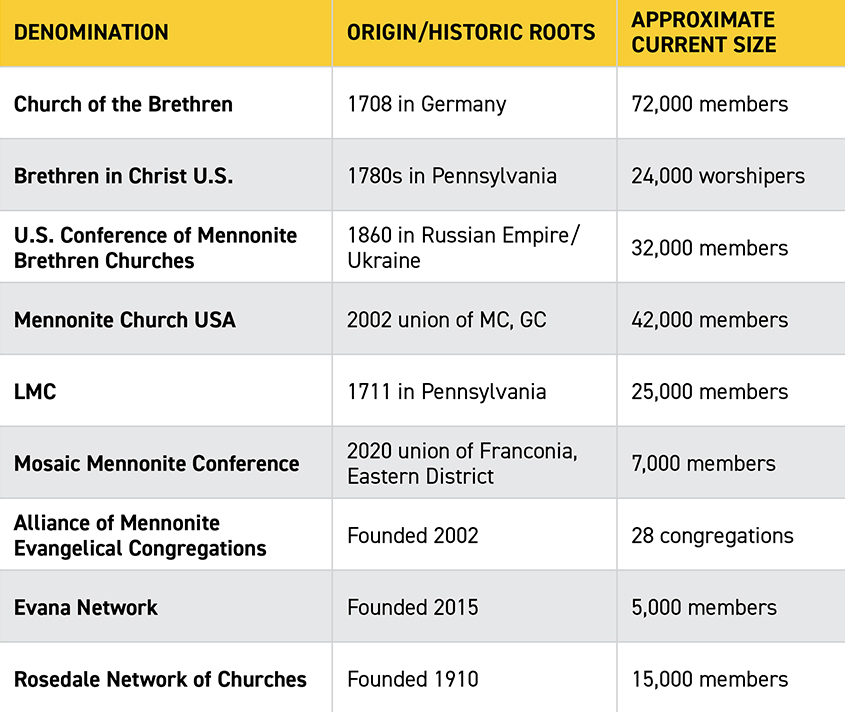
We’ll begin with the Church of the Brethren, the largest U.S. Anabaptist denomination, with about 72,000 members in 773 worshiping communities.
The Brethren branch of Anabaptism runs on a largely separate track from Mennonites, though many Brethren and Mennonites are neighbors, particularly in Pennsylvania, Virginia, Maryland, Ohio and Indiana.
Founded in 1708 in Germany, the Brethren combine Anabaptist and Pietist influences. They’re one of the three historic peace churches, along with Mennonites and Friends (Quakers).
Church of the Brethren realignment has resulted in membership losses. In 2000, the denomination had 135,000 members in 1,037 congregations.
“In recent years, a split over human sexuality and some other concerns has meant a loss of a district in Puerto Rico as well as loss of congregations to a schismatic group,” says Cheryl Brumbaugh-Cayford, news service director and associate editor of Messenger.
“Other leaving congregations have gone independent. Additionally, the Church of the Brethren has not been immune to the overall trends affecting most Christian denominations in the United States that have meant decreasing numbers of attendees and pastors.”
Internationally, the Brethren story is one of growth and vitality, Brumbaugh-Cayford says. Their largest presence is in Nigeria, with an estimated million and a half members, despite violent attacks by Boko Haram and other radical militant groups over the past decade.
After visiting Nigeria in March, Don Fitzkee, denominational moderator and co-pastor of Lancaster Church of the Brethren in Pennsylvania, wrote in Messenger: “I have been a longtime advocate of Christian nonviolence, but I felt unqualified to preach ‘take up your cross’ to Christians who have seen pastors murdered, lost family members, had churches burned and continue to face an ongoing threat of violence. . . .
“In a time when Christians in our country are attracted to violence, maybe we can learn from [the Nigerian Brethren] what it means to be a peace church that chooses faith over fear.”
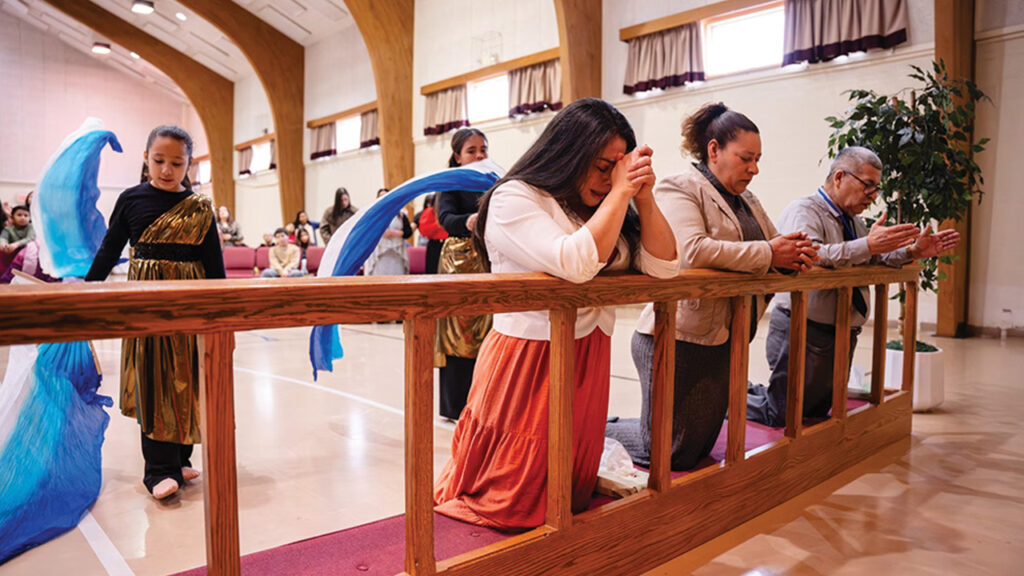
The other leading denomination in the Brethren stream is the Brethren in Christ U.S. Blending Anabaptism, Pietism and Wesleyan revivalism, the BIC emerged in the 1780s in Pennsylvania.
Today the U.S. BIC claims more than 24,000 worshipers in 231 congregations — virtually the same attendance as in 2000 — across 19 states. (The Canadian BIC adopted the name Be in Christ in 2017.)
Like the Church of the Brethren, the BIC are global, which has reshaped who the BIC are in North America,” Bishop Bryan Hoke of the Atlantic Regional Conference tells AW.
“Several congregations in my conference are now led by African pastors, and many of our Spanish-speaking congregations across the U.S. are led by first- or second-generation immigrant pastors,” Hoke says.
The BIC connect with Mennonites in Mennonite Central Committee and MWC. The 50,000-member BIC church in Zimbabwe hosted the 2003 MWC assembly.

Among Mennonite denominations, the U.S. Conference of Mennonite Brethren Churches has “Brethren” in its name but no historic connection to the BIC or Church of the Brethren. A point of commonality, though, is a Pietist influence, which emphasizes a personal, heartfelt faith.
Founded in 1860 in the Russian Empire/Ukraine, the Mennonite Brethren were part of the 1870s migration of Mennonites from Ukraine to the United States and Canada.
Today the USMB denomination counts 223 congregations with 32,452 members. Some large churches don’t have members but only count attendees. Regular weekly attendees, according to church reports, is 43,844. A quarter century ago there were 164 USMB congregations with about 20,000 members.
The USMB denomination is growing in Utah, where three congregations attract people who’ve come out of the Church of Jesus Christ of Latter-day Saints.
Lakeview Church, with two locations in the Salt Lake City metropolitan area, says 60% of its attendees come from LDS background.
South Mountain Community Church, with five campuses, claims an average attendance of 5,000 and expects to launch a sixth site in Hurricane in 2027.
“We are on a mission to reach disenfranchised LDS people,” the church says. “We know they don’t have trust with churches because of their previous experience, so we focus on providing irresistible environments to build trust and give them an opportunity to hear the gospel.”
The Utah congregations hosted the USMB national convention July 21-25 in Salt Lake City.
National director Aaron Box says the Mennonite Brethren are growing in numbers and ethnic diversity.
“Since the beginning of 2025 we have seen nearly 1,000 new baptisms, 11 new USMB churches and an increasing number of leaders being developed,” Box tells AW. “We are an increasingly diverse group of churches, speaking more than 10 languages in our Sunday services.
“More than half of our U.S. churches now have a primary language other than English. This provides incredible opportunity to learn from one another and to find new ways to partner together locally, nationally and in global mission.”
Like the Church of the Brethren and BIC, Mennonite Brethren have a global fellowship, the International Community of Mennonite Brethren, with about 500,000 members in 22 countries. India and the Democratic Republic of Congo have large memberships.
Realignment among U.S. Anabaptists has occurred mostly among those with roots in two denominations — the Mennonite Church and General Conference Mennonite Church — that anchored the 20th-century Mennonite mainstream.

Known as MC (or “Old Mennonite”) and GC, these denominations began exploring a merger in 1989, affirmed it in 1995 and completed their union in 2002, birthing Mennonite Church USA and Mennonite Church Canada.
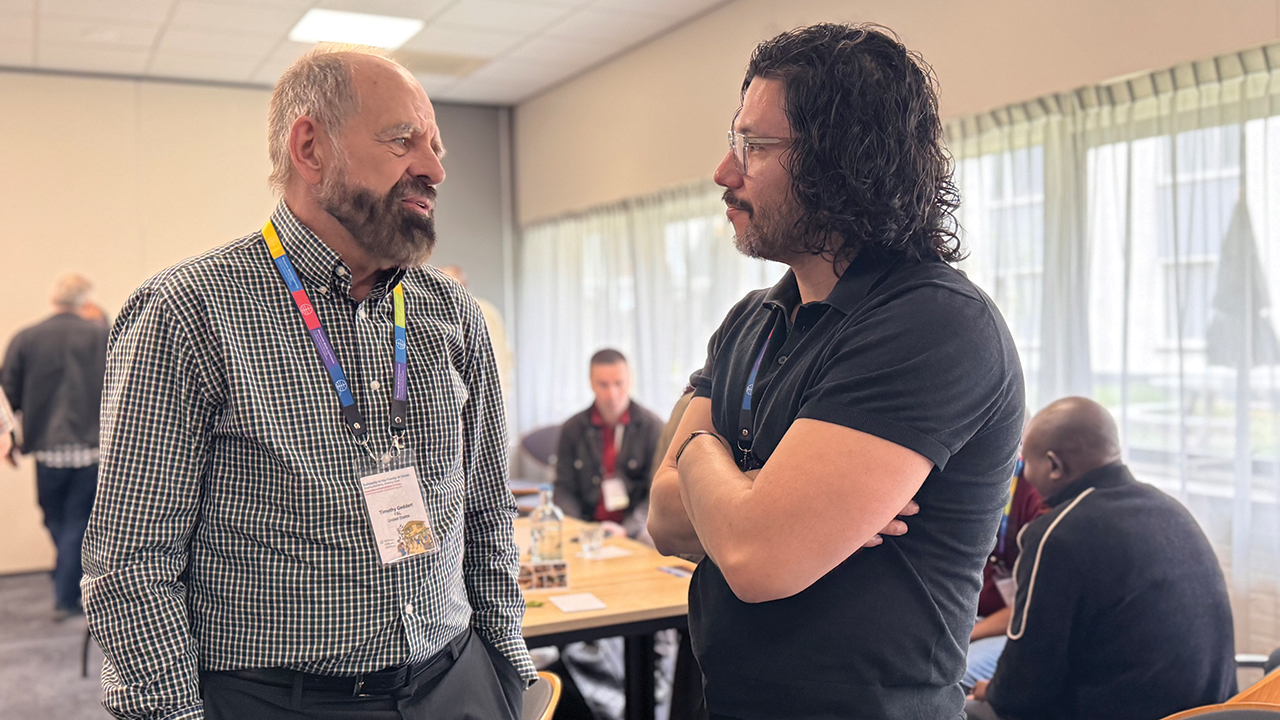
Can we do better than the polarized world?
Anabaptists are diverse in wonderful ways, Tim Geddert says, but diversity brings challenges. As chair of Mennonite World Conference’s Faith & Life Commission, Geddert navigates the hurdles.
During a meeting of MWC’s four commissions May 12-14 in the Netherlands, Geddert reflected on the perspective he brings into the commission.
Born into a Mennonite Brethren family in Hepburn, Sask., he grew up steeped in Mennonite culture but “only learned Anabaptist theology when I attended seminary in Fresno,” he said. Today he’s an emeritus professor at Fresno Pacific University and a member of the U.S. Mennonite Brethren Board of Faith and Life. He’s not naïve about the challenges of diversity, “especially in a world that increasingly polarizes into ‘us’ and ‘them’ — those who ‘have it all figured out’ and those who are ‘just plain wrong.’ ”
Geddert believes Anabaptists can do better.
“In fact, we must do better if we want to be faithful to Jesus,” he says. “We need to learn to give each other the benefit of the doubt, at least long enough to build meaningful relationships and have healthy conversations.”
He cites foundational agreements within the Anabaptist family, as expressed in MWC’s Shared Convictions.
“The centrality of Jesus in terms of theology, hermeneutics, ethics, interpersonal relationships, pursuit of peace and justice — these are high values for Anabaptists that are recognized as centrally important in many other Christian contexts,” he says. “I am optimistic that we as Anabaptists have much to offer the wider Christian world. I am also convinced we have much to learn from others who do not share our Anabaptist labels but truly follow Jesus.
“My hope and prayer are that we learn to dialogue with respect and with trust about the issues that threaten to divide us and that we experience how much more important it is to build community together than to persuade everyone to believe the same.” — Mennonite World Conference
(The MC and GC magazines set a faster pace, merging in 1998. Twenty-two years later, MC USA’s The Mennonite merged with the independent Mennonite World Review to create the independent Anabaptist World.)
In 2001, the emerging MC USA constituency claimed 113,972 members in 840 congregations. Today the denomination counts 42,237 members in 411 congregations.
Responding to changes in the broader church and society, MC USA is halfway through a two-year process of “reimagining the church,” with goals to become more collaborative, follow Jesus, witness to God’s peace and experience transformation.
“The work of the local congregation is really what excites and engages people,” executive director Glen Guyton tells AW. “Given our strong congregational polity, the heart of our work is to support our congregations to minister and serve in their local contexts.”
MC USA’s most-used resources include “immigration initiatives that equip congregations to welcome and support immigrant neighbors through advocacy, partnerships, practical tools, worship resources and opportunities for learning,” Guyton said.
Leaders describe a denomination building on its strengths as it adjusts to a smaller size.
“We’ve experienced a lot of attrition and losses in the church,” said Eric Massanari, executive conference minister for Pacific Northwest Mennonite Conference, at a meeting of the Structure Review Committee in April. “Though these bring grief, they also give rise to a certain degree of clarity and some new creative energies that I find very hopeful.”
Contributing to the losses was the withdrawal of five conferences that wanted a more conservative identity, in contrast to MC USA’s progressive direction, which has included LGBTQ+ affirmation.
Two actions by MC USA delegates impacted decisions to withdraw: a 2015 resolution that called for “forbearance” amid differences of belief on sexuality and a 2022 resolution that affirmed LGBTQ+ inclusion.
Two of the departing conferences, LMC and Mosaic, became denominations. The other three — South Central, Southeast and Franklin — became districts of LMC.
A sixth conference, North Central, dissolved, and several of its congregations joined the Mennonite Brethren.

Under its former name, Lancaster Mennonite Conference, LMC was MC USA’s largest conference before withdrawing in 2017. Today it counts about 25,000 members in 311 congregations.
“The Anabaptist story is of a Jesus movement, and we want to recover that DNA in LMC,” Rodney Martin, an LMC executive bishop, tells AW.
While expanding nationwide, LMC has forged international connections.
“For the past five years, LMC has partnered with 100 movements and built relationships with others who are seeking to create Jesus movements in the Western Hemisphere,” Martin said.
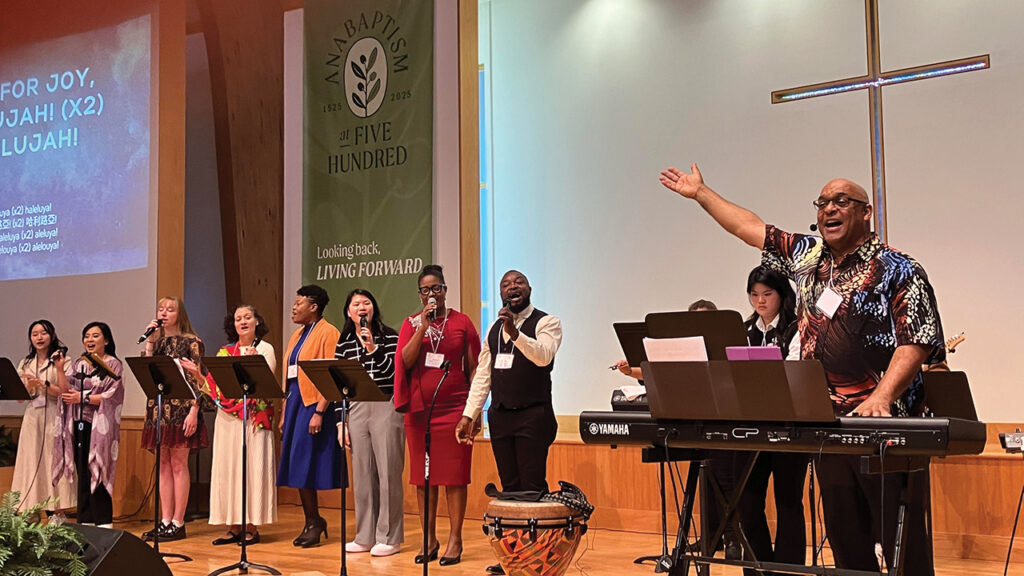
Last November, Mosaic Mennonite Conference became the second denomination to spin off from MC USA. It claims 10,000 people with 7,000 members in 100 communities in the United States, Mexico and Colombia.
Mosaic itself is the product of a realignment, born in 2020 from a merger — officially called a “reconciliation” — of two MC USA conferences, Franconia and Eastern District.
Like LMC, Mosaic has expanded nationwide. After initially drawing a group of congregations from MC USA’s Southeast Conference, it has added communities in Texas, California and elsewhere.
Executive minister Stephen Kriss describes Mosaic as evolving “from a regional, heavily Pennsylvania, group in Bucks and Montgomery counties to a more urbanized, more geographically spread-out community. At least half of our member congregations were not part of that community 20 years ago.”
Kriss calls Mosaic a “centered-set conference working with the MWC core convictions” — a list of seven beliefs endorsed by the global Anabaptist body in 2006.
In Mosaic and elsewhere, congregational realignments continue. In June, Mosaic reported the withdrawal of three congregations. One of these, Deep Run West Mennonite Church in Perkasie, Pa., cited “theological concerns, including disagreement with Mosaic’s approach to congregations that affirm LGBTQ inclusion.”
What is Mosaic’s approach? Kriss tells AW: “At this time, the Mosaic board has not sought to remove LGBTQIA-affirming congregations from membership, believing that membership is best discerned by proxemic, localized communities.”
In a Mosaic report, leadership minister Jeff Wright said: “I continue to hope that churches that self-identify as ‘conservative’ and churches that self-identify as ‘progressive’ can find ways to remain in mission together through a shared confession that Jesus Christ is Lord.”
In addition to the former MC USA conferences LMC and Mosaic, two other new denominations have formed as alternatives to MC USA.
The Alliance of Mennonite Evangelical Congregations was founded in 2002 by former MC and GC congregations that didn’t join the MC USA merger. Its website lists 28 congregations.
On the AMEC website, an article about the group’s founding says it identifies as “Mennonite Evangelical . . . to indicate that as Evangelical Christians, who make no apology for holding to an infallible written Word of God and a Gospel with only one Savior for the whole world, congregations of the Alliance value the distinctives of their Mennonite theological heritage within the Evangelical movement.”
An AMEC article on “Splintering or Strengthening” says: “Separation is sometimes necessary for healthy strengthening. Seeking purity through accuracy and clarity is not being persnickety but obedient. Freedom to flourish in fruitfulness is different from selfish seeking of autonomy.”
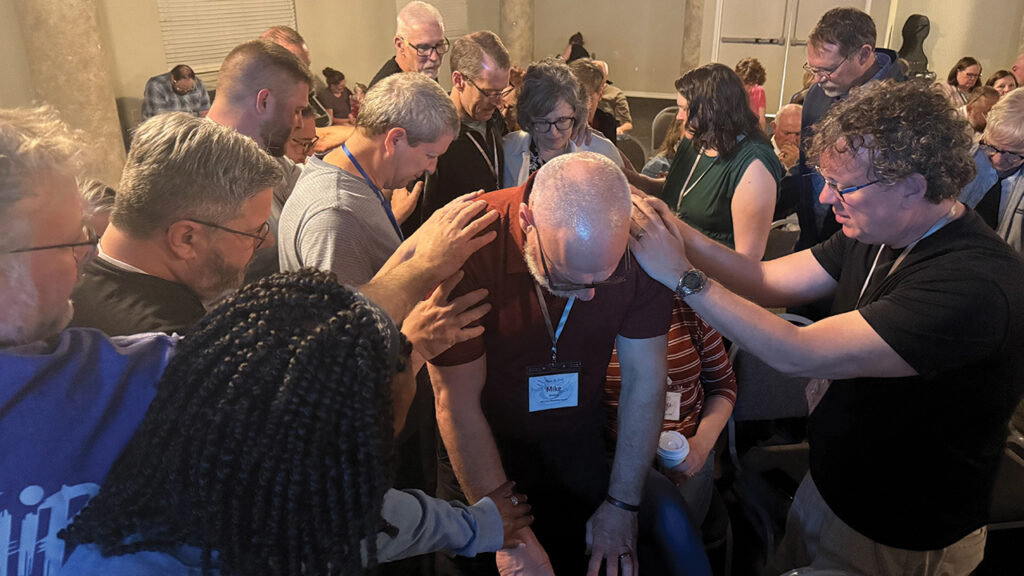
Next came Evana Network, founded in 2015 by former MC USA congregations. It counts 50 congregations with over 5,000 members in 12 states, the largest cluster in Ohio and Indiana. Two Evana congregations are also members of LMC; one is also a member of MC USA.
Executive director Matt Hamsher says Evana is “formed primarily by Anabaptist faith and practice” but also “influenced by evangelical and Spirit- led streams.”
“We have been pleased to develop greater connections with other evangelical Anabaptist groups like LMC, Mennonite Brethren, Brethren in Christ and Rosedale Network,” Hamsher tells AW.
One of Evana’s connections is in education, identifying three Anabaptist partners — Rosedale Network’s Rosedale Bible College and the Mennonite Brethren institutions Tabor College and Fresno Pacific University — along with Malone University, an Evangelical Friends school.
Mission partners include LMC’s Eastern Mennonite Missions and Virginia Conference’s Virginia Mennonite Missions (now Anabaptist Mission Partners).
Evana’s Pulse newsletter introduces the latest congregations to join — Sharon Mennonite of Plain City, Ohio, and Crown Hill Mennonite of Rittman, Ohio — and says Evana is “having more conversations with those outside traditional Mennonite circles” interested in joining.
One of these is the former Grace Lutheran Church of Syracuse, Ind., which has relaunched as Redeeming Grace Church and joined Evana.
Hamsher says: “Our commitment to peacemaking and affirmation of women in ministry, as well as our pro-life stance and understanding of marriage and sexuality, have sometimes set us apart from other Anabaptist groups that are more liberal or more conservative.”
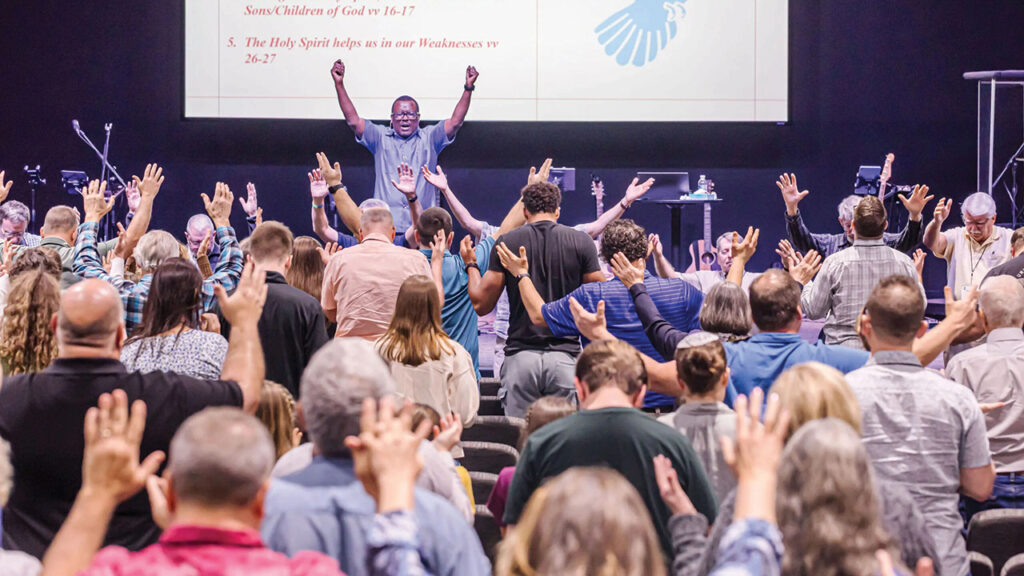
The “Conservative” label historically applied to the denomination known today as Rosedale Network of Churches. Founded in 1910 as Conservative Amish Mennonite Conference, it dropped “Amish” in 1957. In 2023 it adopted its current name, plus the tagline, “a global family of Anabaptists.”
The name comes from the denomination’s school, Rosedale Bible College, and mission agency, Rosedale International. Rosedale is a small town in Madison County, Ohio.
Rosedale Network counts 125 congregations with over 15,000 members in 28 states, an increase from 106 congregations with over 10,000 members in 2000.
“We describe ourselves as evangelical Anabaptists,” executive director Brian Hershberger tells AW. “ ‘Evangelical’ describes where we fit in the broad spectrum of Anabaptist groups, and ‘Anabaptist’ describes where we fit in the broad spectrum of evangelical groups.
“One distinguishing characteristic of Rosedale Network compared to some other evangelical Anabaptist groups is that we are complementarian in our understanding of men’s and women’s roles in church leadership.”
Complementarians define distinct, or complementary, roles for men and women, typically restricting women’s ministry roles, while egalitarians affirm women in all roles.
Regarding the name change to Rosedale Network, Hershberger says: “While some understandably lament the loss of ‘Mennonite’ from our name, others lament that the term ‘Mennonite’ has come to represent too broad a spectrum of beliefs and practices.”
Whether or not one thinks the spectrum has become too broad, the breadth cannot be denied.



Have a comment on this story? Write to the editors. Include your full name, city and state. Selected comments will be edited for publication in print or online.