


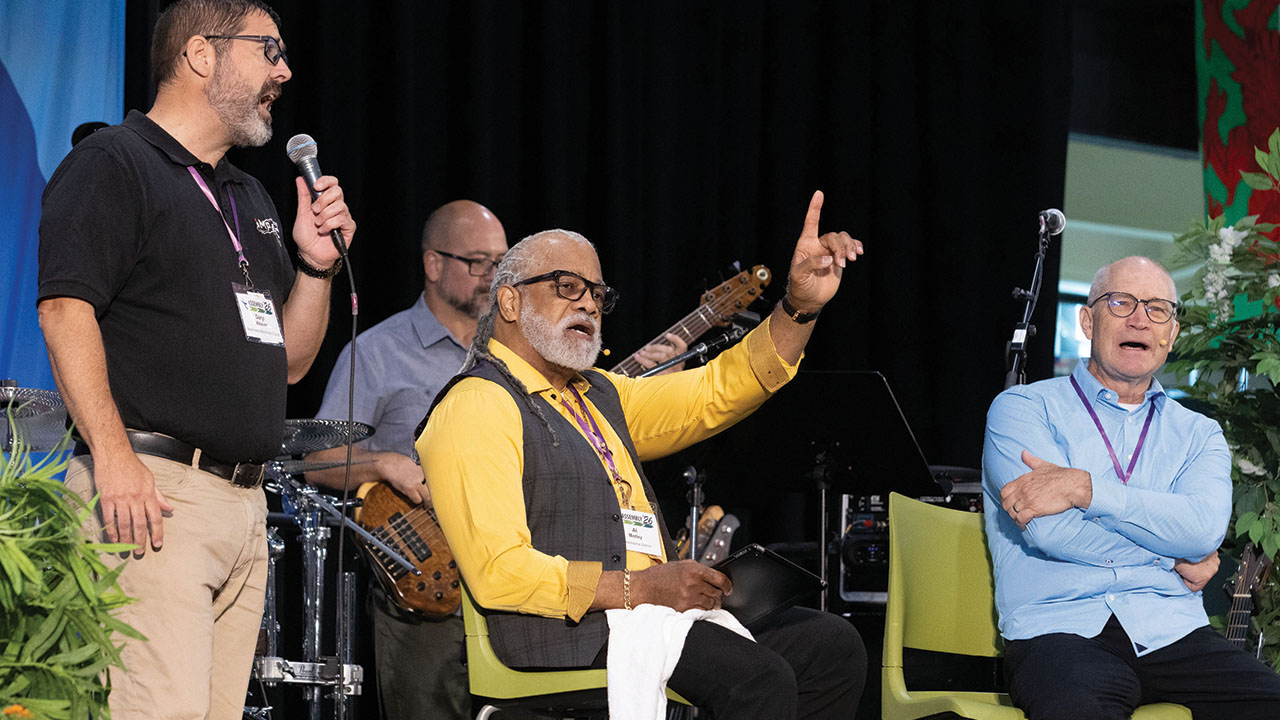
A 300-year-old bastion of tradition aspires to become a hub of innovation. LMC, the former Lancaster Mennonite Conference, heralded a new era June 18-21 with an assembly that generated excitement for growth and change.
About 800 people gathered at Millersville University in Lancaster County, Pa., their numbers bolstered by churches across the country that have found a new home in LMC.
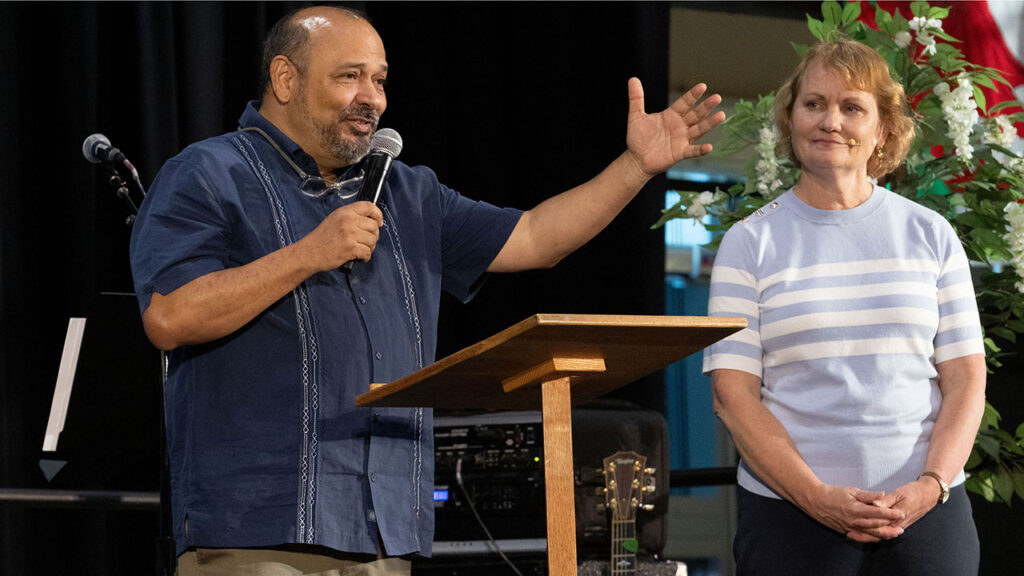
Rodney Martin, who serves on LMC’s Executive Bishop Team, described the influx of congregations as a two-way street.
“We hear you talking about finding a home, but it’s also about what you bring, and it’s a blessing and a privilege to work together,” Martin told the assembly crowd.
More than 40 congregations have joined since 2024, most of them from Mennonite Church USA.
Billed as LMC’s first biennial gathering, the event’s scale exceeded the Celebration of Church Life previously held annually, expanding to match LMC’s emerging identity as a nationwide and international Anabaptist denomination.

LMC now has 311 congregations with about 25,000 members across 26 states and eight countries. Since withdrawing from MC USA in 2017, it has returned to the independent status it held prior to 1971, when it joined the Mennonite Church denominational structure.
LMC has almost doubled in size since 2015, when 82% of credentialed leaders affirmed a Bishop Board proposal to leave MC USA. At that time, it claimed 13,838 members in 163 congregations.
In 2018 it changed its name from Lancaster Mennonite Conference to LMC, adding the tagline, “A Fellowship of Anabaptist Churches.”
Throughout the assembly, people spoke of “the new LMC” — once culturally restrictive but now committed to “apostolic innovation” and “intercultural embrace,” as LMC defines two of its five core values.
“We’re moving into a new way of being, but also repenting for ways we’ve been too strict, too legalistic,” said Keith Blank, one of the executive bishops, who also serves the Landisville-Manor District.
In a plenary session, Martin said: “Around us in this [Lancaster] county there are many churches that had their origins in LMC but didn’t find the space to do what they felt called to do and were pushed out. But today, LMC is moving in a different direction. We want to create space for people to innovate, to step into their calling and to go [in mission], whether it is to their families or neighbors or halfway around the world.”
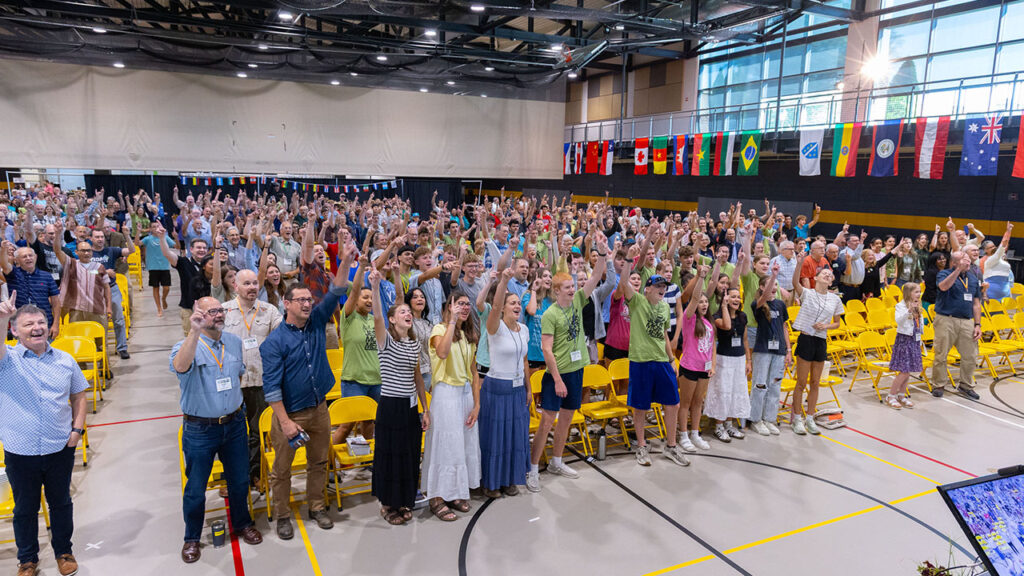
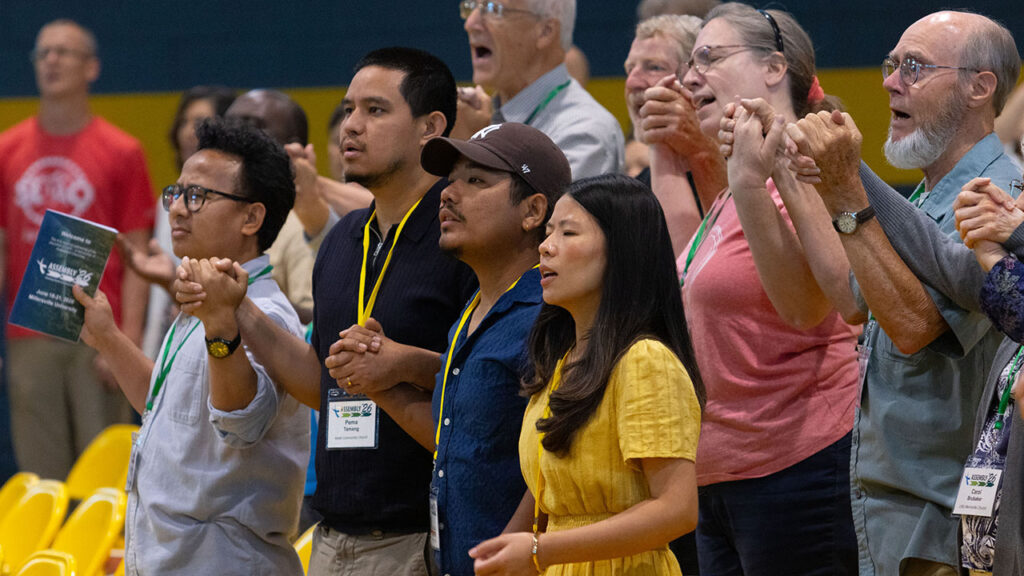
The assembly stirred enthusiasm for the conference’s stated mission to be a Spirit-led movement that makes disciples of Jesus, mobilizes every member as a missionary and multiplies faith communities locally and beyond.
Youth accounted for about a third of the attendance and had their own YouthCon ’26 activities. They joined adults for the opening and closing plenary sessions, where speakers prayed for them and urged the adults not to hold them back from becoming innovative disciple-makers.
Attenders expressed excitement about the assembly’s upbeat mood and passionate evangelistic calls.
“This momentum is very catching, and I want to bring it back to my church, particularly the youth,” said Deb High of Stumptown Mennonite Church in Bird in Hand, Pa. “There’s a hunger out there for the Lord, and they want to be equipped.”
“This is the most fun I’ve had at a Lancaster Conference meeting,” one seminar attender said.
A ventriloquist act by Groffdale District Bishop Ryan Bomgardner, lead pastor of Metzler Mennonite Church in Ephrata, Pa., contributed to the fun on the opening night.
Mark Wenger, bishop of the LanChester, New Danville and Willow Street-Strasburg districts, said the assembly signaled “a new day in LMC,” infused with “energy, joy and spirit.”
“This kind of gathering is a new expression of something that has been bubbling along for a while,” he said. “Evangelical, missional language is at the forefront.”
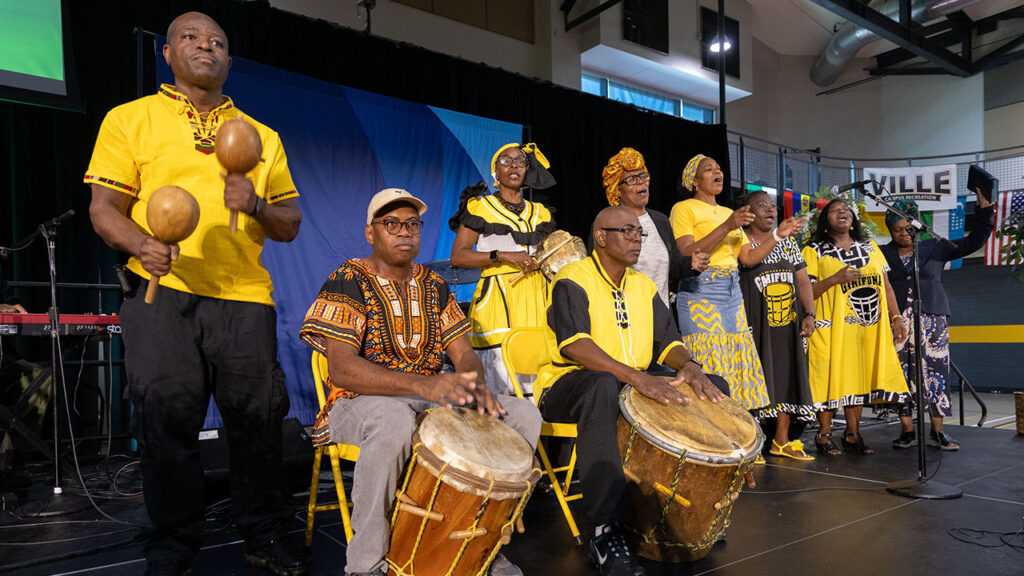
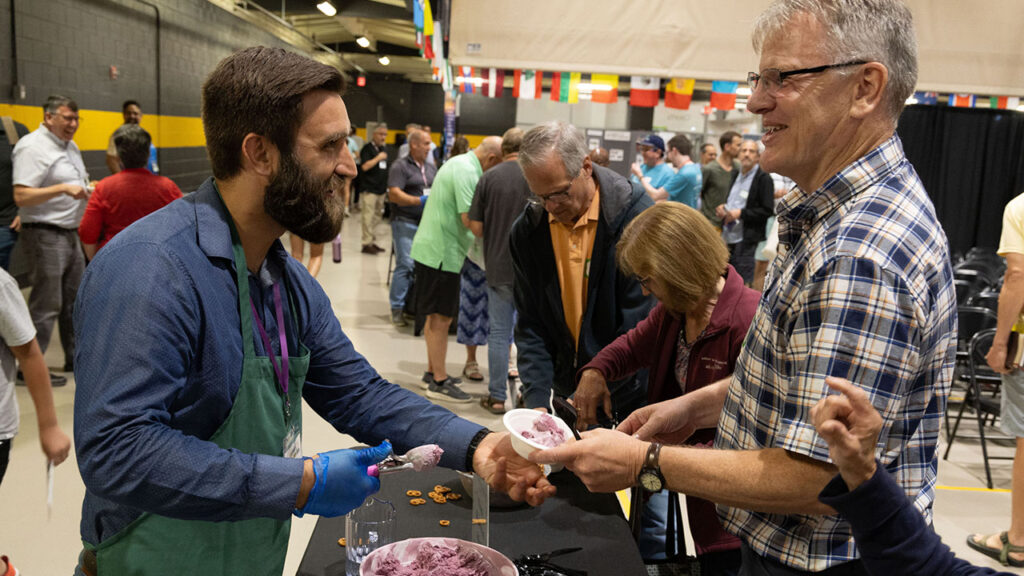
Multicultural diversity was also at the fore. Many songs included verses in Spanish, one of 18 languages used across the LMC fellowship. About a third of LMC churches worship in Spanish. A “Celebration of Cultures” one afternoon featured displays and music from various ethnic groups.
Plenary speaker Alvin Motley, Philadelphia District bishop and pastor of The Way Thru Christ Ministry, sprinkled his talk on the core value of “intercultural embrace” with lighthearted asides.
“We’ve got to learn the value of accepting and valuing all cultures under the authority and lordship of Jesus Christ,” he said. “You belong to me and I belong to you. I love you, and there’s nothing you can do about it! . . .
“I love where LMC is right now. We are becoming more diverse, more intercultural, and there’s nothing you can do about that! . . .
“I look out in this room today and I see all nationalities, and it’s so beautiful.”
Motley preached on Acts 6:1-7, which tells of conflict that arose when Aramaic-speaking Jews marginalized Greek-speaking Jews.
“There was a threat to divide the church by cultural and racial lines, and I believe that is something Satan still wants to do today,” he said.
Franklin District Bishop Eric Lehman noted the lingering influence of LMC’s historic Swiss German culture, which prized uniformity.
“Some of us have a history that pushes back against this core value [of intercultural embrace],” he said. “So, this is a Spirit-led movement that calls some of us out of what we have always known and what we once were and calls us to be something new.”
Tuyen Nguyen, a member of the Executive Bishop Team, cited LMC’s potential for geographic expansion.
“I hope that within five years LMC will have a district on the West Coast,” said Nguyen, who’s also a bishop in the Philadelphia District and lives in Data Point, Calif. “I believe it can be done anywhere, as God shows us where to go and what to do.”
Leaders highlighted LMC’s expansion as they called out the names of states — Kansas, Virginia, Oregon, Florida, Illinois and others — where new members come from.
In a seminar, Martin described a recent visit to the western portion of South Central District, a former MC USA regional conference that decided to join LMC in 2024. The district has 24 congregations spanning six states.
Stops on the trip included Peace Mennonite Community Church in Aurora, Colo., in the Denver metropolitan area, full of mission opportunities; East Holbrook Mennonite Church in Cheraw, Colo., “rediscovering their mission” in the rural eastern part of the state; Light of Life Mennonite Church in Farmington, N.M., a mostly Navajo congregation with “new leaders being raised up”; and Defiance Church in Glenwood Springs, Colo., where “people without Anabaptist roots have come to know the Lord,” Martin said.
In an interview, Kurt Horst of Yoder, Kan., a bishop in South Central District, noted the novelty of being an LMC bishop far from the historic Lancaster heartland.
“It still gets a bit of a laugh,” he said of the bishop title. “Because we all have this perception of a bishop that doesn’t fit with the person who’s titled ‘bishop.’ People who know me, they kind of chuckle at it. I’m a conference minister with a new name.”
Horst appreciates LMC’s bishop structure.
“The model of bishops that lead pastors that lead congregations strengthens leadership and strengthens a common, shared mission,” he said. “It’s not authoritarian, but it’s more centralized visioning.”
Women bishops are relatively new in LMC. Of the 45 bishops, three are women. All serve on bishop teams: Hyacinth Banks Stevens in New York District, Juanita Nuñez in Southeast District and Marcia Mylin on the Executive Bishop Team.
The Bishop Board (now called the Bishop Team) decided in December 2021 to “acknowledge and affirm that space has been created within LMC for women to serve on Bishop Oversight Teams.”
Among the six congregations that didn’t go along with South Central’s decision to join LMC, limits on women’s roles were a concern, Horst said. He sees LMC becoming more accepting of women in leadership.
“Women as part of bishop teams sounds complementation, but the reality is egalitarian as I experience it,” he said, referring to two theological streams regarding gender roles.
He noted a growing emphasis on bishops working in teams rather than as individuals and cited women’s prominent roles at the assembly.
“We are experiencing something new in LMC, and that is women on the platform,” he said. “It is a conscious choice that says the Spirit speaks to and through all of us.”
In the six worship services, two of the 12 featured speakers were women.
Horst said South Central churches were drawn to LMC’s cultural diversity and its commitment to unity, centered on “Jesus as Lord of absolutely everything.”
He acknowledged that MC USA’s movement toward LGBTQ+ affirmation — articulated in a resolution passed by delegates in Kansas City in 2022 — played a role in the decision to join LMC.
“It is obvious that the Kansas City decision was the final element in choosing to seek other affiliations,” he said.
South Central is one of three former MC USA conferences — along with Southeast and Franklin — that have become LMC districts, bringing most of their congregations along.
Missions, both overseas and domestic, are a historic emphasis in LMC, led by its mission agency, Eastern Mennonite Missions. EMM President Marvin Lorenzana said the agency has 80 missionaries in 25 countries, serving among 20 largely unreached people groups in Central Asia, Central Europe, Southeast Asia and West Africa and with refugees in Lancaster County. Thailand, with nine missionaries, has the largest number of EMM personnel.
A mission success story is in Ethiopia, where the world’s largest Anabaptist body, the Meserete Kristos Church — with over 514,000 baptized members, according to Mennonite World Conference’s 2025 census — grew out of EMM mission work.
On a recent visit to Ethiopia, Lorenzana said, “They said to me, we are growing so fast that we need to develop leaders at a rate that matches the velocity of the growth. And can LMC and EMM give us a hand? Otherwise, we will see the church grow but not develop deep disciples of Jesus.”
A native of Honduras, Lorenzana accepted Christ as a 10-year-old in 1975 through the ministry of EMM mission worker Ed King.
Reflecting the assembly’s theme, “Sowing Seeds of a Jesus Movement,” worship services featured talks on LMC’s five core values:
- Delighting in God: discovering the fullness of God’s presence;
- Following Jesus: walking daily on mission with Jesus;
- Deepening surrender: yielding more fully to God every day;
- Intercultural embrace: relating to all peoples with God’s heart; and
- Apostolic innovation: creating and building with God.
Speaking about following Jesus, Lorri Bentch, EMM mission team director, said: “Following implies that the person is moving. Jesus is on the move and invites us to be on the move with him.”
She emphasized the “every member a missionary” phrase in LMC’s mission statement.
“Jesus, show me which of my neighbors are in need of a conversation today,” she prayed, and added: “If LMC is going to live into this vision to be a Spirit-led movement, it can’t just be the pastors and leaders, it needs to be all of us.”
Executive Bishop Rodney Martin defined the core value of apostolic innovation: “The apostle is one who sees over the horizon, who calls the church to go where the Spirit of God is leading.”
Speaking alongside Martin, Glenn Kauffman, bishop of the Washington-Baltimore District and lead pastor of Capital Christian Fellowship in Lanham, Md., said an apostle goes where God sends and is willing to innovate, not knowing whether new ideas will work but trusting that “the God who created the world is still creating.”
Martin prayed: “Let us no longer be known as the quiet in the land. Let us be known as those who are sent . . . as people on fire for Jesus who move forward in your mission.”



Have a comment on this story? Write to the editors. Include your full name, city and state. Selected comments will be edited for publication in print or online.