


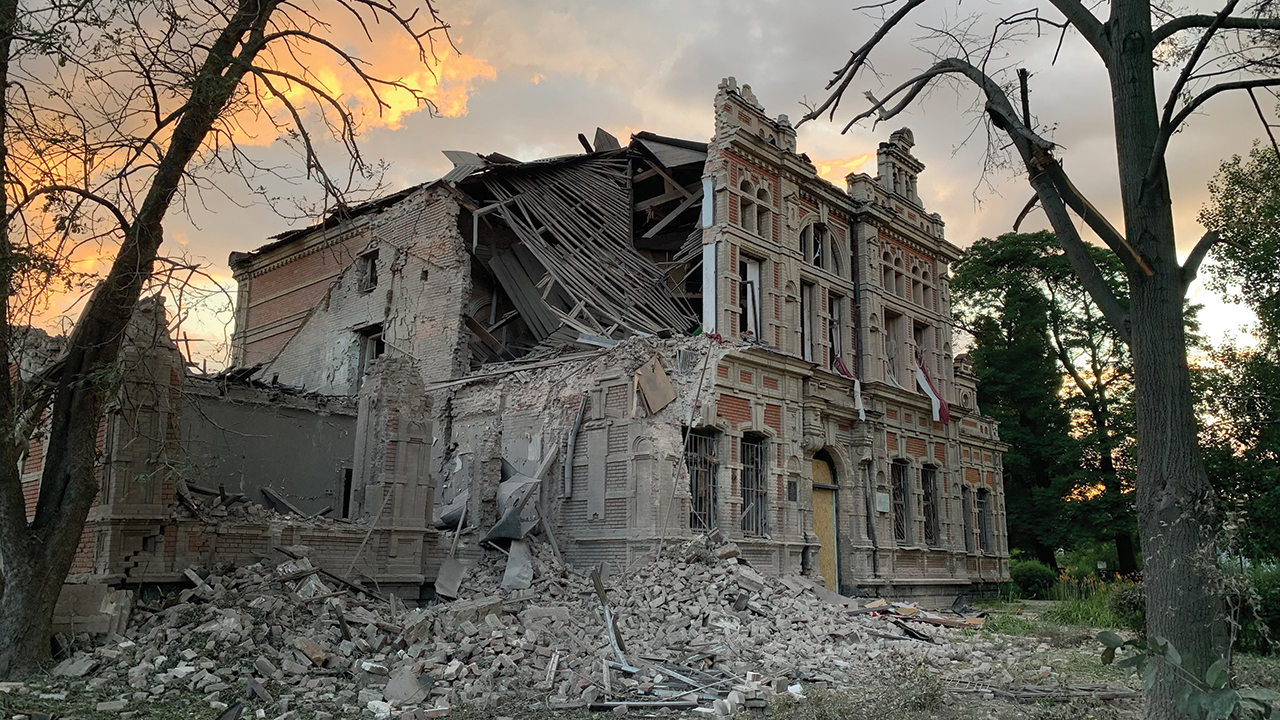
A Russian airstrike July 4 destroyed a century-old school built by Mennonites in Ukraine, punctuating the scope of suffering and loss of life since Russia escalated the conflict in 2022.
The Chortitza Mädchenschule (Girls’ Secondary School), completed in ornate art nouveau style in 1904, was one of the most significant symbols of former Mennonite prosperity remaining in the country.
The building, which stood in the community that sits just across the Dnieper River from the sprawling city of Zaporizhzhia, took a direct hit, reported Alexei Stoyanovsky, a historian in Zaporizhzhia who has worked extensively with North American Mennonites for decades.
“The most beautiful of all Mennonite schools throughout all of the colonies — a girl’s central school in [what we call Upper Khortytsya] — has been bombed by a direct impact today by a glide bomb launched from a Russian Su-34,” he shared on social media.
Though the historic building had virtually no military strategic value, Toronto researcher Arnold Neufeldt-Fast said the loss was significant.
“Of course, buildings are not people,” he said. “The suffering of those who live under the bombs is infinitely greater than the loss of any historic structure. Yet the destruction of cultural landmarks is never insignificant. It is an assault on memory, identity and belonging.

“Today I grieve not only because this is part of Mennonite history, but because it is part of Ukraine’s history. Mennonite colonists helped build this place, but over generations it became woven into the cultural fabric of the country that welcomed them. To destroy such places is to diminish Ukraine itself.”
Founded in 1895 under the conviction — uncommon for the time — that females deserved advanced education to become teachers, nurses and community leaders, the school served more than a thousand young women before the Soviets closed it in 1920.
“Its influence did not end in Ukraine,” Neufeldt-Fast said. “Graduates and descendants carried that educational vision to Canada and Paraguay, helping shape Mennonite schools, churches, women’s organizations, hospitals and communities. . . . This school building survived revolution, civil war, Soviet repression, Nazi occupation and decades of political upheaval. In 2021, Ukraine formally recognized its significance by adding it to the State Register of Immovable Monuments. And now a bomb has torn through it. I could weep.”
The area was hit by Russian strikes again July 28.
Stoyanovsky noted both Russian attacks on Chortitza were launched from the direction of Molochansk, site of a former Mennonite colony where the Canada-based Friends of the Mennonite Centre in Ukraine were headquartered before Russian forces occupied the area.
FOMCU board chair Dave Regehr of Winnipeg, Man., said the organization had to shift how it operates after Russian forces commandeered the former Mennonite school in Halbstadt that the organization refurbished and used for relief work offices.
“Much of our attention has gone to assisting organizations in evacuating people from the war zone in the east and providing in assisting housing of some kind, food and medications in western Ukraine,” he said. He added that FOMCU’s donations tripled since the war’s escalation in 2022, and last year’s donations totaled about $1 million (Canadian).
FOMCU coordinator Olga Rubel wrote in the organization’s summer newsletter that the group helped an evangelical church in Balaklia provide clean water to its village by purchasing a vehicle and a trailer, 1,000-liter tanks and gas, which led to supplying other needs, such as diapers for young mothers.
“But then on May 23, there was a massive drone and missile attack on Balaklia. Three drones hit the church building,” wrote Rubel. “It was a targeted attack. It wasn’t a military target. It happened in the daytime.”
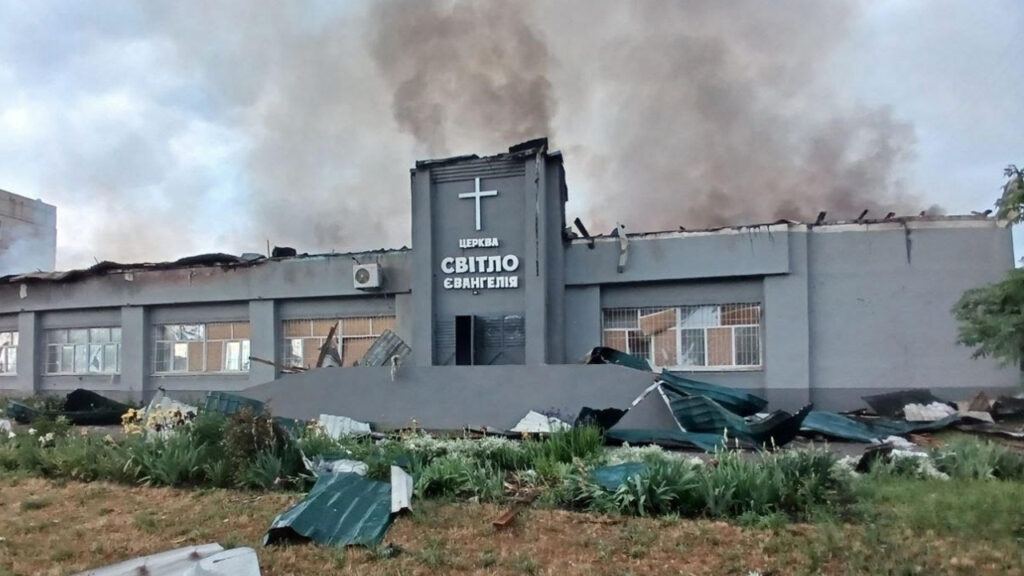
Although a teens’ meeting was scheduled, the building was empty when it caught on fire. The roof, interior and windows were destroyed.
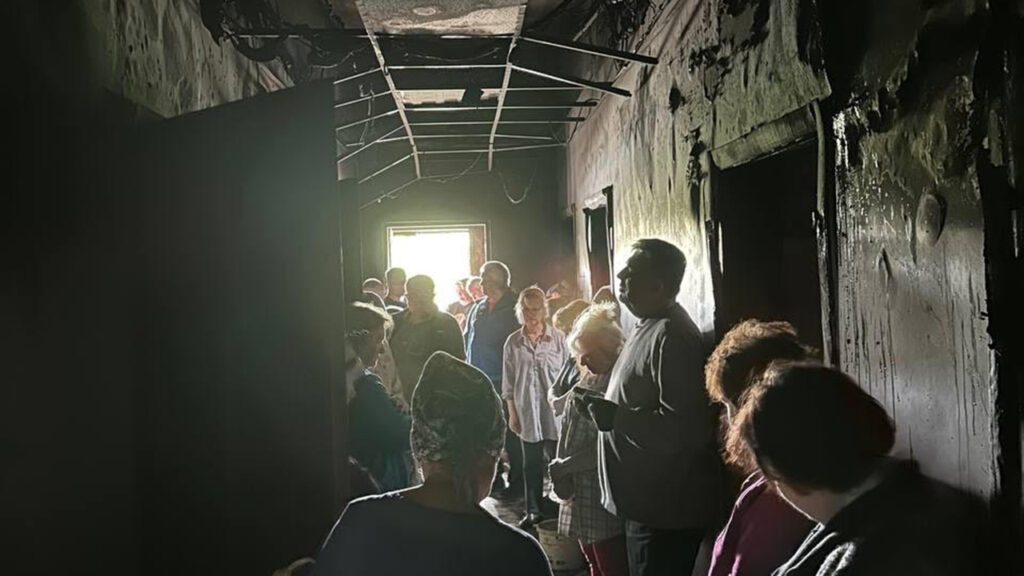
“The next day, Sunday morning, they had a church service, where they sang glorifying God, standing in the ruined building,” she wrote. “One can destroy the building of the church. You cannot destroy the church. . . .
“Is it worth investing into something which can be destroyed tomorrow? I am Ukrainian and this is my response: Life is going on. We cannot stop it, to wait until the war ends. Babies are being born, children are growing. Even if we stop restoring and building, they won’t stop destroying. Those who decided to stay in Ukraine do not have another option.”
One group that decided to stay in Ukraine is the Mennonite Brethren church. A few days before the Chortitza school building airstrike, Roman Rakhuba, who chairs the Association of Mennonite Brethren Churches in Ukraine, shared about the challenges faced by the AMBCU’s more than two dozen churches and ministry centers.
AMBCU and Mission Eurasia’s Caring Hands ministry are conducting more than 50 children’s camps and outreach projects for over 4,000 children traumatized by the war.
“Several camps, especially in the Zaporizhzhia region and other communities close to the front lines, are being conducted next to bomb shelters so children can immediately take cover whenever air raid sirens sound,” Rakhuba wrote in a July 2 email to MB Foundation and published in Christian Leader. “Please pray for God’s protection and wisdom for the leaders and for thousands of children to encounter Christ and discover lasting hope.”
He added that pastors and leaders, their spouses and families experience exhaustion, burnout, grief and other stress daily after more than four years of war. Still, a “tremendous influx of unbelievers” come to AMBCU congregations.
“Every week, people come to our churches to pour out their traumatized hearts and seek food, medicine, emotional support, counseling, prayer and ultimately hope in Christ,” Rakhuba wrote. “The churches rejoice to see many coming to faith, yet the harvest is growing much faster than the number of mature believers available to disciple these new Christians. Please pray that God would continue raising up spiritually mature men and women who can teach, mentor and walk alongside this new generation of believers.”



Have a comment on this story? Write to the editors. Include your full name, city and state. Selected comments will be edited for publication in print or online.