


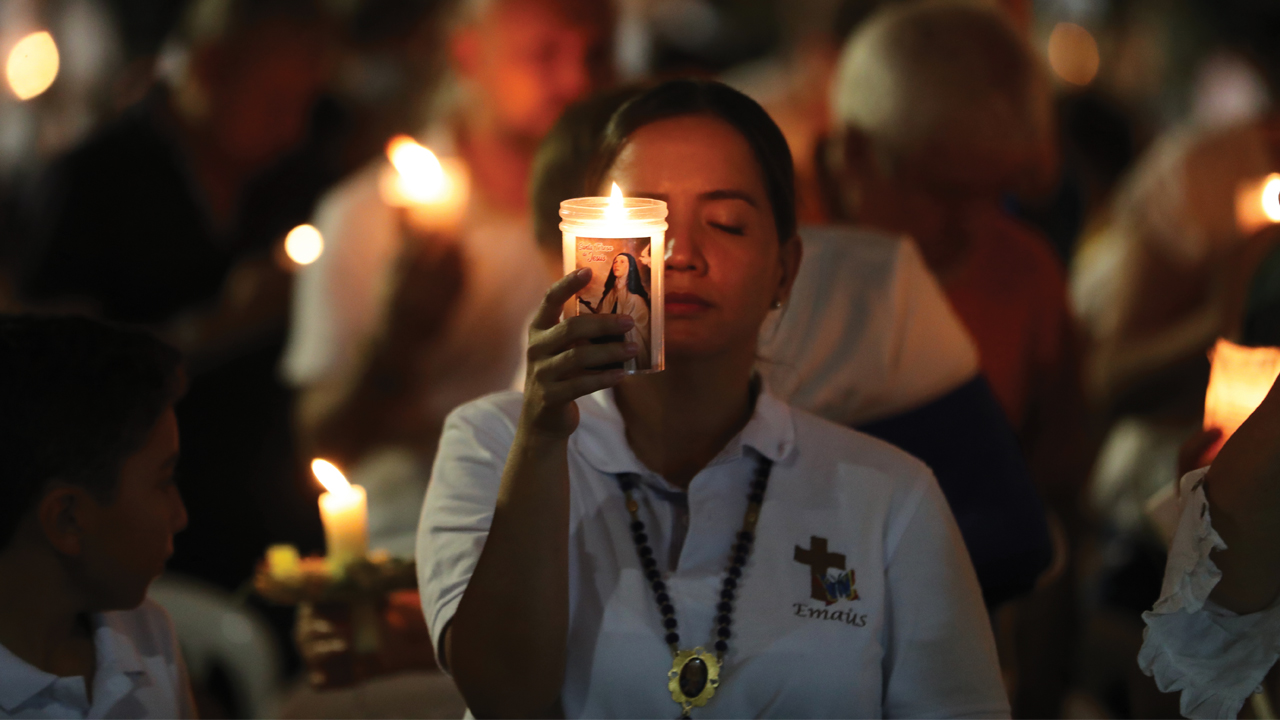
Isdalia Ortega, a Mennonite Brethren leader in Cali, Colombia, was having her morning coffee at 7:34 a.m. Aug. 10 when everything started shaking.
“We desperately ran out of the building, and as we did, the building began to collapse,” she said.
It was a magnitude 7.4 earthquake, which affected 16 departments across Colombia. By September, according to Colombia’s National Unit for Disaster Risk Management and the Red Cross, 331 people had died, 4,505 were injured and 111 remained missing. The earthquake also destroyed 36,326 homes.
In the weeks that followed, Ortega and her family received housing support through their church community while they searched for a new place to live. Their home is uninhabitable.
Mennonite Brethren communities in Cali are working with Edupaz, a local peace education organization, and Mennonite Central Committee to seek funding and support. The disaster has also brought churches together.
“As people of God, we are called to support all of our communities, not only our church,” said Jorge Morales, a Mennonite Brethren pastor in Cali. “We are working with everyone around us, despite our political differences.”

The Mennonite Church of Colombia, or IMCOL, is coordinating with local teams to develop projects and distribute funds among affected communities, particularly Mennonite Brethren congregations among the hardest hit.
“We hope our wider community keeps us in their prayers and supports us through the humanitarian projects we are developing to help those affected,” said Juvenal Pacheco, regional coordinator for western Colombia with IMCOL and part of the pastoral team at Armenia Mennonite Church.
Francisco Mosquera, a Mennonite Brethren pastor in Cali, recalled being in a car when the earthquake struck.
“We felt as if we were in the ocean, but in the middle of the road,” he said. “The stoplights and cables were swinging from left to right. . . .
“Several people in our church have lost members of their families, while others were injured with fractures and deep cuts from falling rubble. It has been a very challenging and traumatic experience for our community, and we face major economic challenges as we rebuild our lives. We thank God we are alive.”
Adriana Herrera, a Mennonite pastor in Pereira, said hospitals, schools, homes and other buildings collapsed, while the loss of public services during the first days created panic and chaos.
“People are very scared that this can happen again and are wondering how we will respond as a community,” she said. “To rebuild means depending on God as the foundation of our faith while we help others and recover what has been lost.”
Chocó, where the epicenter was located, has historically been one of Colombia’s most neglected regions. Its predominantly Black and Indigenous population has long faced structural racism, poverty and limited access to public infrastructure and services.
José Rutilio Rivas, pastor of the Mennonite Brethren church in Istmina, Chocó, described the aftermath.
“I’ve traveled to several communities where people have lost everything,” he said. “Entire communities have had to relocate because of geological instability. Since Aug. 10, there have been several smaller earthquakes, so we are still dealing with this.”
Pacheco reflected on how previous disasters have shaped the church’s response. The city of Armenia, rebuilt after a devastating earthquake in 1999, was less affected this time.
“Historically, we have experienced different natural disasters throughout Colombia, and some of them have been consequences of our poor relationship with the Earth,” Pacheco said. “They have given us important lessons and experiences.” He added that earthquakes should not be understood as acts of God against humanity.
For Pacheco, the pastoral response must combine spiritual accompaniment with practical action.
“It is very important to accompany, listen and put ourselves in the place of the affected person,” he said. “Everything must be accompanied by actions that address people’s needs — practical things.”


Have a comment on this story? Write to the editors. Include your full name, city and state. Selected comments will be edited for publication in print or online.