


My parents were Amish-Mennonite church planters, and they didn’t vote. Though their church sat mere miles from the Capitol and the White House, they cared not a bit for the political power nearby.
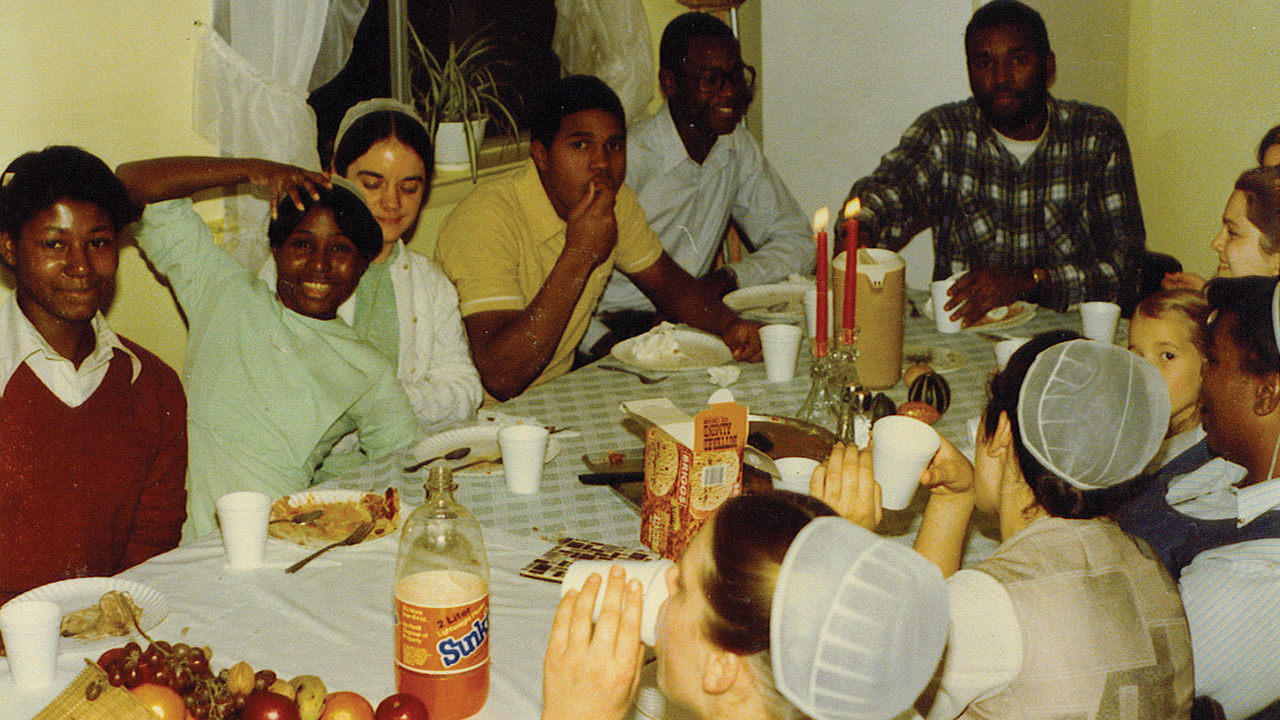
In the marginalized Black neighborhood where they brought their conservative Beachy Mennonite traditions and Amish-derivative plain dress, Elmer and Fannie Lapp’s power in the community started not with politics but with snacks.
Yes, snacks.
Because what was a young, White, covering-wearing, beard-growing family to do when they had just moved from Pennsylvania Amish country and needed to build relationships in a hard-life ’hood dominated by an asset-poor housing project?
Recognize that there were a lot of hungry kids around and then feed them, of course.
A Bible story and a few peanut butter apples with some boys under a backyard tree amid 1965’s civil rights foment led to afternoon youth clubs — with more snacks. Which led to summer camps featuring liberal supplies of peanut butter sandwiches and Amish-Mennonite casseroles like yumazetti. Which led in 1975 to a volunteer-built church house offering Sunday school, along with plenty of potluck dinners after.

Elmer and Fannie Lapp spent 40 years supporting young people and families in the neighborhood of Kenilworth in a forgotten corner of Washington. Located adjacent to power but placing themselves among many who felt powerless, they helped neighbors beset by poverty, joblessness, addiction, abuse, violence and a gnawing despair driven by systemic racial disadvantages.

But when I hang out with a group of Kenilworth old-timers now, I find they remember the snacks the most. Inevitably, after someone praises my parents for helping them stay on the straight and narrow, someone else will say, “Really, we came to the Lapp church to eat.”
My parents’ neighborhood-level actions meeting basic needs situated them within an Anabaptist tradition that roots communal and spiritual power not in the machinations of governance but in hands-on compassion.
Elmer and Fannie believed the teachings of Jesus mandated a meek, generous, love-thy-neighbor life built around serving others — and discouraged participation in the power scramble of political affairs.
So they served snacks instead of exercising their right to universal suffrage.
In the Amish-Mennonite faith of my childhood, pacifism and abstaining from the vote were twinned. Both rejected participation in a “worldly” government that operated outside of our “heavenly” kingdom. The words of Jesus to Pontius Pilate got quoted a lot: “My kingdom is not of this world: if my kingdom were of this world, then would my servants fight” (John 18:36, KJV).
My father communicated clearly to me that he believed Christians were not put in this world to seek power or physical might but to seek God’s love and offer that love to others. Purity of heart, mind and body was the goal. Political power (as we saw it) did nothing but corrupt the will and inflate a sinful ego.
During my teenage years, I challenged my dad on his choice not to vote. The most I got out of him was that he agreed more with Republicans on issues related to sexual morality, more with Democrats on the need for social justice, but neither was following the way of Jesus. He didn’t want to be part of either.
Though I’m no longer a practicing Amish-Mennonite, I keep my parents’ tradition of avoiding the vote. I’m open to arguments that this avoidance is regressive and, in a time of stark moral and political choices, even irresponsible.
I’m not ready to let go, however, of this connection to my spiritual past. My decision not to vote is a pointed choice upholding an Anabaptist-inspired belief that politics is a limited and innately corruptible agent of change. I think, as did my parents, that people-focused compassion (remember the power of snacks!) is a more effective way to improve the world than seeking political authority.
Our world, of course, needs both compassion and hard-nosed action.

Alongside my parents, the neighborhood of Kenilworth had another positive actor in Kimi Gray. Kimi was a single mom on welfare who rose to lead a remarkable 1980s neighborhood revitalization that brought help, self-determination and hope to many in the government-built housing complex where she lived.
Unlike my parents, she chose to extend her reach through political power, forming an alliance with District of Columbia mayor Marion Barry, which led to national recognition and the chance to advise multiple U.S. presidents on housing policy. But, when political winds shifted and her approach was no longer in favor, the dreams she had for the neighborhood suffered.
Political favor comes and goes. The power of faith and love to help others is constant.
You might think my and my parents’ decision to remain outside the political system by not voting is a cop-out. Or you might see it as I see it: a clear-eyed connection to Anabaptist tradition. Either way is OK by me. It’s a big world with many choices, and we can disagree on the best way to bring positivity to our communities.
Yes, in this age of polarization, we can have faithful disagreement. But I hope we can agree that following the way of Jesus means prioritizing compassion over political power. Because putting love and outreach first is, I think, the most effective way Anabaptists can remain true to their faith and do good in the world.
Joe Lapp is a writer, communicator and expat from the United States who has lived abroad on four continents. He writes the Cross/Culture newsletter on Substack.


Have a comment on this story? Write to the editors. Include your full name, city and state. Selected comments will be edited for publication in print or online.