


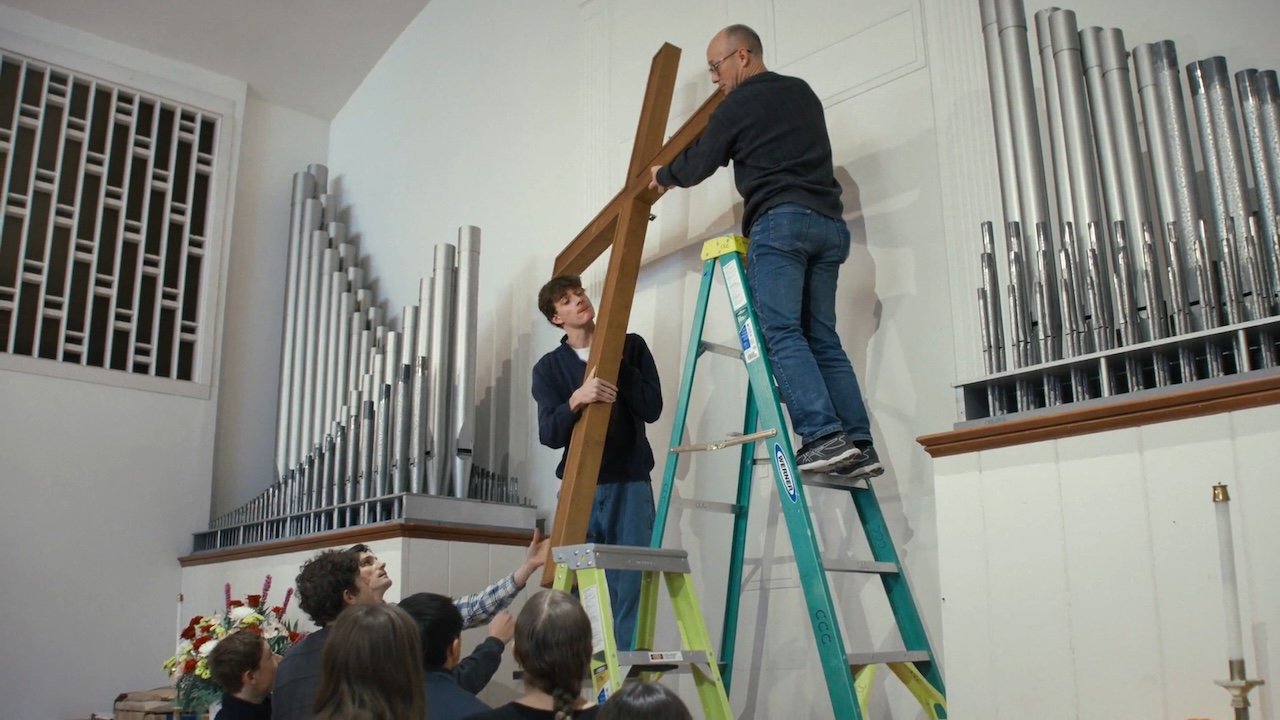
A 120 year-old United Methodist Church in rural Michigan shutters. A traditional Catholic church in New York’s Greenwich Village is packed with young people in their 20s and 30s. And a network of house churches meeting in people’s living rooms is growing across the country.
These are among the many snapshots of American Christianity featured in a four-part documentary series that began airing Oct. 1 on public television stations across the country.
Christianity at a Crossroads, by documentary filmmaker Martin Doblmeier, tells the story of congregational church life in the United States at a critical moment when growth has flatlined, younger generations are less religious and a raft of scandals have overtaken nearly every Christian denomination.
Doblmeier is no stranger to the subject. His Journey Films production company has specialized in religious subjects with PBS-style documentaries on theologian Dietrich Bonhoeffer, Catholic activist Dorothy Day and philosopher and theologian Howard Thurman, among others.
The new series, funded by Lilly Endowment, which also provides funding for Religion News Service, features interviews with leading experts: sociologist Ryan Burge, writer and ethicist Russell Moore and pollster Melissa Deckman. But it’s the portraits of half a dozen churches and how they’ve weathered change that provide a glimpse of the variety of Christian church expressions today. There’s even a segment on virtual reality church.
RNS talked to Doblmeier about the making of the series, which is also going to be available for free on its website, journeyfilms.com. The interview was edited for length and clarity.
What prompted this project and how long did it take to film?
Well, the answer to the second part is about 20 months. It was originally conceived as two hours, and then we found we had such good material we asked for, and were allowed to go, four hours with it. We were keenly aware there was lots of data about the decline of Christian life in America, and our objective was not to challenge that, but to understand better what did that mean and who’s impacted by it. We tried to do it in a balanced way. If you’re patient enough to look, you can see there are plenty of signs of hope, plenty of signs of vitality. Our argument is, these are challenging moments. Christianity is at a crossroads. It’s going to have to make some decisions, and I think it’s doing that. There may be a decline in numbers. But I think what’s going to be left is going to be the foundation of something unique and possibly even stronger.
The series addresses a lot of challenges facing U.S. Christianity: the decline in churchgoing, a younger generation that’s less religious, a loss of trust in institutions, the sex abuse crisis, especially in the Catholic Church, declining infrastructure. What’s the biggest?
We presented the argument that the biggest factor is people no longer believe in religion. It’s not the priority that it was maybe two generations ago. In past generations your faith tradition was passed on from one generation to the next. The comment we have in the film from one person is, “It’s just not happening anymore.” I think that’s a big factor in all of this. The numbers show that if you’re not raised in a family where religion is practiced and given a priority, the likelihood of you getting into that practice and maintaining it later in life declines.
You report on the rise of Christian nationalism but you don’t examine the political landscape — Trump and MAGA — and how that’s affected Christianity. And there’s no mention of the impact of Trump’s immigration crackdown on Christian communities.
We’d like to hope our films will be around for many years. Who knows what’s going to happen in the next couple of years? We wanted to highlight Christian nationalism, but I think we were clear to say the amount of noise that Christian nationalism makes may not really be reflective of the number of people who really adhere to Christian nationalism principles. We believed that was maybe the most important thing. And I also, I know a lot of people who say to themselves, “Well, I’m, you know, I’m a Christian, and I love this country, does that make me a Christian nationalist?” The title of Christian nationalism is most often used by others as opposed to people self-identifying as Christian nationalists.
Also, this film was originally conceived to be a contribution to the America 250 story. So that was kind of the starting place for it. In some ways, we wanted to see if we could possibly tell the story and transcend some of the contemporary politics of it.
Was there any one church portrait you felt was emblematic of what was happening across the country?
The chapter on Resurrection Church in Kansas City. I left Kansas City feeling there was hope that there could actually be a middle ground. There’s so much conversation as to whether we’ll ever settle these deep divisions, these social political divisions. Adam Hamilton, the pastor who founded that church when he was 25 years old in a funeral home, has continued to build it and try to figure out a way to do it. And yes, he could be labeled a megachurch pastor, but it still has that kind of hometown feel to it. And they’re trying to preach a gospel that’s socially engaged, politically aware and yet holds true to the high ground, which they feel as though is the gospel tradition, and that gave me hope that things were possible.
And of course, he’s running for the Senate now.
He’s got his hands filled trying to become the first (Kansas) Democratic senator in 100 years.
You end the series on a hopeful note about the future of churchgoing in America. Am I reading that right?
Yeah, I mean, I don’t think reimagining, recalibrating, reevaluating where we are right now at this moment in history is a bad thing. There are thousands of churches across this country that are, kind of, on an edge. They have to rethink what they’re doing, and yet some people are forward-thinkers. I admired (Silver Spring, Maryland’s Christ Congregational Church), which said, “Look, we don’t want to be burdened by the building that we have. So we’ll sell the building. But we’re gonna stay together as a community. So if we have to meet for two years in the basement of a neighbor’s church, we’re going to do that.” I thought that was a great model.
When you talk about hopeful signs, we thought St. Joseph’s Church in Greenwich Village, New York, was an interesting hopeful sign. The Catholic church is completely packed, and the pastor will say, “We’re not doing anything different. We’re not trying to cater to this younger generation. We’re presenting what we think are the Catholic teachings, and we’re preaching out of the Catholic texts, and yet the (young) people are coming.” So just when you think you’ve figured out a formula, what’s working here, this church presents itself and says, sometimes the old formulas still hold value. These people want something they can think about and hold on to and they can value because they believe there’s so little they can actually trust. I think that’s the most important message right now: Give me something I can believe in and trust.



Have a comment on this story? Write to the editors. Include your full name, city and state. Selected comments will be edited for publication in print or online.