


Whenever my three children brought home a fundraiser, I ended up buying most of whatever it is. I have no entrepreneurial spirit or skills, and I have been fortunate to not need those skills to survive.
In September 2025, I attended a four-part online Mennonite Action Courage School. The third session focused on direct support and mutual aid. I thought I was familiar with mutual aid. But the school’s definition required more than a fundraiser or donation. Instructors stated solidarity requires an “emphasis on mutuality and relationship building. . . . Trust takes time; this is work for the long haul.” Mutual aid must be based on both the interdependence and equality mentioned in Paul’s letter from Corinthians.
Courage School challenged me to shake off my fundraiser fear. Was the Spirit telling me to consider a mutual aid project? Perhaps.
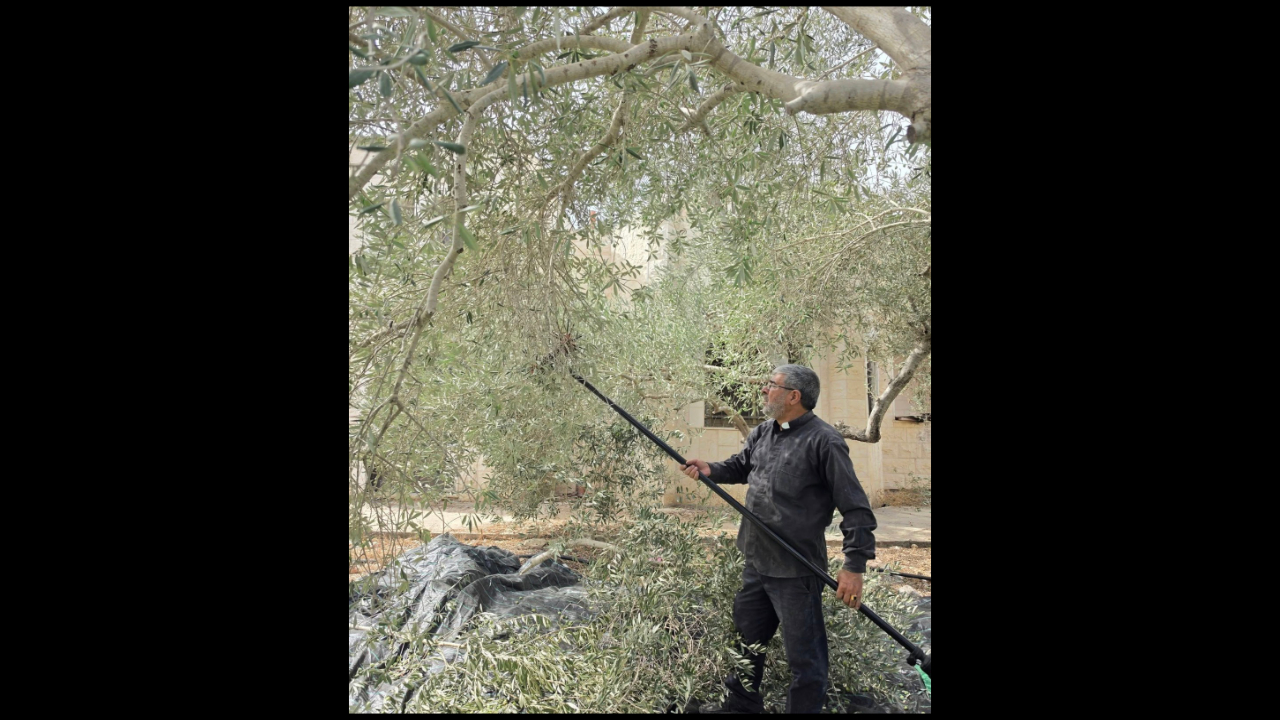
The next day, Mennonite Palestine Israel Network’s monthly MennoPIN email included a mutual aid project. Abouna (Father) Firas Khoury Diab of St. George Melkite Catholic Church in Zababdeh, Palestine, requested congregations in the United States support the community’s cooperative olive oil soap project.
Unlike the candy, candles or cards from my children’s fundraisers, this mutual aid project evolved into much more than selling soap. We have exchanged nearly 100 emails since Khoury and I began corresponding last year. The emails focused initially on purchasing the soap to sell in Philadelphia. By December 2025, he shared about the congregation’s Christmas preparations and gradual, guarded accounts of life under Israeli occupation. Since then, Abouna Khoury has shared reflections on community life during Christian holy seasons, celebrations of school graduations and our families’ similarities — we both have three sons, including twins.
Here are responses to email interviews with Khoury and members of St. George’s Church.
What are the Christian origins in Zababdeh, Palestine?
The roots of Zababdeh’s Christian presence in the northern West Bank dates to the 400s CE. In the early 19th century, additional Christian families from Taybeh, Palestine, moved to the area. The first families lived in caves, cultivated the land and raised animals. By the early 20th century, Zababdeh grew from a small agricultural community based on olive trees and agriculture into a close-knit town with schools, churches, a university and social and economic initiatives. Remaining on the land is more than an economic decision. The land is part of our history, identity and Christian faith.
What should we know about the current Christian community in Zababdeh?
Today, there are about 3,000 Christians in Zababdeh, or 75% of the town. For us, Christianity is not religious tourism. Christianity is a way of life connected to this land. We pray, raise our children, teach children and young people, serve those in need and celebrate the Eucharist in the land where Christ lived, suffered, died and rose from the dead. The challenge today is to keep this community alive rather than allowing it to become only a memory. Therefore, preserving Christianity requires supporting the ability of people to live, work, raise their children, practice their faith and build a future on this land.
What is your family’s connection to Zababdeh?
In 1935, my grandfather, Father Stephanos Khoury Diab, became the priest of St. George’s Church. He served for 54 years until his death in 1987. After that, the church was closed for 15 years. I returned to Zababdeh after my ordination to the priesthood on Dec. 14, 2002. Beginning in 2003, the community began to restore the church building and community.
How has the work of St. George’s Church evolved since 2003?
After rebuilding the church and reopening the parish, we have built a community that includes education and social projects, assistance to families in need, medical support and projects with children, youth and women. We have opened our door to solidarity groups to visit with us and hear our stories.
In addition, we created a cooperative to develop income-generating projects for work opportunities. The cooperative is part of a social and economic community: The farmer produces, the craftsperson works, the cooperative gathers and markets the products, churches and partners abroad purchase them and help sustain the work, and the income returns to the people. In this way, the cooperative helps the community remain productive and connected rather than simply waiting on “aid.”
How is the cooperative part of your Christian witness?
In the church, we teach people about hope, steadfastness and resilience, but we cannot speak about hope to someone who does not have enough to eat or cannot provide for their family. Hope is not simply a word; it must become a way of life and action.
We believe that the survival of Christians in Palestine is not achieved simply by telling people to stay. We must also help create the conditions that make it possible to stay with dignity.
After October 7, 2023, this became even more urgent as the Israeli government closed roads, built barriers and denied work permits. Employment opportunities disappeared, especially for young people.
At the same time, we are witnessing the construction of new Israeli settlements and expanded checkpoints and road closures. There are repeated Israeli military incursions and violent Israeli settler harassment and attacks. Land has been confiscated and olive trees uprooted. This is deeply painful because the land is not simply a piece of property. It represents a family’s labor, memory, livelihood and history.
How can North Americans support the Zababdeh cooperative?
Zababdeh is a living community of families, farmers, children, youth and a church that continues to pray, work, serve and hope. We do not want pity. We want to live with dignity and safety, and we want to remain on our land and build a future for our children in Palestine.
We know the road ahead is difficult, but we continue to believe that the cross is not the end of the story. The empty tomb reminds us that death does not have the final word. We remain in our home — Palestine — because we believe that Christ is alive, and hope is still possible.
We invite you not only to hear our story but to walk with us, pray with us and become part of a living witness to the good news of Christ.
Next steps
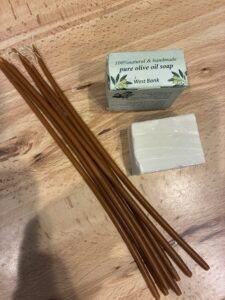
Your community can join in equality and mutuality by selling products from Zababdeh including olive oil soap, beeswax candles, za’atar (a spice blend) and Palestinian embroidery.
Contact: Abouna Firas, melkitecatholic at yahoo.com.


Have a comment on this story? Write to the editors. Include your full name, city and state. Selected comments will be edited for publication in print or online.