


Michael J. Sharp, a Mennonite worker with the United Nations kidnapped in the Democratic Republic of Congo, was found dead March 27.
Multiple media outlets reported Congo communications minister Lambert Mende said March 28 the bodies of two U.N. experts were found. The U.N. confirmed it later that day. One of the bodies, a female, had been decapitated.
“It is now a certainty,” Mende said. “It is the two investigators. We identified the third body in the grave with them as their Congolese interpreter.”
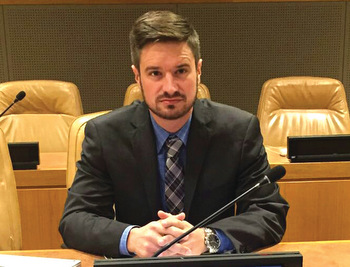
Sharp, 34, was one of six people abducted by an unidentified militia group while traveling by motorcycle near the village of Ngombe in Kasai Central province, the Congolese government said March 13.
He was accompanied by U.N. colleague Zaida Catalan, of Swedish citizenship, and four Congolese people — interpreter Betu Tshintela, driver Isaac Kabuayi and two other unidentified drivers.
The group was investigating human rights violations and armed groups. Mounting deaths, including targeting of civilians, women and children, have been attributed to clashes between government security forces and Kamuina Nsapu militia members in Kananga, the capital of Central Kasai.

Human Rights Watch, France and Belgium had called on Congo and its security forces to do more to help the search.
“We are extremely worried about the missing U.N. team,” Ida Sawyer, Central Africa director at Human Rights Watch, said March 27. “The Congolese government should cooperate fully with the U.N. and other international investigators to do all they can to bring the team back safely.”
HRW criticized the “lack of cooperation from the Congolese government.” A week after the group was abducted, Monusco, the U.N. peacekeeping command in Congo, said it was concerned by “restrictions placed on its freedom of movement by security forces in Kananga” that is “restricting [its] ability to exercise its mandate.”
The group was investigating human rights abuses near the village of Bunkonde, south of Kananga.
On March 22, the United Nations Office of the High Commissioner for Human Rights said its investigators had visited at least two mass graves. The office has confirmed 10 mass graves and reports allegations of at least seven more. Some of the bodies in the graves are believed to be people killed by the Congolese military during fighting in February against the Kamuina Nsapu militia.
Africa Times reports both sides are accused of human rights violations, which is what it says Sharp and Katalan were investigating.
President Joseph Kabila’s government has refused to move forward with elections and democratic reforms. Africa Times reports the Kasai area had been relatively peaceful until August, when Congolese security forces killed Jean-Pierre Mpandi, a critic of Kabila’s government who had begun calling on insurgents to fight Congolese “occupation” and foreigners.
At least 400 people have died in Kasai and surrounding provinces, and 225,000 people have been displaced by the fighting. On March 24, more than 40 police officers were decapitated by rebel fighters. A week earlier, the Congolese military announced seven officers had been charged with war crimes after video showed soldiers shooting civilians in the province, killing at least 13 people.
A former worker with Mennonite Central Committee in Congo and Mennonite Mission Network in Germany, Sharp is a graduate of Eastern Mennonite University in Harrisonburg, Va., and Bethany Christian Schools in Goshen, Ind.
Thomson Reuters Foundation reported Congo communications minister Lambert Mende said villagers discovered three bodies not far from where the group disappeared.
“It is probable that it is them, unfortunately,” Mende said.
On March 27, police informed the Kinshasa government of the discovery and a team was sent to identify the bodies of two Caucasians and one Congolese.
This story was updated March 28, 2017.


Have a comment on this story? Write to the editors. Include your full name, city and state. Selected comments will be edited for publication in print or online.