


An Amish community near Auburn, Ky., is at odds with a municipal ordinance compelling animal owners to clean up excrement left on streets and public property.
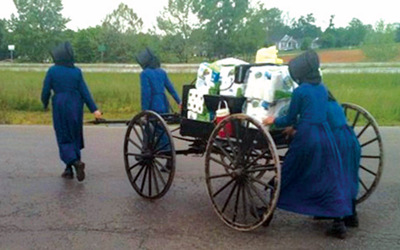
Multiple members of the community were cited for not following the ordinance in January and demanded a jury trial when they refused to pay the $50 fine.
The Logan County News-Democrat & Leader reports Amos Mast and his son, Dan Mast, were found guilty April 6 and ordered to pay the fine plus court costs by June 25 or face jail time. Both say they will not pay the fine and won’t set a precedent of compromising their beliefs by using a manure-collection device.
“Amos said he had spoken with several other Amish communities who told him not to do it because then the English would eventually make all Amish do it,” the News-Democrat & Leader reported.
Clara Mast was scheduled to appear in court May 27 for a similar infraction, but an anonymous person paid her fine.
The village of Gouverneur, N.Y., considered a similar ordinance a few years ago that would have required horses to wear diapers but ultimately decided it was too targeted at the Amish and bad for local businesses.

Goshen (Ind.) College history professor Steve Nolt, author of several books about the Amish, said the Kentucky group is an offshoot of the Swartzentruber Amish, in many ways the most conservative Amish.
He said Swartzentrubers and related groups have routinely resisted interference with their black buggies, to the point of occasionally going to jail.
“Swartzentrubers have said that the triangle is a symbol of the trinity and the [orange slow- moving-vehicle] triangle is thus like a pagan talisman,” Nolt said. “And the slow-moving-vehicle triangle is an attempt to put one’s security and safety in the hands of state regulation instead of in God.”
While virtually all other Amish accept such regulation in the name of public safety, Nolt said this group likely sees the manure-collection ordinance as a “back-door effort” to regulate buggies.
“From an outside perspective this does not seem like it has anything to do with the slow-moving-vehicle triangles, but for these people it probably does,” he said. “It’s a fear that if they are not absolutely consistent in resisting new things, the state will be able to force all new things on them.”
Another group, in this case Swartzentruber Amish near Huevelton, N.Y., has been navigating a similar disagreement over buggy safety for decades.
North Country Public Radio reported four bishops met with state Sen. Pattie Ritchie, county legislators and law enforcement officials May 21 after a local politician proposed legislation that would ask the state to require all buggies to display an orange reflective triangle.
Police ticketed offending vehicles in the 1980s, and Amish went to jail for infractions before a compromise set out rules requiring 72 inches of reflective tape to surround the frame of Swartzentruber buggies and red lenses to be used with lanterns.
NCPR reported the bishops are willing to work with law enforcement to test reflector options and remind buggy drivers to replace reflective tape and lanterns more regularly.
“Bishop Moses Miller said he’d even be willing to ride along in a police car so he could see what the buggies look like from behind,” said NCPR reporter Sarah Harris.
There are now about 500 Amish communities in North America, as large families and high land prices inspire new communities.
“The spread of Amish people in recent years into more and more new places that have never been home to them means that they are living with new neighbors, and more such conflicts are likely to surface,” Nolt said. “So we may be seeing more of these sorts of stories.”



Have a comment on this story? Write to the editors. Include your full name, city and state. Selected comments will be edited for publication in print or online.