


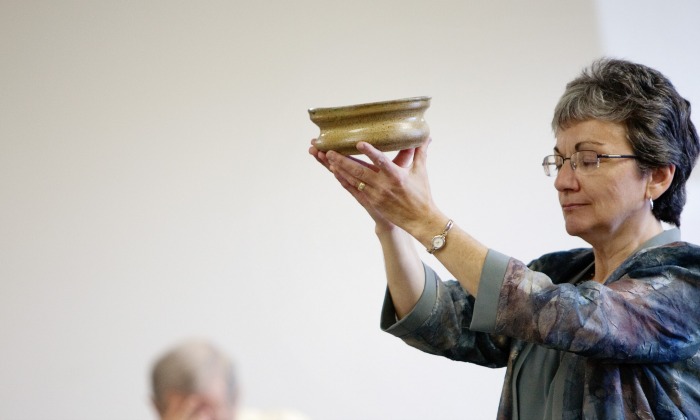
Photo: Brenda Martin Hurst is the pastor of Frazer (Pa.) Mennonite Church. Photo provided.
Frazer (Pa.) Mennonite Church’s journey as an LGBT-inclusive church reached a milestone last month.
On Oct. 25, after a deliberate process led by the Atlantic Coast Conference’s executive committee in September, ACC delegates accepted Frazer as a full member of ACC.
John Denlinger, moderator of ACC, said that unity among delegates—despite differing views on LGBT inclusion—was possible through reframing the question.
The question for the leaders at their Sept. 18 meeting was not, do we support LGBT inclusion, said Denlinger on Oct. 7.
“We were not making a theological statement. Instead we were saying Frazer has met the full membership qualifications as stated in our conference by laws,” he said. “So the vote was really about following our ACC history and practice of congregational polity, and not a theological position in regard to LGBT issues.”
Denlinger acknowledged that not everyone is at the same place regarding LGBT inclusion within ACC.
“But for the purpose of the October vote, we saw them as separate issues,” Denlinger said.
The ACC executive committee recommendation passed with an 88 percent approval from ACC delegates.
The vote was part of the ACC fall delegate assembly at Blossom Hill Mennonite Church in Lancaster, Pa.
Frazer transferred from Lancaster Conference in June 2013, as it was in conflict with Lancaster Conference’s expectations for membership policies—among other reasons. Atlantic Coast Conference invited the congregation to become an associate member.
Frazer claimed the identity of being a “welcoming, connecting and healing ” place long before “welcoming” took on a certain meaning related to a position on LGBT individuals, said Brenda Martin Hurst, pastor, on Oct. 29.
Changing from Lancaster Conference to ACC was “never only about our response to LGBT individuals seeking membership,” she said.
In addition to this reason, Frazer wanted to belong to a conference with a clear and unified commitment to Mennonite Church USA, congregational representation in decision-making and a shared calling to practice unity amid diversity, she said.
ACC has other LGBT-welcoming churches—for example, Community Mennonite in Lancaster; Manhattan Mennonite in New York; and Boston Mennonite—but Frazer has been more public because it is a new church in the conference.
“We are delighted and celebrate that Frazer is a full member of ACC,” said Denlinger on Oct. 27.
“Being full members finally settles the question of Frazer’s conference affiliation after three years of some uncertainty,” Martin Hurst said. “We can now focus our attention and energies on other priorities.”
The process leading up to the recommendation for the delegates began with a day hosted by the executive committee to gather all ACC credentialed leaders.
“We really wanted this recommendation to have broad ownership—not just from the executive committee but from all pastors,” said Denlinger.
Throughout the day they worked slowly at table groups.
(The churches from New York City were not present at the September leaders gathering, but they would have represented a similar spectrum, said Denlinger.)
By the end of the day, the leaders were able to say, “For now, we are responding to Frazer and accepting the church as a full member, but we’re not coming out with a statement on LGBT inclusion,” Denlinger said.
“When we sat there at the end of the day, we realized God’s Spirit was at work. It was clearly beyond us,” he said. “Frazer was a gift to us and allowed us to talk freely about this issue.”
The credentialed leaders agreed to go back to their congregations and communicate this process after the gathering.
Since being received as an associate member, Frazer has been participating just like a full member by being fully present at all the conference gatherings and supporting the conference financially.
During the business session, delegates received a request from Sandy Hill Community Church, Coatesville, Pa., to be released from ACC. They will join the Alliance of Mennonite Evangelical Congregations, according to Denlinger.


Have a comment on this story? Write to the editors. Include your full name, city and state. Selected comments will be edited for publication in print or online.