


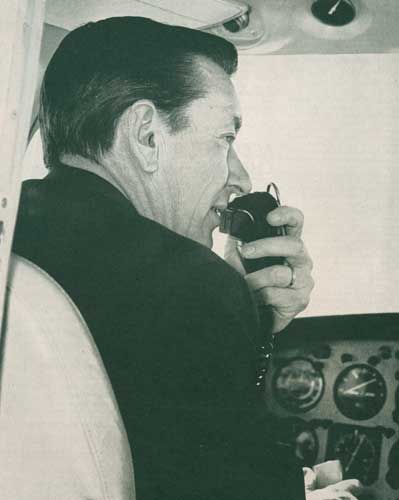
Lyle Yost improved the lives of farmers and benefited future generations.
Hesston College put the town of Hesston, Kan., on the Mennonite map, but it took the entrepreneur Lyle E. Yost to make the town’s name recognizable around the world on Hesston-branded machinery.

Years before the college claimed the tag line, “Start Here, Go Everywhere,” Yost, as a young Mennonite farmer, did just that. As president, CEO and chair of the board of Hesston Manufacturing/Hesston Corporation, he traveled around the world to achieve his goal: “to improve the life of the farmer.” Yost’s philanthropy and the impact that the corporation he founded—now AGCO Corporation’s Hesston facility—has on
the economy continue to bless people in many ways, especially those in his hometown.
Yost died April 5, 2012, exactly 11 months before his 100th birthday.
Yost spent a lot of his growing up time with his grandparents, Peter and Suzanna Yost, members of the Church of God in Christ Mennonite, who lived beside the farm home he shared with his sister Zella, and parents, Joseph and Edith Alma (Hensley) Yost, absorbing their faith and farming ingenuity.
He graduated from Hesston Academy just before the Great Depression forced the college part of the academy and Bible school to shut down for a few years. Before returning to Hesston College as a freshman, Yost helped his family survive the Dust Bowl by driving around the Great Plains, acquiring abandoned, dust-covered machinery and bringing the implements back home to refurbish and resell in his father’s farm implement dealership.
Yost continued his education at Goshen (Ind.) College, graduating in 1937 with a degree in economics and completing a second bachelor’s degree in education in 1942. He married Erma Martin on July 31, 1938, after five years of courtship.

Hesston College President Milo Kauffman had visited Erma and her sister Ruby in their Minot, N.D., home and recruited them to come to Hesston College, where Erma and Lyle met. On their first date, Lyle took her to Pennsylvania Mennonite Church (which later moved to a new building in town and changed its name to Whitestone) for a Sunday evening service in which his uncle, Earvy Yost, preached and sang. After Erma’s death, Lyle noted in a letter to his children, “As they were placing [Erma’s] headstone, here I stand 75 yards (a pitching wedge) and 70 years from where I had my first date.”
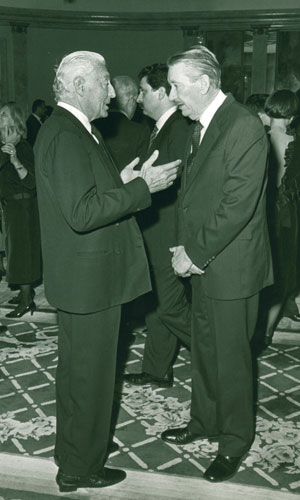
During their marriage, the couple experienced the sorrow of the stillbirth of their first daughter and the joys of parenting Byron, Winston, Susan and Cameron. They endured the rigors of custom harvesting and the exhilaration of a transatlantic Concorde supersonic jet flight. Erma used her talents to help start the first kindergarten and public library in Hesston while adapting from a rural farm to an international corporate lifestyle with Lyle. In retirement the couple enjoyed more time together, traveling, golfing, reading and enjoying their grandchildren.
After Yost worked at a bank and taught in Elkhart County, Ind., the death of his father and the draft board’s farm deferment obligated him to return to his family’s farm near Hesston in 1943. He spent the next four years farming and custom harvesting.
Knowing that a farmer’s livelihood depends on getting grain harvested and stored while the sun shines, Yost grew impatient with the harvesting time lost in manually unloading stopped combines. To save the day, he invented an unloading auger and took his plans to Adin Holdeman, who made the prototype in his Hesston Machine Shop. Elmer Berner, an implement dealer, found eager buyers for the combine attachment, and the three men joined to found Hesston Manufacturing Company to mass-produce the augers in 1947.
In 1955, the growing manufacturing company produced its first self-propelled farm instrument and branded it the Hesston Swather. Swathers (also called windrowers) and many of the implements that followed made haymaking a one-person job and established Hesston’s reputation as a leading manufacturer of hay and forage implements.
Lyle Yost checks an advertising layout. Photo provided.
When the new public high school replaced Hesston Academy, students chose the Hesston Swather as their unique mascot, since by the mid-1960s “Hesston Corp.” had become such an important part of the city’s identity and prosperity.
Yost, while busy envisioning new products for farmers, took actions to improve his community to make it an inviting place to live and showcase his factory.
He became president of Hesston’s first Chamber of Commerce and used his influence with the city to “insist that all the streets be curbed and guttered,” his daughter Susan Yost says. He wanted the city to be “tidied up.”
He and two other entrepreneurs, Roy Mullet and LeRoy King, helped start the municipal Hesston Golf Park. Last year, a younger generation of friends and family members of the three “founders” and of the first Hesston golf pro, Dean Adkisson, raised enough money and in-kind donations to fully fund the new Dean Adkisson Learning Center, which was dedicated this spring. The center will help youth learn the game these golfers love, and a scholarship fund will help economically disadvantaged and at-risk youth participate.
Floyd Sowers, planner of the fund-raising event, says, “The response was unbelievable—all because of the impact that all four of those individuals had on the community.”
Ahead of his time in many ways—Lyle got his pilot license in 1945 and flew his private Cessna to scout the best routes for his custom combining crews—Yost, like the biblical Esther, was a leader “for such a time as this,” Peter Wiebe said at Yost’s memorial service. Wiebe was Yost’s pastor at Hesston Mennonite Church for 13 years in the 1960s and ’70s, and visited him at his winter home in Arizona.
“When Mennonite farmers were struggling, he helped not only the Mennonites but the world,” Wiebe said. “He knew how to follow Jesus in the marketplace.”
Yost was determined to manufacture and market quality products. When the first clutches failed on the augers his factory manufactured, Yost offered replacement clutches at the manufacturer’s cost. “[That] decision gave dealers and buyers confidence in the honesty of management and assured them that the company was here to stay,” Murray Bandy wrote (in Hesston Centennial, 1886-1986).
Nearly all the first officers and employees of the corporation were local Mennonites, and quite a few were related to each other. Even today, 70 percent of the 1,500 AGCO employees live within a 20-mile radius of Hesston, says AGCO’s human resources director Tom Nutting.
In the early years, many farmers worked on production lines in the winter months and returned to work their farms in the spring. Yost welcomed the farmers’ ideas for creating and improving new farm products and promoted promising employees, keeping morale high.
Employee Gary Vogt, whose father had worked on Yost’s custom-harvesting crews, began working at the Corp. after he graduated from high school in 1962 and resigned in 1989 to start his own business. His jobs over the years included finish assembly worker, fork lift operator, engineer, experimental mechanic, production control supervisor, materials analyst and more.
“[Working for Lyle] was very exciting because the Corp. started from nothing. If you worked hard you could go places in the Corp,” Vogt says.
While Yost’s creativity, ambition, persistence and confidence in his ideas for making things better led to much of Hesston Corp.’s success, he was quick to acknowledge the contributions of others. Near the end of his career as president of Hesston Corp., he wrote, “I tell managers that my success with this company has been in bringing in the right people, people who know more about their specialty than I do, and I depend on them” (quoted in Mary Hess’ Anatomy of a Town, Hesston, Kansas).
Yost combined his love for flying, invention and problem solving with ways to help others. In the early years, he would land his Cessna in a farmer’s field, troubleshoot mechanical problems, then fly back home and make changes to the implements just before they went into production.
When his flying included overnight hotel stays, Yost took along Gideon Bibles and placed them in hotels. He served as President of the Kansas Gideons Chapter and Trustee of Gideons International.
He took his family, sometimes one child at a time, with him on business trips, giving them the opportunity to spend quality time with him as they traveled around the world.
At the time Hesston Corp. was growing the most, Yost made at least six trips to South America to direct the work of Mennonite Economic Development Associates in Uruguay during its first 25 years. “MEDA was the perfect position for him,” Wiebe says. Yost served on the MEDA board from 1963 to 1985.
“He realized there was emptiness and a need for the church to become involved in helping those who need help,” Susan Yost says.
“In 1961, when Lyle joined MEDA, we had projects only in Paraguay,” says Allan Sauder, MEDA president. “He began raising funds in Kansas to support a group of very poor farmers, living hand to mouth on their small farms in Uruguay. It was Lyle’s keen business sense that recognized an opportunity to sell their milk products into the larger markets of Montevideo. During one of the many trips he made to Uruguay, together with his wife, Erma, Lyle convinced farmers that a creamery would help them earn more income—money they desperately needed to feed their families, to educate their children, to afford better health care and be able to dream about increasing their farms beyond the subsistence level.
“Today, many thousands of small farmers are able to access better markets using the value-chain approach pioneered by people like Lyle.”
Hesston Corp. continued to grow as it acquired manufacturing plants in North America and Europe In 1974, when he was selected Kansan of the Year, Yost was leading “a worldwide conglomerate with a total of 11 operating divisions … and a work force of some 4,000 employees, more than 2,500 of them in Hesston alone” (Billy M. Jones, Factory on the Plains, Lyle Yost and the Hesston Corporation).
In 1975, when “the company was enjoying the longest and strongest surge in its brief history,” Jones writes, Yost stepped aside, and Howard Brenneman became president. Yost continued to serve as CEO until 1982. During that interim, the farm recession, overproduction and other factors caused Hesston stock to drop dramatically, and the company faced major losses.
Susan Yost says her father had options: “He could have shut the factory down. But Dad felt a real responsibility, especially for the job security of the Hesston work force.”
The solution that kept the plant operating, although scaled back, was the result of Yost’s
negotiation with representatives of the Italian firm Fiat Trattori and the sale of “50.2 percent of Hesston’s outstanding voting stock” on Sept. 13, 1977, writes Jones. Fiat’s friendly takeover led to the formation of a new corporation retaining the Hesston brand name on hay and forage equipment. In 1991, AGCO purchased the corporation. As an international corporation, AGCO leads as Hesston and as Harvey County’s largest employer and continues to expand even after two years of drought have plagued the Great Plains.
During his retirement, Yost continued his work as a philanthropist and adviser.
Throughout his lifetime he supported the church, its educational institutions and personnel, both openly and anonymously. He helped the Milo and Clara Kauffman family through many lean years while Milo served the church and college, and he asked the Chester and Eva Osborne family to make payments on the house they purchased from Yosts to Hesston College.
“He was generous to me [as well],” Wiebe says. “When the time came to change styles, Lyle tossed me a suit.” This was just another way the tall business leader with an upright stature shared with the equally tall and upright man in the pulpit.
Current Hesston College President Howard Keim says Yost came to his office yearly advising him to “have something new every year to keep people interested.”
Greg Anderson, chaplain at the Prince of Peace Chapel in Aspen, Colo., describes Yost as a man of “warmth, acceptance, gentleness and kindness” and says that Yost in his vision and support for the interfaith chapel he and his Uncle Earvie started “was a century ahead of his time.”
The Yosts’ lead gift made the construction of Hesston College’s largest building possible. At the dedication of Yost Center, Lyle summarized some of his beliefs: “I believe that we are God’s workmanship and that we are here for a purpose. … We are created to do good works, which God prepared in advance for us to do.
“I believe that … we should give back to [God] a part of what we receive—whether it be time, talent or money.
“I believe in the principle of multiplying—a seed planted grows and multiplies. … A dollar given in faith multiplies many times.”
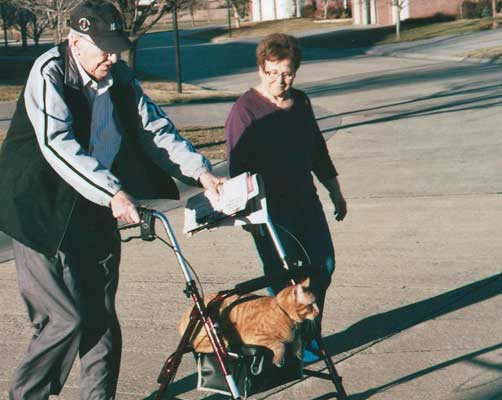
Lyle’s gift in 2011 of gliding swings to Mennonite nursing homes in the south central Kansas area is symbolic of his transition from being young, ambitious and innovative to living life in the jet set to handing over leadership responsibilities to younger people to relaxing, reminiscing and letting go of most of his material possessions. He continued to read his Bible and the newspaper every day and remained mentally alert throughout his last year.
Although he held many more leadership positions than one can imagine being doable, he was not a controlling person. He led by asking probing questions and encouraging others to do their best. He helped his children discern their own vocational callings, all unrelated to Hesston Corporation, and supported them in their decisions. Honored in more than 100 publications and with many of the highest awards in industry, Yost retained his humility and kept advancing his goal to improve the lives of farmers. As farmers benefitted, so have and will thousands of others in his generation and in those to come.
Yost leaves a legacy of economic leadership, creativity, kindness and generosity.


Have a comment on this story? Write to the editors. Include your full name, city and state. Selected comments will be edited for publication in print or online.