


The place of Mary for Mennonites
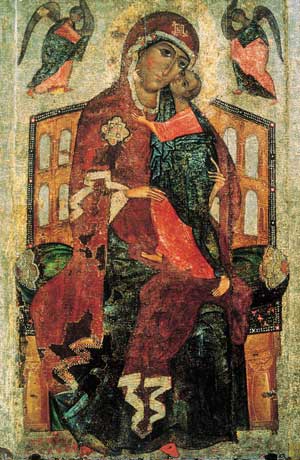
I stalked the hallways of the Anglican church nervously as I waited for the healing prayer conference to begin. I had come to do some soul work on inner wounds, and I felt uncertain about what was to unfold. As I veered into a corridor off the beaten path from the registration tables, I was drawn to a giant Renaissance painting of the toddler Jesus in the arms of his mother, Mary.
I stopped cold in my fidgety tracks and quieted like a calm before a storm.
As a Mennonite girl who grew up with a minimal rendering of Mary, the painting seemed garish in its larger-than-life size and message: This is no ordinary toddler, no ordinary mother, no ordinary relationship between parent and child. In my Anabaptist formation in the 1960s and ’70s, the portrayal of Mary was sparse, given how the biblical text said so little about her. Mary was a backdrop to the main character of Jesus rather than a character in direct connection to him. The painting dared me into a 3-D reflection on the bond of Jesus to his mother, the mother to her son.
During the conference, I uncovered how some important emotional links between me and my mother were broken in childhood. I was broken by those missing links and needed healing. During the interior pilgrimage at the conference, I contrasted what I saw in that painting with a lack of connectedness in my own life. As an adult, I could not go back into childhood. But I could restore that parent-child connection. I could forgive others who had hurt me and confess my wrongs in hurting others. I could give my pain and suffering to the suffering Christ on the cross. I could receive a sense of being and affirmation from my Creator and my Redeemer. I could heal.
But too dangerous to absorb at the time was the thought that I could experience an intimate connection to the mother of my Redeemer that could aid in my healing and my redemption. In the following decade-plus after this conference, my winding journey led me down many detours that were always within eye shot of this mother, but never close enough to be cradled in her arms. Paralleling my healing journey was a growing unrest. Though I valued my Anabaptist heritage that had faithfully brought me into a solid faith, I was stirred to seek a different expression of Christian faith. It was one that embraced the view that Jesus instituted the church and passed it on to the apostles. They in turn passed it on to a visible and unbroken line of apostolic succession in the Roman Catholic Church for almost 2,000 years.
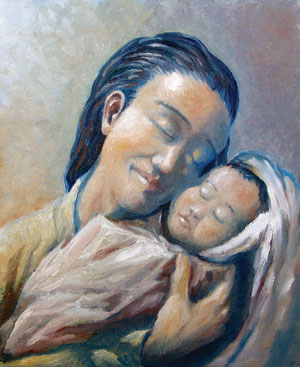
Reluctantly, doggedly, I inched my way toward Mary as I simultaneously struggled to discern whether I would enter this visible Body of Christ. I was a product of the Reformation that had broken away from this ancient church, and I was alternately awed, frightened and repelled by where I sensed the Holy Spirit leading me. But finally, after 15 years of struggle, I was tired and longed to be “home.” On Easter Vigil 2009, I entered the Catholic Church and finally rested in the arms of Mother Church and its Mother, who I now recognized as my spiritual mother, too.
On my journey, I discovered I could not separate the Redeemer from the virgin woman who birthed him as the Son of God and Son of Humanity. According to Catholic doctrine, God chose her for an integral role in the gospel story before she was born. At the moment of her conception, she was set free from the stain of original sin by the grace of Christ, who would be both her child and her Savior. In light of this long-held orthodox view of Mary, I wanted not only to honor his mother as a model in her yes to God’s plan. I wanted to recognize her as a spiritual mother who would help birth Christ in me so I could better say “yes” to his plan for my life.
And as part of the Communion of Saints, she was in heaven to intercede for me to my heavenly Father and my heavenly Savior. She did not seek worship for herself; neither was I to worship her. Her role was to guide me into a deeper relationship with Jesus and aid me in my journey of entering into union with our Lord. As a part of this communion on both sides of the vale, I no longer felt like a motherless child, disconnected in a disconnected world. I was part of an unbroken chain of connected children within the family of God.
Clothing Mary in Anabaptist dress
My soul has suffered many birth pangs as I’ve struggled to absorb this larger understanding of Mary as mother of Mother Church as well as my own mother. I desire to more fully understand this powerful primal, familial connection that I share with the Mother of God—in theological terms as well as in my personal discipleship. Many Mennonites are also struggling to understand the role of Mary and how their view of her may be changing in their own lives and in the life of the Anabaptist church.
For example, this past spring, the Associated Mennonite Biblical Seminary (AMBS) in Elkhart, Ind., sponsored a conference, “My Soul Rejoices in God my Savior: Mary in Anabaptist Dress.” In an AMBS news story afterward, Mary E. Klassen described the findings of the conference, including excerpts from a presentation given by John Rempel, AMBS professor of theology and Anabaptist studies. He examined how the Reformers of the 16th century viewed Mary. Affection for Mary carried forward into most Anabaptists’ faith, he said. But first-generation Protestants connected “Mary in her relationship to Christ rather than as co-mediator of salvation.” One area for further Anabaptist exploration is the belief in the Communion of Saints, he said. “The saints in God’s presence are now so at one with God’s will that they pray with us for God’s purposes to be realized in our lives. The saints pray with us, not because we appeal to them, but because they now unreservedly will what God wills.”
Elizabeth Soto Albrecht, an ordained minister in the Colombian Mennonite Church and moderator-elect of Mennonite Church USA, reflected how Mary has been important in her spiritual journey, beginning in her early life as a Catholic. She observes that in the Mennonite church today, there may be little room for appreciating Mary. But Soto Albrecht confessed she sees a need for more female images to nurture Mennonite theology. “We have thrown out the basin with the bathwater,” she said. “We have kept Jesus” but not the womb that bore him, the woman who created with God. By so doing, the church lost valuable perspectives that can help it know and follow Jesus.
Wendy Wright, professor of theology at the University of Creighton in Omaha, Neb., looked for commonalities between the Catholic devotion to Mary and elements of Mennonite, Anabaptist faith: Three of these are discipleship: the free acceptance of invitation to do God’s will, martyrdom: seeing the love of God and the cross of Christ as connected, and the corporate nature of the Christian life: sharing God’s love with others after experiencing it personally.
She emphasized that a template of discipleship is present in Mary, who said yes to God and went to visit Elizabeth, sharing her news. “When we open to God—open to the ‘yes’—we intrinsically visit others,” Wright said.
The echoes of this conference are resounding closer to home, as members of local congregations are also re-examining Mary. For example, pastors and laity in Newton, Kan., hosted a vesper service, “Celebration of Mary, the Mother of Jesus.” It was held at New Creation Fellowship on Aug. 14 to correspond with the Feast of the Assumption, which in the church year celebrates Mary’s bodily assumption into heaven. One of the event planners was Mary Herr, a longtime spiritual director. With her husband, Gene, she helped pave the way for Anabaptists to experience a more contemplative spiritual journey as the Herrs hosted guests at The Hermitage, a retreat center they founded in Michigan.
“Many people have been drinking out of other traditions [regarding Mary], and it is time to bring her closer to home, where we can view her from our Anabaptist traditions,” Herr said.
She believes the AMBS conference, as well as the many ways in which congregations are singing hymns about Mary in new hymnals, such as Sing the Journey and Sing the Story, show a growing awareness of the connection to Mary from the Anabaptist perspective. It’s a connection that Herr has nurtured for many years in her own spiritual journey as she views Mary as a model of Christian discipleship and mentor for the human experience. Much of her formation on Mary was shaped by the spiritual classic The Reed of God by the late Caryll Houselander, recently republished by Ave Maria Press.
“This book opened me up to a new awareness of Mary as a person who believed what she had been given and didn’t refute it with a no,” Herr said. “She asked the question, ‘How can this be?’ But then she went on to accept God’s plan with a ‘yes.’ She could say, “Be it unto me,” even though she did not know the full implications of this ‘yes.’ She modeled an acceptance of life as it is but a life that is also lived in the presence and strength of Jesus.”
Daring to receive Mary as mother
I resonate with Herr and the AMBS conference participants, as I do with my Catholic family. I have strong relationships with brothers and sisters in both faith traditions. And because of those bonds, I pray for the grace for all of us to ponder a couple of potentially unifying questions: How did she view herself? How did Jesus view her? What place, what role, what name did they ascribe to her?
A good place to start, and perhaps a good place to end this essay, is to reflect on the words found in The Magnificat in Luke 1, as well as Jesus’ words on the cross in John 19.
In Luke 1:46-50, Mary sings, “My soul magnifies the Lord, and my spirit rejoices in God my Savior, for he has looked with favor on the lowliness of his servant. Surely, from now on all generations will call me blessed; for the Mighty One has done great things for me, and holy is his name. His mercy is for those who fear him from generation to generation.”
In John 19:25-27, Jesus, about to expire from crucifixion, looked down at those standing near the cross, including his mother and his disciple John, and said, ‘Woman, here is your son,’ and to the disciple, ‘Here is your mother.’ From that time on, this disciple took her into his home.”
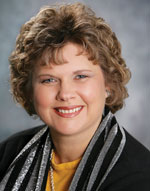
Many Roman Catholics, including myself, address Mary as the Blessed Mother. That title intertwines two threads: Mary’s self-description as blessed because of what God has done in her life and Jesus’ desire to give Mary to John as his mother and John to his mother as her son—a symbol of her mothering role in the ongoing life
of the church.
Could Mennonites dare to join centuries of Christians, from John onward, who have received Mary not only as a model but as mother? It is a question God’s children cannot ignore as they receive Jesus as brother and Savior. He was born and raised by a mother who still helps birth and guide those on earth who are born in Christ from above.


Have a comment on this story? Write to the editors. Include your full name, city and state. Selected comments will be edited for publication in print or online.