


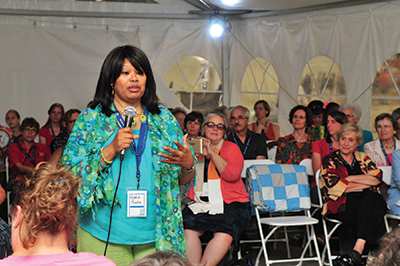
Photo: Addie Banks talks about her ordination experience.
Anabaptist women discussed the dynamics of gender and theological identities in a variety of workshops at Mennonite World Conference.
In the workshop “Global Mennonite Women Building Peace,” Marlene Epp said the Anabaptist peace position sometimes leaves women out.
Historically, the peace position meant not bearing arms. But because women weren’t conscripted, the definition didn’t really extend to them, said Epp, a professor of history, peace and conflict studies at Conrad Grebel University College in Waterloo, Ontario.
“So I think the peace position for Anabaptist Mennonites is an opportunity but can also be a dilemma for women,” she said. She invited three women from around the world to describe peacemaking they do in their contexts.
Carol Penner, a theologian and pastor from Edmonton, Alberta, said she learned in college that peace meant not fighting in the army. But after college, she witnessed domestic violence. Family members and friends were sexually assaulted, sometimes by family members.
She started writing and speaking about, “What does it mean for women to be peacemakers in the face of this violence?”
She said, “The church should be a place where women can say our prayers out loud, where we can go to be healed, where we can feel safe, this is what it means to be a peace church.”
Edna Younas talked about trying to make peace in India, in a context of many languages and religions. “Even in the church there are large differences, of course,” she said. “In spite of all the differences, we women have tried to live peace with each other and maintain good relationships.”
She described an effort she made to make peace, in a village where she taught primary school. Villagers had a cultural custom to ask for money during a holiday she felt compromised her faith. She declined to give money to anyone, causing tension.
But when a young child in the community got sick, she gave him money. “The boy lived, and the villagers and I had a new peace,” she said.
Angelica Rincón described two hopeful stories of women making peace in her work with Justapaz in Bogota, Colombia.
She said the internal conflict in Colombia has victimized around 3.5 million women. One impoverished region, Choco, is home to a significant Mennonite Brethren population. MB women have come together to create spaces for victims.
“These spaces mean that men and women from the churches can participate and talk about the violence the conflict has generated,” she said.
In Bogota, Rincón said, an ecumenical group of women meet to advocate in their contexts. They are promoting a political pact for peace supported by human rights defenders, soldiers, ex-combatants, conflict victims, academics and women of faith.
Sidonie Swana, from Congo, was denied a visa for assembly, but Epp read a statement from her. Swana described the causes and impact of psychological, emotional, domestic and other physical violence women experience in Congo.
Women there have begun taking seminars and workshops, initiated by the Association of Mennonite Women Theologians in Congo, going into remote, sometimes dangerous areas to lead workshops on violence against women.
Radical Anabaptist women
Addie Banks, pastor at King of Glory Tabernacle in the Bronx, described in the workshop “Radical Anabaptist Women” her decision to push for ordination after years of ministry.
She was inspired by a delegation to Congo in 2007 while she served on the Mennonite Church USA Executive Board. Though not ordained, she was introduced to Mennonite church members there as a pastor.
They were surprised and excited to see a woman pastor, saying women couldn’t be ordained in Congo. Everywhere she went, people wanted her to preach.
At a commissioning before she left for the delegation, a friend told her the women in Congo would never be the same after they met her.
Later, she said, “I realized that thing she was talking about was the ordination of women.”
She was the first African-American woman ordained by Lancaster Conference in 2011.
In 2012, Congo ordained its first women, one of whom was Sidonie Swana. Swana also missed sharing her experience in this workshop, because of visa denial.
Attendees shared their experiences with silencing and hope in the church. One, Nancy Myers, said she visited women ministers in Congo in 2013. “I asked them what was their inspiration, where did their call come from,” she said.
One woman said: “When Addie Banks was here, I realized that if Addie Banks was ordained, I could be ordained, too.”
Sandra Perez Cruz also told the history of Radical Anabaptist Women, a group that encourages women to be ordained. Ruth Yoder Wenger, pastor of North Bronx Mennonite Church, read stories of first silencing, then hope of Anabaptist women in the church. With each silencing story, a blanket was piled on Sylvia Shirk, pastor of Manhattan (N.Y.) Mennonite Fellowship. With each story of hope a blanket was removed.
Gender challenges
Christina Duhoux-Rueb and Jacoba Winkler Prins, pastors from the Netherlands, facilitated discussions on “Gender Challenges in a Changing World.”
Duhoux-Rueb told about Anna Zernike, the first Mennonite woman ordained in the Netherlands, possibly in Europe and “even maybe in the world.” Zernike was ordained at the Mennonite Church in Bovenknijpe in 1911.
She was the first woman to attend the Mennonite seminary in Amsterdam, and her first public sermon drew large crowds of “curious people who want to find out if she is real,” Duhoux-Rueb said.
Zernike’s life had many challenges, Duhoux-Rueb said. “Not every challenge is a gender challenge, but sometimes it is hard to distinguish,” she said.
She ended the workshop with questions: “Why didn’t she fit in? Because she was a woman? Because she was ahead of her time? Because she was an independent thinker?”


Have a comment on this story? Write to the editors. Include your full name, city and state. Selected comments will be edited for publication in print or online.